Comparison
Jalap vs Mexican Morning Glory
Jalap (Ipomoea purga) and Mexican Morning Glory (Ipomoea tricolor) both belong to the genus Ipomoea (morning glory) and part ways below it. Both are recorded in 4 countries.

Jalap
Ipomoea purga
Franz Eugen Köhler, Köhler's Medizinal-Pflanzen, Public domain, via Wikimedia Commons

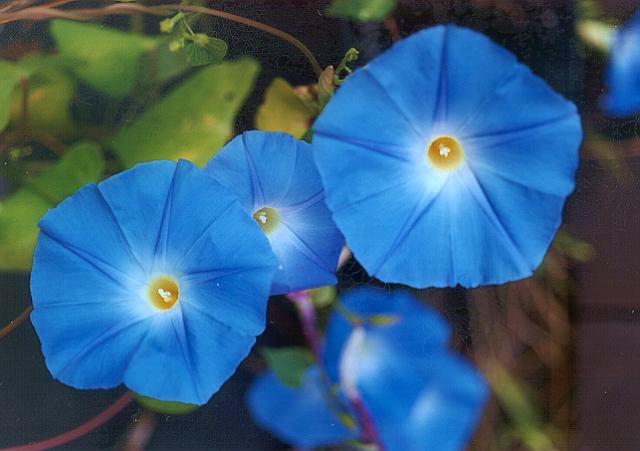
Mexican Morning Glory
Ipomoea tricolor
Russell E (Photograph of Ipomoea violacea, taken by rkundalini.), CC BY-SA 3.0, via Wikimedia Commons

Side by side
| Jalap | Mexican Morning Glory | |
|---|---|---|
| Scientific name | Ipomoea purga (Wender.) Hayne | Ipomoea tricolor Cav. |
| English name | Jalap | Mexican Morning Glory |
| Group | Flowering plants | Flowering plants |
| Class | Magnoliopsida | Magnoliopsida |
| Order | Solanales | Solanales |
| Family | Convolvulaceae Bindweed Family | Convolvulaceae Bindweed Family |
| Genus | Ipomoea Morning Glory | Ipomoea Morning Glory |
| Countries on record | 9 countries | 35 countries |
| GBIF occurrence records | 310 records | 1,881 records |
Rows where the two agree are shown in grey.
Where each is found
Both recorded in 4 countries
Only Jalap (5)
Only Mexican Morning Glory (31)
- Antigua and Barbuda
- Argentina
- Bangladesh
- Bolivia
- Bonaire, Saint Eustatius and Saba
- Brazil
- Canada
- Chad
- China
- Colombia
- Cuba
- Dominican Republic
- Ecuador
- Ethiopia
- Germany
- Guadeloupe
- Honduras
- Hungary
- Madagascar
- Malawi
- Mozambique
- Nicaragua
- Peru
- Puerto Rico
- Saint Martin
- U.S. Virgin Islands
- Uzbekistan
- Venezuela
- Vietnam
- Zambia
- Zimbabwe
From Catalogue of Life checklists and GBIF occurrence records. A country missing from a list means no record is held, which is not proof of absence.
Checked facts
| Jalap | Mexican Morning Glory | |
|---|---|---|
| Appearance |
|
|
| Size |
|
|
| Habitat | No checked fact yet |
|
| Behaviour | No checked fact yet |
|
| Reproduction | No checked fact yet |
|
| Lifespan | No checked fact yet |
|
| Distribution |
|
|
| Uses |
|
|
| Similar species | No checked fact yet |
|
| Other |
|
|
In brief
Jalap
Ipomoea purga is native to Mexico and has become naturalized in other parts of the Neotropics. Its root contains a resin called jalap that acts as a powerful cathartic. Full profile
Mexican Morning Glory
Ipomoea tricolor is native to the tropical regions of the Americas and has become naturalised outside its native range. Its seeds contain ergine and lysergic acid hydroxyethylamide, produced by a symbiotic fungus identified as Periglandula ipomoeae. Full profile
Compare something else
Page built on 27 November 2026 from the data on the two species pages, where every source is listed.
Cite this page
ScientificNames.org. (2026). Jalap vs Mexican Morning Glory. Retrieved November 27, 2026, from https://scientificnames.org/compare/jalap-vs-mexican-morning-glory
“Jalap vs Mexican Morning Glory.” ScientificNames.org, 2026, scientificnames.org/compare/jalap-vs-mexican-morning-glory. Accessed 27 Nov. 2026.
ScientificNames.org. “Jalap vs Mexican Morning Glory.” Accessed November 27, 2026. https://scientificnames.org/compare/jalap-vs-mexican-morning-glory.
@misc{scientificnames_jalap_vs_mexican_morning_glory,
  author = {{ScientificNames.org}},
  title = {Jalap vs Mexican Morning Glory},
  year = {2026},
  url = {https://scientificnames.org/compare/jalap-vs-mexican-morning-glory},
  note = {Accessed 2026-11-27}
}