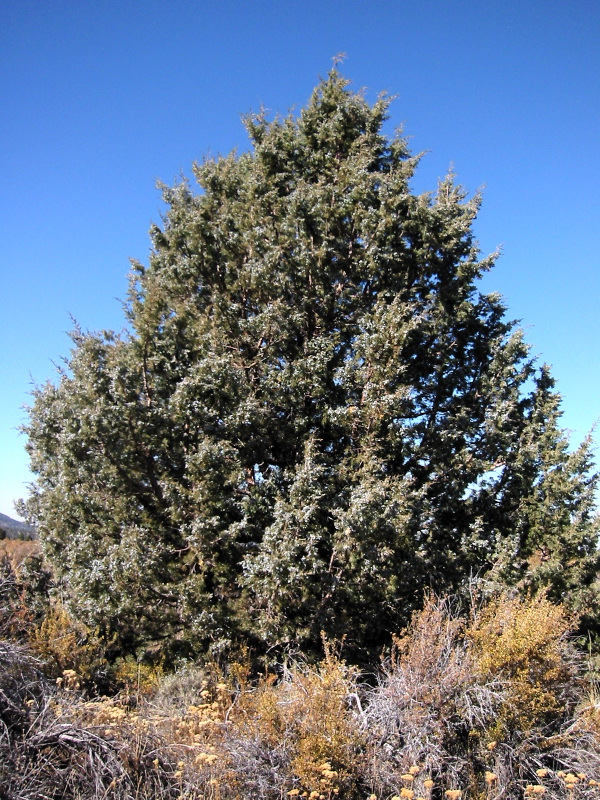
| Appearance | - Western juniper grows as a shrub or small tree. English Wikipedia
- Juvenile western juniper leaves are needle-shaped and measure 5–10 millimeters long. English Wikipedia
- Adult western juniper leaves are scale-shaped and generally measure 1–2 millimeters long and 1–1.5 millimeters wide. English Wikipedia
- Western juniper produces berry-like cones measuring 5–10 millimeters in diameter, with a blue-brown color and whitish waxy coating. English Wikipedia
- At exposed high elevations, western juniper can grow close to the ground with a broad trunk. English Wikipedia
- Western juniper has layered bark and a structural form that the document associates with protection against pests, animals, disease, and low-level fires. klamathswcd.gov
| - The species is an evergreen coniferous tree with a dense crown that is typically conical or subcylindrical. English Wikipedia
- Its bark is reddish-brown, fibrous, and separates into narrow strips. English Wikipedia
- Juvenile leaves are sharp and needle-like, measuring 5–10 millimetres long. English Wikipedia
- Adult leaves are tightly attached, scale-like structures measuring 2–4 millimetres long. English Wikipedia
- Its seed cones are berry-like, dark purple-blue, and covered with a whitish wax that gives them a sky-blue appearance. English Wikipedia
- The species' foliage may develop a bronze color during winter. extension.umd.edu
- Female trees produce blue-gray, waxy or frosted-looking berry-like cones. extension.umd.edu
|
|---|
| Size | - Western juniper typically reaches 4–15 meters in height. English Wikipedia
- Exceptional western juniper specimens in Oregon's John Day area exceed 26–28 meters in height. English Wikipedia
- Approximately 95 percent of western junipers are younger than 100 years. klamathswcd.gov
| |
|---|
| Habitat | - Western juniper generally grows in mountains at elevations of 800–3,000 meters. English Wikipedia
- Western juniper occasionally occurs at elevations as low as 100 meters. English Wikipedia
- Western juniper commonly occupies dry, rocky sites where competition from larger trees is reduced. English Wikipedia
- Western juniper can occur in locations receiving as little as 20 centimeters of annual precipitation. English Wikipedia
- Old-growth western juniper stands established before the 1870s occur mainly on low-productivity sites such as claypan soils, rimrock, outcrops, mesa edges, and upper slopes. fs.usda.gov
- Postsettlement western juniper stands have established on low slopes and in valleys, particularly in areas formerly dominated by mountain big sagebrush. fs.usda.gov
- Western juniper occurs across all stages of ecological succession. fs.usda.gov
- Western juniper can dominate rimrock and outcrop habitats because these sites lack sufficient fuels to carry surface fires. fs.usda.gov
- Western juniper occurs from near sea level to elevations exceeding 3,050 meters. fs.usda.gov
- Western juniper is native to rocky bluffs in the high deserts of the western United States. klamathswcd.gov
- Western juniper grows in soils ranging from poorly drained clay to porous pumice sands. klamathswcd.gov
| - The species commonly grows in prairies, oak barrens, old pastures, and limestone hills. English Wikipedia
- The species occurs in soils ranging from drought-prone rocky substrates to nutrient-rich alluvial soils. English Wikipedia
- The tree tolerates dry to moderately moist soils and can grow in any soil type. extension.umd.edu
- The species tolerates salt spray and brackish water. extension.umd.edu
- The tree grows best in full sunlight, although young plants tolerate some shade. extension.umd.edu
|
|---|
| Diet | - The cones of western juniper provide food for American robins, Clark's nutcrackers, phainopeplas, and cedar waxwings. English Wikipedia
| - The berry-like cones are consumed by robins, catbirds, eastern bluebirds, blue jays, and mockingbirds. extension.umd.edu
- Turkeys, bluebirds, rabbits, foxes, raccoons, and coyotes consume the species' berries. English Wikipedia
|
|---|
| Behaviour | - Birds feeding on western juniper cones digest their fleshy scales and disperse seeds in their droppings. English Wikipedia
- Western juniper expansion into adjacent shrub and bunchgrass steppes has occurred since the late nineteenth century. fs.usda.gov
- Severe surface fires and crown fires kill western junipers of all age classes. fs.usda.gov
- Mature western junipers with thick bark can survive low-severity fires and occasionally moderate-severity fires. fs.usda.gov
- Western juniper can survive for months without water. klamathswcd.gov
- Western juniper can consume as much as 30 gallons of water per day when its water source can sustain that amount. klamathswcd.gov
- Western juniper has extensive branching roots that allow it to reach nutrients over large soil distances. klamathswcd.gov
- Western juniper canopies shade new grass growth and leave the soil beneath them barren. klamathswcd.gov
| - The species is an early colonizer of disturbed sites. English Wikipedia
- The tree is highly tolerant of drought because of its extensive fibrous root system and reduced leaf area. English Wikipedia
- The species is intolerant of fire. English Wikipedia
- The species' compact evergreen foliage provides nesting sites and winter shelter for birds and mammals. English Wikipedia
|
|---|
| Reproduction | - Western juniper cones take approximately 18 months to mature. English Wikipedia
- Western juniper male cones measure 2–4 millimeters long and release pollen in early spring. English Wikipedia
- Western juniper populations include approximately equal proportions of monoecious and dioecious plants. English Wikipedia
- Western juniper cones contain between one and three seeds. English Wikipedia
- Most western juniper seeds germinate during spring. English Wikipedia
- Western juniper seeds in Oregon germinate in April, and foliage emerges in June. English Wikipedia
- Western juniper seeds are dispersed through water runoff, gravity, and animals. English Wikipedia
- Western juniper establishes from seed. fs.usda.gov
- Western juniper begins producing seed cones at approximately 20 years of age, although substantial production generally does not begin until at least 50 years. fs.usda.gov
- Mature western junipers produce seeds nearly every year, but production varies considerably between sites and years. fs.usda.gov
- Western juniper seeds are stored in tree crowns and soil. fs.usda.gov
- Passage through animal digestive tracts accelerates germination of dormant western juniper seeds. fs.usda.gov
- Western juniper does not regenerate by sprouting after fire. fs.usda.gov
| - The species is usually dioecious, with pollen cones and seed cones occurring on separate trees. English Wikipedia
- Some individuals of the species are monoecious. English Wikipedia
- Pollen cones release pollen in late winter or early spring. English Wikipedia
- Seed cones mature six to eight months after pollination. English Wikipedia
- Each seed cone generally contains one to three seeds, with four occurring rarely. English Wikipedia
|
|---|
| Distribution | - Western juniper is native to the western United States. English Wikipedia
- Western juniper occurs in southeastern Washington, eastern and central Oregon, southwestern Idaho, northeastern California, and extreme northwestern Nevada. English Wikipedia
- In the early 1990s, western juniper occupied approximately 42 million acres across the Intermountain West. fs.usda.gov
| - The species is native to eastern North America, extending from southeastern Canada to the Gulf of Mexico and east of the Great Plains. English Wikipedia
- The species occurs throughout Maryland's Mountain, Piedmont, and Coastal regions. extension.umd.edu
- The species is native to all regions of Maryland. extension.umd.edu
|
|---|
| Conservation | - Western juniper is classified as Least Concern on the IUCN Red List. English Wikipedia
- Western juniper populations have increased as the species has expanded into western sagebrush steppe ecosystems. English Wikipedia
- The expansion of western juniper has been associated with reduced fire frequency, livestock overgrazing, and wetter, milder climatic conditions. English Wikipedia
- Western juniper expansion in Oregon increased from approximately 440,000 acres in 1926 to more than five million acres in 2022, according to the document. klamathswcd.gov
- The document associates western juniper expansion with reductions in surface water, groundwater, native plant growth, and wildlife habitat. klamathswcd.gov
| - The species is considered invasive outside its native geographic range. English Wikipedia
- Dense populations of the species can reduce the presence of bird and small mammal species in affected Great Plains areas. English Wikipedia
- The species is an alternate host of cedar apple rust. extension.umd.edu
|
|---|
| Uses | - Several distilleries, particularly in Bend, Oregon, use western juniper berries to flavor gin. English Wikipedia
- Western juniper wood has been investigated for commercial applications including signposts and guardrails. English Wikipedia
- Western juniper lumber is characterized by durability and high compression strength. English Wikipedia
| - Selected portions of the heartwood are suitable for pencil manufacture. English Wikipedia
- The wood is widely used to manufacture recorder blocks. English Wikipedia
- The tree is planted as a windbreak and for erosion control. English Wikipedia
- The species is used in windbreaks, screening, hedges, shore plantings, and wildlife gardens. extension.umd.edu
- The species is commonly used as a Christmas tree in the Arkansas, Missouri, and Oklahoma Ozarks. English Wikipedia
- The tree's dense branches provide shelter and nesting places for birds. extension.umd.edu
|
|---|
| Other | - Western juniper commonly develops galls caused by the juniper tip midge, Oligotrophus betheli. English Wikipedia
- Western juniper galls are violet-purple before fading to brown and measure 1–2 centimeters in diameter. English Wikipedia
| No checked fact yet |
|---|