Comparison
Kola Nut vs Owé Cola
Kola Nut (Cola nitida) and Owé Cola (Cola verticillata) both belong to the genus Cola (kola nut) and part ways below it. Both are recorded in 10 countries.
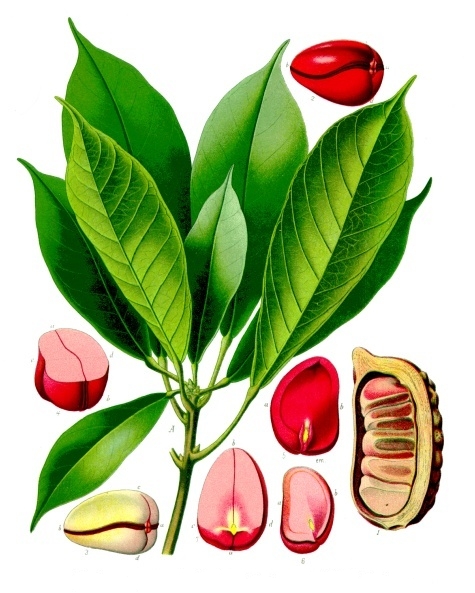
Kola Nut
Cola nitida
Franz Eugen Köhler, Köhler's Medizinal-Pflanzen, Public domain, via Wikimedia Commons

Owé Cola
Cola verticillata
Side by side
| Kola Nut | Owé Cola | |
|---|---|---|
| Scientific name | Cola nitida (Vent.) Schott & Endl. | Cola verticillata (Thonn.) Stapf ex A.Chev. |
| English name | Kola Nut | Owé Cola |
| Group | Flowering plants | Flowering plants |
| Class | Magnoliopsida | Magnoliopsida |
| Order | Malvales | Malvales |
| Family | Malvaceae Mallow Family | Malvaceae Mallow Family |
| Genus | Cola Kola Nut | Cola Kola Nut |
| Red List category | Least Concern | Not recorded |
| Countries on record | 31 countries | 12 countries |
| GBIF occurrence records | 891 records | 417 records |
Rows where the two agree are shown in grey.
Where each is found
Both recorded in 10 countries
- Benin
- Cameroon
- Central African Republic
- Democratic Republic of the Congo
- Equatorial Guinea
- Gabon
- Ghana
- Guinea
- Ivory Coast
- Nigeria
Only Kola Nut (21)
- Burkina Faso
- Dominica
- Gambia
- Grenada
- Guadeloupe
- Guinea-Bissau
- Honduras
- Jamaica
- Liberia
- Mali
- Martinique
- Mauritius
- Mayotte
- Reunion
- Senegal
- Seychelles
- Sierra Leone
- Sri Lanka
- Togo
- Trinidad and Tobago
- Vietnam
Only Owé Cola (2)
From Catalogue of Life checklists and GBIF occurrence records. A country missing from a list means no record is held, which is not proof of absence.
Checked facts
| Kola Nut | Owé Cola | |
|---|---|---|
| Appearance |
| No checked fact yet |
| Size |
| No checked fact yet |
| Habitat |
| No checked fact yet |
| Diet |
| No checked fact yet |
| Reproduction |
| No checked fact yet |
| Distribution |
| No checked fact yet |
| Uses |
| No checked fact yet |
| Other |
| No checked fact yet |
In brief
Kola Nut
Kola nut (Cola nitida) is an evergreen flowering tree in the family Malvaceae, order Malvales and class Magnoliopsida. It grows naturally in tropical West African rainforests and is native to Sierra Leone, Liberia, Ivory Coast, Ghana and Nigeria. It produces fleshy, star-shaped fruits containing seeds with two folded cotyledons that are chewed as a stimulant. Full profile
Compare something else
Page built on 26 November 2026 from the data on the two species pages, where every source is listed.
Cite this page
ScientificNames.org. (2026). Kola Nut vs Owé Cola. Retrieved November 26, 2026, from https://scientificnames.org/compare/kola-nut-vs-owe-cola
“Kola Nut vs Owé Cola.” ScientificNames.org, 2026, scientificnames.org/compare/kola-nut-vs-owe-cola. Accessed 26 Nov. 2026.
ScientificNames.org. “Kola Nut vs Owé Cola.” Accessed November 26, 2026. https://scientificnames.org/compare/kola-nut-vs-owe-cola.
@misc{scientificnames_kola_nut_vs_owe_cola,
  author = {{ScientificNames.org}},
  title = {Kola Nut vs Owé Cola},
  year = {2026},
  url = {https://scientificnames.org/compare/kola-nut-vs-owe-cola},
  note = {Accessed 2026-11-26}
}