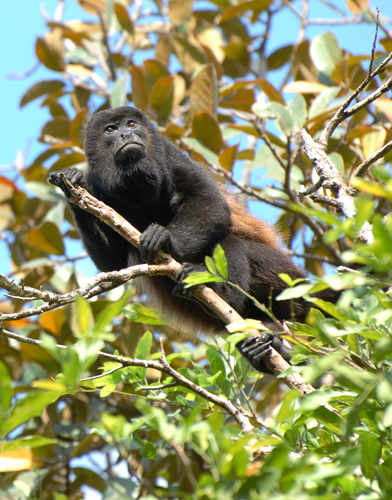
| Appearance | - The species has thick, woolly fur and a prehensile tail with a hairless patch on its underside. primate.wisc.edu
- Its fur is longer and denser than that of other woolly monkeys. primate.wisc.edu
- Its coat is deep mahogany or copper, becoming darker toward the upper body and nearly black around the head. primate.wisc.edu
- The species has a whitish facial patch extending from the chin to between the eyes. primate.wisc.edu
- Males have somewhat darker coloration than females. primate.wisc.edu
- The ends of its extremities are nearly black. primate.wisc.edu
- Its belly is covered with long dark-brown fur. primate.wisc.edu
- The inside of the final third of its tail has yellowish fur. primate.wisc.edu
- The yellow coloration on the tail is absent in infants and juveniles. primate.wisc.edu
- The species has a prominent tuft of long yellowish pubic hair, particularly in males. primate.wisc.edu
| - The mantled howler is primarily black, with yellow or golden-brown guard hairs along its flanks. English Wikipedia
- Adult males develop a white scrotum. English Wikipedia
- Infants are born with silver fur that becomes pale or gold after a few days. English Wikipedia
|
|---|
| Size | | |
|---|
| Habitat | - The species inhabits primary tropical and subtropical premontane, montane, and montane cloud forests. primate.wisc.edu
- Its habitat occurs at elevations between 1,500 and 2,700 metres above sea level. primate.wisc.edu
- Its habitat consists of mountainous, steep, rugged and foggy terrain containing gorges and ravines. primate.wisc.edu
- The forest canopy in its habitat is generally 20–25 metres above the ground. primate.wisc.edu
- Its habitat has thick vegetation at ground level. primate.wisc.edu
- At a recorded habitat in Yambrasbamba, Peru, temperatures ranged from 8°C to 25°C. primate.wisc.edu
- Its habitat has a relatively dry season between March and September and a particularly wet season between November and February. primate.wisc.edu
| - The species inhabits secondary and semi-deciduous forests as well as other forest types. English Wikipedia
- The species occurs at higher densities in older forests and forests containing evergreen vegetation. English Wikipedia
- Studied groups occupy home ranges measuring between 10 and 60 hectares. English Wikipedia
|
|---|
| Diet | | - Leaves constitute approximately 50–75% of the mantled howler's diet. English Wikipedia
- The species preferentially consumes young leaves rather than mature leaves. English Wikipedia
- Fruits can constitute as much as half of the diet when available. English Wikipedia
- Fruits and leaves from Ficus trees are preferred food sources. English Wikipedia
- Flowers can constitute a significant part of the diet, particularly during the dry season. English Wikipedia
|
|---|
| Behaviour | - The species spends almost all its time in trees. primate.wisc.edu
- It uses its tail for balance while moving through trees. primate.wisc.edu
- The species can leap distances of up to 15 metres. primate.wisc.edu
- Yellow-tailed woolly monkeys are generally inactive. primate.wisc.edu
- The species lives in social groups of approximately 23 males and females. English Wikipedia
- The species has a multiple-male group social system and a polygamous mating system. English Wikipedia
- Individuals may shake branches, expose their scrotal tuft and produce short barking vocalizations when first encountered. English Wikipedia
- The species uses loud barking vocalizations as territorial or alarm calls. English Wikipedia
| - The mantled howler is diurnal and arboreal. English Wikipedia
- The species sleeps or rests throughout the night and approximately three quarters of the day. English Wikipedia
- The species spends approximately 4% of the day interacting socially. English Wikipedia
- Groups generally contain one to three adult males and five to ten adult females. English Wikipedia
- Groups travel approximately 750 metres per day on average. English Wikipedia
- The species uses clucking sounds to maintain auditory contact with group members. English Wikipedia
- The species has not been observed using tools. English Wikipedia
|
|---|
| Reproduction | - The species has a low reproductive rate and long intervals between births. English Wikipedia
| - The species has a polygamous mating system in which one male mates with multiple females. English Wikipedia
- Females reach sexual maturity at approximately 36 months. English Wikipedia
- The gestation period lasts approximately 186 days. English Wikipedia
- Infants are carried beneath their mothers for the first two or three weeks of life. English Wikipedia
- Infants are weaned at approximately 18 months of age. English Wikipedia
- Adult females typically give birth every 19–23 months when their previous infant survives to weaning. English Wikipedia
- Approximately 79% of males and 96% of females leave their original social groups. English Wikipedia
|
|---|
| Distribution | - The species is endemic to northern Peru. academia.edu
- Its distribution includes the western Amazonas and eastern San Martín departments of northern Peru. primate.wisc.edu
- The species occurs south and east of the Marañón River. primate.wisc.edu
| - The species is native to Colombia, Costa Rica, Ecuador, Guatemala, Honduras, Mexico, Nicaragua, Panama, and Peru. English Wikipedia
|
|---|
| Conservation | - The species is categorized as Critically Endangered on the IUCN Red List. pubmed.ncbi.nlm.nih.gov
- Its geographic distribution is small and fragmented. primate.wisc.edu
- Deforestation and habitat fragmentation threaten the species. English Wikipedia
- Agricultural expansion, logging and cattle ranching contribute to habitat loss and fragmentation. English Wikipedia
- Subsistence hunting is among the threats contributing to the species' predicted population decline. English Wikipedia
- The species is predicted to decline by at least 80% over the next three generations. English Wikipedia
| - Deforestation affects the mantled howler, although it can adapt better than some other species. English Wikipedia
- The species contributes to rainforest ecology through seed dispersal and germination. English Wikipedia
|
|---|
| Name origin | - The species' common name refers to the yellowish fur on the final third of its tail. English Wikipedia
| No checked fact yet |
|---|