Comparison

White-throated Shrike-tanager vs White-winged Shrike-tanager

White-throated Shrike-tanager (Lanio leucothorax) and White-winged Shrike-tanager (Lanio versicolor) both belong to the genus Lanio (shrike-tanagers) and part ways below it.
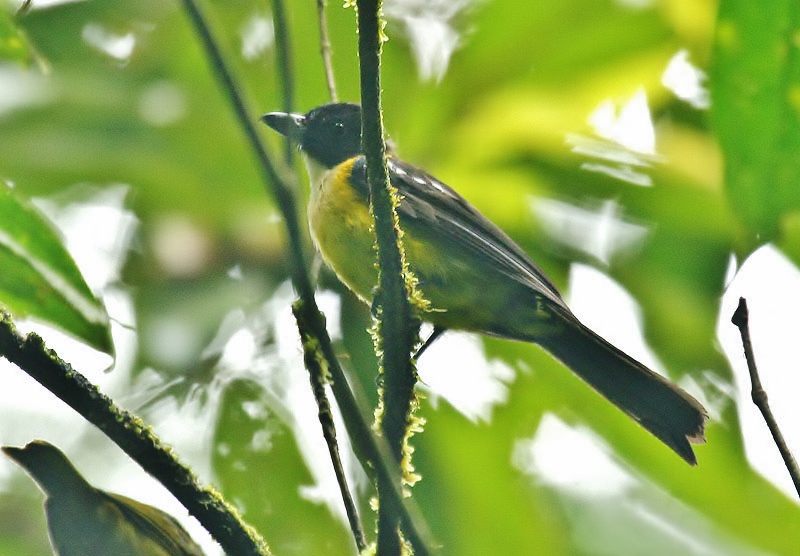
White-throated Shrike-tanager

White-throated Shrike-tanager

Lanio leucothorax

Michael Woodruff, CC BY-SA 2.0, via Wikimedia Commons

White-winged Shrike-tanager

White-winged Shrike-tanager

Lanio versicolor

Hector Bottai, CC BY-SA 4.0, via Wikimedia Commons

Side by side

White-throated Shrike-tanagerWhite-winged Shrike-tanager
Scientific nameLanio leucothorax Salvin, 1865Lanio versicolor (d'Orbigny & Lafresnaye, 1837)
English nameWhite-throated Shrike-tanagerWhite-winged Shrike-tanager
GroupBirdsBirds
ClassAves BirdAves Bird
OrderPasseriformes PasserinePasseriformes Passerine
FamilyThraupidae TanagerThraupidae Tanager
GenusLanio Shrike-TanagersLanio Shrike-Tanagers
Named in18651837
Red List categoryNear ThreatenedLeast Concern
Countries on record4 countries4 countries
GBIF occurrence records9,128 records4,736 records

Rows where the two agree are shown in grey.

Where each is found

Only White-throated Shrike-tanager (4)

Only White-winged Shrike-tanager (4)

From Catalogue of Life checklists and GBIF occurrence records. A country missing from a list means no record is held, which is not proof of absence.

Checked facts

White-throated Shrike-tanagerWhite-winged Shrike-tanager
Appearance
  • The species has a shrike-like bill with a hooked tip and a toothed appearance. English Wikipedia
  • The species exhibits sexual dimorphism. English Wikipedia
  • Adult males of the nominate subspecies have predominantly yellow upperparts, a black head, nape, wings and tail, and a white throat. English Wikipedia
  • Adult females of the nominate subspecies have reddish-brown upperparts and a grayish-brown head. English Wikipedia
  • Adult females of the nominate subspecies have a golden-yellow belly and pale cinnamon sides, flanks, and undertail coverts. English Wikipedia
  • Both sexes of all subspecies have dark brown irises and blackish legs. English Wikipedia
  • Males have black bills, whereas females have dusky bills. English Wikipedia
  • The male of subspecies melanopygius has a black lower back, lower belly, and undertail coverts. English Wikipedia
  • The male of subspecies ictus resembles melanopygius but has broad yellow tips on the rump feathers. English Wikipedia
  • The male of subspecies reversus has a black rump, lower belly, and undertail coverts. English Wikipedia
  • The species has a yellow body, black head and wings, white throat, and white shoulder patch. ebird.org
  • The species is described as a large, long-tailed tanager. ebird.org
  • Adult males of the nominate subspecies have predominantly black heads with olive forecrowns and ochraceous-yellow bodies. English Wikipedia
  • Adult males have black wings with extensive white markings on the upperwing coverts and black tails. English Wikipedia
  • Adult females are predominantly ochraceous brown with ochraceous-yellow bellies. English Wikipedia
  • Both sexes have brown irises, long black hooked bills, and black legs. English Wikipedia
  • Males have bright yellow plumage with black heads, tails, and wings featuring a white patch. ebird.org
  • Females have predominantly yellow plumage. ebird.org
  • The species has a hooked bill with a shrike-like toothed appearance. English Wikipedia
Size
Habitat
  • The species inhabits the interior of evergreen forests in tropical and lower subtropical lowlands and foothills. English Wikipedia
  • Published estimates of the species' upper elevational limit range from 750 to 1,100 m. English Wikipedia
  • In Costa Rica, one field guide lists the species' upper elevation as 900 m. English Wikipedia
Diet
Behaviour
  • The species is resident throughout the year. English Wikipedia
  • Pairs and small family groups usually travel as members of mixed-species feeding flocks. English Wikipedia
  • The species forages from the middle levels to the canopy of forests, most frequently in the subcanopy. English Wikipedia
  • The species frequently serves as a sentinel within mixed-species feeding flocks. English Wikipedia
  • The species captures prey disturbed by flock activity through rapid, acrobatic chases. English Wikipedia
  • The species forages mainly in the forest canopy. English Wikipedia
  • Pairs usually lead mixed-species feeding flocks that remain together throughout the year. English Wikipedia
  • The species captures prey disturbed by its feeding flock while flying. English Wikipedia
  • The species also captures prey by flying from a perch to the underside of foliage. English Wikipedia
  • The species eats fruit while perched. English Wikipedia
  • Within mixed-species flocks, the species acts as a sentinel and leader. English Wikipedia
  • The species gives alarm calls when potential predators such as accipiters approach. English Wikipedia
  • The species has been observed producing false alarms before capturing prey abandoned by fleeing flock members. English Wikipedia
  • The species remains in its range throughout the year. English Wikipedia
Reproduction
  • The breeding season is not fully known but includes November in Peru. English Wikipedia
  • The one documented nest was a cup constructed from plant fibers on a foundation of twigs and dead leaves. English Wikipedia
  • The documented nest was approximately one metre above the ground in an epiphyte growing on a tree trunk. English Wikipedia
  • The documented nest contained two nestlings that were fed by both parents. English Wikipedia
Distribution
Conservation
  • The species has been classified as Near Threatened since 2022. English Wikipedia
  • The species has an estimated population of at least 50,000 mature individuals. English Wikipedia
  • The species' population is believed to be decreasing. English Wikipedia
  • The species is threatened by the loss, degradation, and fragmentation of wet and humid forests within its range. English Wikipedia
  • Deforestation outside protected areas has caused local population declines and extinctions. English Wikipedia
  • The species is considered uncommon in Honduras and Costa Rica. English Wikipedia
  • The species occurs in several protected areas. English Wikipedia
  • The IUCN assessed the species as Near Threatened in its 2021 assessment. iucnredlist.org
Similar species
  • The species was formerly classified together with the black-throated shrike-tanager as a single species. English Wikipedia
  • The white-throated shrike-tanager and black-throated shrike-tanager form a superspecies. English Wikipedia
No checked fact yet
Other
  • The species was formally described in 1865 under its current scientific name. English Wikipedia
  • Four subspecies are recognized within the white-throated shrike-tanager. English Wikipedia
No checked fact yet

In brief

White-throated Shrike-tanager

The White-throated Shrike-tanager is a bird formally described in 1865 under its current scientific name. It occurs in Costa Rica, Honduras, Nicaragua, and Panama. It is a large, long-tailed tanager measuring approximately 20 cm in length, with a yellow body, black head and wings, white throat, and white shoulder patch. Full profile

White-winged Shrike-tanager

Lanio versicolor occurs in Bolivia, Brazil, and Peru. Males have predominantly black heads, black wings with extensive white markings, and ochraceous-yellow bodies, while females are predominantly ochraceous brown. Full profile

Compare something else

Page built on 27 November 2026 from the data on the two species pages, where every source is listed.

Cite this page

ScientificNames.org. (2026). White-throated Shrike-tanager vs White-winged Shrike-tanager. Retrieved November 27, 2026, from https://scientificnames.org/compare/white-throated-shrike-tanager-vs-white-winged-shrike-tanager