Comparison
Red-billed Leiothrix vs Grey-cheeked Fulvetta
Red-billed Leiothrix (Leiothrix lutea) and Grey-cheeked Fulvetta (Alcippe morrisonia) both belong to the family Leiothrichidae (laughingthrush) and part ways below it. Both are recorded in 7 countries.
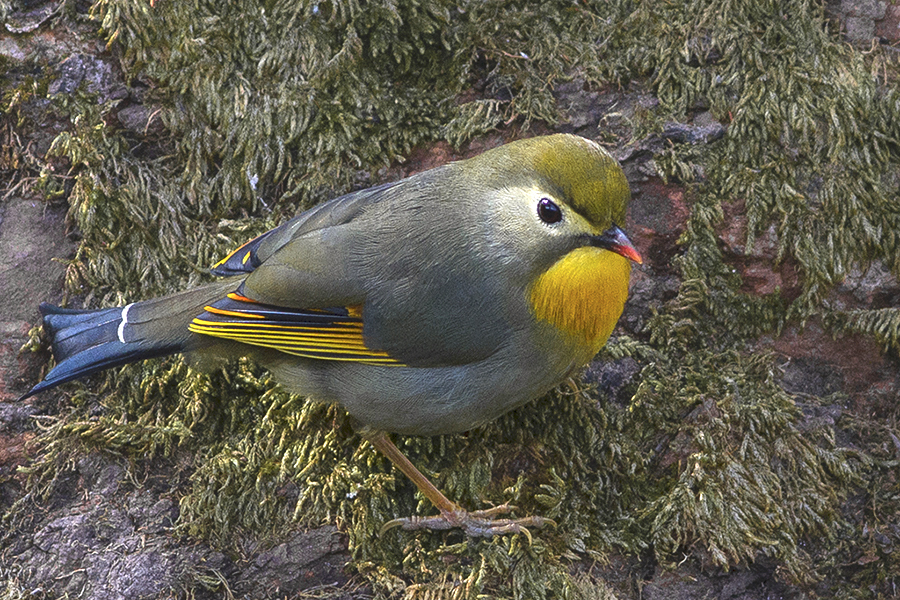


Side by side
| Red-billed Leiothrix | Grey-cheeked Fulvetta | |
|---|---|---|
| Scientific name | Leiothrix lutea (Scopoli, 1786) | Alcippe morrisonia Swinhoe, 1863 |
| English name | Red-billed Leiothrix | Grey-cheeked Fulvetta |
| Group | Birds | Birds |
| Class | Aves Bird | Aves Bird |
| Order | Passeriformes Passerine | Passeriformes Passerine |
| Family | Leiothrichidae Laughingthrush | Leiothrichidae Laughingthrush |
| Genus | Leiothrix Leiothrixes | Alcippe Nun Babblers |
| Named in | 1786 | 1863 |
| Red List category | Least Concern | Least Concern |
| Countries on record | 24 countries | 8 countries |
| GBIF occurrence records | 82,966 records | 113,777 records |
Rows where the two agree are shown in grey.
Where each is found
Both recorded in 7 countries
Only Red-billed Leiothrix (17)
- Belgium
- Bhutan
- Canada
- France
- Germany
- Hong Kong
- Italy
- Japan
- Macao
- Nepal
- Pakistan
- Portugal
- Spain
- Sweden
- The Netherlands
- United Kingdom
- United States
Only Grey-cheeked Fulvetta (1)
From Catalogue of Life checklists and GBIF occurrence records. A country missing from a list means no record is held, which is not proof of absence.
Checked facts
| Red-billed Leiothrix | Grey-cheeked Fulvetta | |
|---|---|---|
| Appearance |
|
|
| Size |
|
|
| Habitat |
|
|
| Diet |
| No checked fact yet |
| Behaviour |
|
|
| Reproduction |
| No checked fact yet |
| Distribution |
|
|
| Conservation |
| No checked fact yet |
| Uses |
| No checked fact yet |
| Similar species | No checked fact yet |
|
| Name origin | No checked fact yet |
|
| Other |
|
|
In brief
Red-billed Leiothrix
The Red-billed Leiothrix is a bird in the genus Leiothrix, alongside the silver-eared mesia. Adults have bright red bills, olive-green backs, yellow throats and orange-shaded breasts, with colourful wing-feather edges. Full profile
Grey-cheeked Fulvetta
Alcippe morrisonia is endemic to Taiwan and occurs throughout the island at elevations between 600 and 3,000 metres, occasionally descending to 50 metres above sea level. It has brown upperparts, buff underparts, a predominantly grey head and a conspicuous white eye-ring. Full profile
Compare something else
Page built on 28 November 2026 from the data on the two species pages, where every source is listed.
Cite this page
ScientificNames.org. (2026). Red-billed Leiothrix vs Grey-cheeked Fulvetta. Retrieved November 28, 2026, from https://scientificnames.org/compare/red-billed-leiothrix-vs-grey-cheeked-fulvetta
“Red-billed Leiothrix vs Grey-cheeked Fulvetta.” ScientificNames.org, 2026, scientificnames.org/compare/red-billed-leiothrix-vs-grey-cheeked-fulvetta. Accessed 28 Nov. 2026.
ScientificNames.org. “Red-billed Leiothrix vs Grey-cheeked Fulvetta.” Accessed November 28, 2026. https://scientificnames.org/compare/red-billed-leiothrix-vs-grey-cheeked-fulvetta.
@misc{scientificnames_red_billed_leiothrix_vs_grey_cheeked_fulvetta,
  author = {{ScientificNames.org}},
  title = {Red-billed Leiothrix vs Grey-cheeked Fulvetta},
  year = {2026},
  url = {https://scientificnames.org/compare/red-billed-leiothrix-vs-grey-cheeked-fulvetta},
  note = {Accessed 2026-11-28}
}