Comparison
West Siberian Lemming vs Muskrat
West Siberian Lemming (Lemmus sibiricus) and Muskrat (Ondatra zibethicus) both belong to the subfamily Arvicolinae (arvicoline rodents) and part ways below it. Both are recorded in 3 countries.
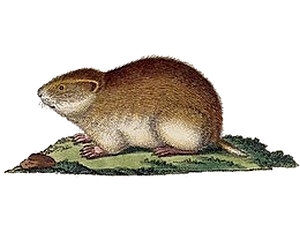


Side by side
| West Siberian Lemming | Muskrat | |
|---|---|---|
| Scientific name | Lemmus sibiricus (Kerr, 1792) | Ondatra zibethicus (Linnaeus, 1766) |
| English name | West Siberian Lemming | Muskrat |
| Group | Mammals | Mammals |
| Class | Mammalia Mammal | Mammalia Mammal |
| Order | Rodentia Rodent | Rodentia Rodent |
| Family | Cricetidae New World Mice and Rats | Cricetidae New World Mice and Rats |
| Genus | Lemmus True Lemming | Ondatra Muskrat |
| Named in | 1792 | 1766 |
| Red List category | Least Concern | Least Concern |
| Environment | Not recorded | freshwater, terrestrial |
| Countries on record | 3 countries | 51 countries |
| GBIF occurrence records | 4,032 records | 1,181,297 records |
Rows where the two agree are shown in grey.
Where each is found
Both recorded in 3 countries
Only Muskrat (48)
- Aland Islands
- Argentina
- Austria
- Belarus
- Belgium
- Belize
- Bosnia and Herzegovina
- Bulgaria
- Chile
- China
- Croatia
- Czechia
- Denmark
- Estonia
- Finland
- France
- Georgia
- Germany
- Greece
- Hungary
- Ireland
- Italy
- Japan
- Kazakhstan
- Kosovo
- Kyrgyzstan
- Latvia
- Liechtenstein
- Lithuania
- Luxembourg
- Mexico
- Moldova
- Mongolia
- North Macedonia
- Norway
- Poland
- Romania
- Serbia
- Slovakia
- Slovenia
- South Korea
- Spain
- Sweden
- Switzerland
- The Netherlands
- Ukraine
- United Kingdom
- Uzbekistan
From Catalogue of Life checklists and GBIF occurrence records. A country missing from a list means no record is held, which is not proof of absence.
Checked facts
| West Siberian Lemming | Muskrat | |
|---|---|---|
| Appearance | No checked fact yet |
|
| Size | No checked fact yet |
|
| Habitat | No checked fact yet |
|
| Diet | No checked fact yet |
|
| Behaviour |
|
|
| Reproduction | No checked fact yet |
|
| Distribution |
|
|
| Conservation | No checked fact yet |
|
| Uses | No checked fact yet |
|
| Similar species |
|
|
| Name origin | No checked fact yet |
|
| Other |
| No checked fact yet |
In brief
West Siberian Lemming
The West Siberian Lemming (Lemmus sibiricus) is a mammal in the family Cricetidae, order Rodentia, and class Mammalia, belonging to the true lemming group. It is endemic to the Russian Federation and is widely distributed throughout Siberia, from south of the White Sea eastward to the Verkhoyansk Range. It does not hibernate during winter and experiences large-scale fluctuations in population size. Full profile
Muskrat
Ondatra zibethicus occurs across most of Canada, the United States, and a small part of northern Mexico, and has been introduced into parts of Eurasia and South America. It is distinguished by a long, laterally compressed, scaly tail adapted for swimming and partially webbed hind feet. Full profile
Compare something else
Page built on 28 November 2026 from the data on the two species pages, where every source is listed.
Cite this page
ScientificNames.org. (2026). West Siberian Lemming vs Muskrat. Retrieved November 28, 2026, from https://scientificnames.org/compare/west-siberian-lemming-vs-muskrat
“West Siberian Lemming vs Muskrat.” ScientificNames.org, 2026, scientificnames.org/compare/west-siberian-lemming-vs-muskrat. Accessed 28 Nov. 2026.
ScientificNames.org. “West Siberian Lemming vs Muskrat.” Accessed November 28, 2026. https://scientificnames.org/compare/west-siberian-lemming-vs-muskrat.
@misc{scientificnames_west_siberian_lemming_vs_muskrat,
  author = {{ScientificNames.org}},
  title = {West Siberian Lemming vs Muskrat},
  year = {2026},
  url = {https://scientificnames.org/compare/west-siberian-lemming-vs-muskrat},
  note = {Accessed 2026-11-28}
}