Comparison
Leopold's Angelfish vs Oscar
Leopold's Angelfish (Pterophyllum leopoldi) and Oscar (Astronotus ocellatus) both belong to the subfamily Cichlinae and part ways below it. Both are recorded in 1 country.
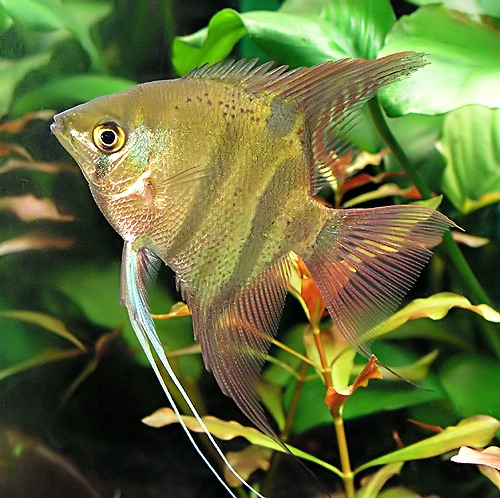
Leopold's Angelfish
Pterophyllum leopoldi
The original uploader was Hodowlaniec at Polish Wikipedia., CC BY-SA 3.0, via Wikimedia Commons


Side by side
| Leopold's Angelfish | Oscar | |
|---|---|---|
| Scientific name | Pterophyllum leopoldi (Gosse, 1963) | Astronotus ocellatus (Agassiz, 1831) |
| English name | Leopold's Angelfish | Oscar |
| Group | Fishes | Fishes |
| Class | Teleostei Teleost | Teleostei Teleost |
| Order | Cichliformes | Cichliformes |
| Family | Cichlidae Cichlid | Cichlidae Cichlid |
| Genus | Pterophyllum Angelfishes | Astronotus Oscars |
| Named in | 1963 | 1831 |
| Environment | freshwater | freshwater |
| Countries on record | 1 country | 12 countries |
| GBIF occurrence records | 19 records | 2,098 records |
Rows where the two agree are shown in grey.
Where each is found
Both recorded in 1 country
Only Oscar (11)
From Catalogue of Life checklists and GBIF occurrence records. A country missing from a list means no record is held, which is not proof of absence.
Checked facts
| Leopold's Angelfish | Oscar | |
|---|---|---|
| Appearance |
|
|
| Size |
| No checked fact yet |
| Habitat |
|
|
| Diet | No checked fact yet |
|
| Behaviour | No checked fact yet |
|
| Reproduction | No checked fact yet |
|
| Distribution |
|
|
| Conservation | No checked fact yet |
|
| Uses | No checked fact yet |
|
| Similar species |
| No checked fact yet |
| Other |
| No checked fact yet |
In brief
Leopold's Angelfish
Pterophyllum leopoldi is native to the Amazon River and occurs between Manacapuru and Santarém. It lacks a pre-dorsal notch and has a black blotch at the dorsal insertion on its fourth vertical bar. Full profile
Oscar
The native range includes Brazil, Colombia, Ecuador, Guyana, French Guiana, Suriname, Peru, and Venezuela, where it occurs in the Amazon River basin and the Approuague and Oyapock River drainages. It is distinguished by a large black eyespot surrounded by an orange ring on each side of the upper caudal peduncle and its ability to change coloration rapidly. Full profile
Compare something else
Page built on 29 November 2026 from the data on the two species pages, where every source is listed.
Cite this page
ScientificNames.org. (2026). Leopold's Angelfish vs Oscar. Retrieved November 29, 2026, from https://scientificnames.org/compare/leopolds-angelfish-vs-oscar
“Leopold's Angelfish vs Oscar.” ScientificNames.org, 2026, scientificnames.org/compare/leopolds-angelfish-vs-oscar. Accessed 29 Nov. 2026.
ScientificNames.org. “Leopold's Angelfish vs Oscar.” Accessed November 29, 2026. https://scientificnames.org/compare/leopolds-angelfish-vs-oscar.
@misc{scientificnames_leopolds_angelfish_vs_oscar,
  author = {{ScientificNames.org}},
  title = {Leopold's Angelfish vs Oscar},
  year = {2026},
  url = {https://scientificnames.org/compare/leopolds-angelfish-vs-oscar},
  note = {Accessed 2026-11-29}
}