Comparison

Lesser Mealworm vs Red Flour Beetle

Lesser Mealworm (Alphitobius diaperinus) and Red Flour Beetle (Tribolium castaneum) both belong to the subfamily Tenebrioninae and part ways below it. Both are recorded in 30 countries.

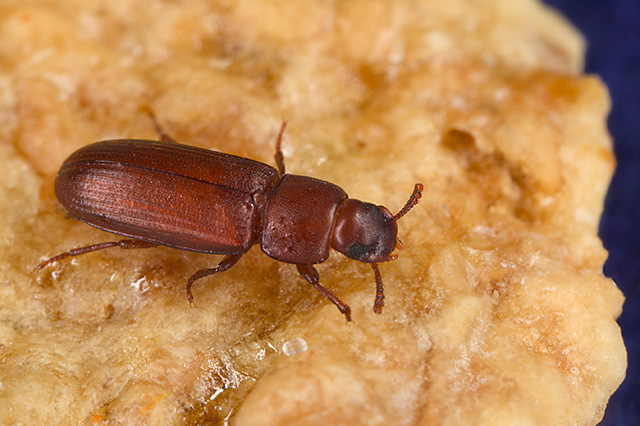
Lesser Mealworm

Lesser Mealworm

Alphitobius diaperinus

Emil Hochdanz, Public domain, via Wikimedia Commons

Red Flour Beetle

Red Flour Beetle

Tribolium castaneum

Unknown author, Public domain, via Wikimedia Commons

Side by side

Lesser MealwormRed Flour Beetle
Scientific nameAlphitobius diaperinus (Panzer, 1797)Tribolium castaneum (Herbst, 1797)
English nameLesser MealwormRed Flour Beetle
GroupInsectsInsects
ClassInsecta InsectInsecta Insect
OrderColeoptera BeetleColeoptera Beetle
FamilyTenebrionidae Darkling BeetleTenebrionidae Darkling Beetle
GenusAlphitobiusTribolium Flour Beetles
Named in17971797
Environmentterrestrialterrestrial
Countries on record36 countries48 countries
GBIF occurrence records4,213 records5,025 records

Rows where the two agree are shown in grey.

Where each is found

Both recorded in 30 countries

Only Lesser Mealworm (6)

Only Red Flour Beetle (18)

From Catalogue of Life checklists and GBIF occurrence records. A country missing from a list means no record is held, which is not proof of absence.

Checked facts

Lesser MealwormRed Flour Beetle
Appearance
  • Adult beetles have a uniform rust, brown, or black coloration, with the head and pronotum sometimes darker than the rest of the body. English Wikipedia
Size
Habitat
  • The species inhabits warm and humid environments, including natural and human-established habitats. English Wikipedia
  • The species occurs in caves, rodent nests, and bird nests. English Wikipedia
  • Recorded bird-nest hosts include kites, pigeons, hamerkops, house sparrows, and purple martins. English Wikipedia
  • The species colonizes grain-processing facilities, grain-storage facilities, and poultry housing. English Wikipedia
  • The beetles occur in damp or moldy manure, litter, grain, milled products, and spoiling food. extension.umaine.edu
  • Larvae and pupae commonly hide beneath boards and in litter. extension.umaine.edu
Diet
  • The species attacks flour, cereals, pasta, biscuits, beans, and nuts. English Wikipedia
Behaviour
  • Adults can disperse considerable distances by flying. English Wikipedia
  • Females can mate with multiple males during a single copulation period. English Wikipedia
  • Females can store sperm from different males in multiple sperm receptacles, allowing subsequent selection of which sperm to use. English Wikipedia
  • Males generally prefer mature females that have not previously mated. English Wikipedia
  • Males can recognize their relatives, whereas females cannot. English Wikipedia
  • Males can remove sperm stored by previous mates during subsequent copulations. English Wikipedia
  • Obstacles affect the beetles' movement more strongly than corridor length or turns. pmc.ncbi.nlm.nih.gov
  • Beetles travel greater distances through obstructed straight corridors than through longer unobstructed corridors. pmc.ncbi.nlm.nih.gov
  • Turns increase movement distances and reduce movement speed. pmc.ncbi.nlm.nih.gov
  • Narrow passage gaps can restrict beetle movement when they fall below a certain threshold. pmc.ncbi.nlm.nih.gov
  • A passage-gap threshold of 1 cm was identified as relevant to movement restriction. pmc.ncbi.nlm.nih.gov
Reproduction
  • Females typically lay approximately 200 to 400 eggs during their lifetime. English Wikipedia
  • Some females can produce as many as 2,000 eggs. English Wikipedia
  • Females deposit eggs every few days throughout their lives. English Wikipedia
  • Females deposit eggs in litter, droppings, grain stores, and structural cracks. English Wikipedia
  • Larvae generally emerge from eggs within one week. English Wikipedia
  • Larval development to maturity takes approximately 40 to 100 days, depending on environmental conditions and food availability. English Wikipedia
  • Larvae typically molt seven to eleven times during development. extension.umaine.edu
  • The pupal stage lasts approximately seven days on average. extension.umaine.edu
  • The complete egg-to-egg life cycle takes approximately 70 days under generally favorable temperatures and diets. extension.umaine.edu
  • Exposure to desiccating conditions for eight days significantly reduces adult reproductive output compared with control conditions. pmc.ncbi.nlm.nih.gov
  • Females that engage in polygamous mating produce more offspring than females with fewer mates. English Wikipedia
  • Females store more sperm from their first mating than from subsequent matings. English Wikipedia
  • Males that mate last have an advantage in fertilizing a female's eggs. English Wikipedia
  • Matings between related beetles produce significantly fewer offspring than matings between unrelated beetles. English Wikipedia
  • Females may mate with multiple males to increase the likelihood of successful fertilization when genetic diversity is low. English Wikipedia
DistributionNo checked fact yet
ConservationNo checked fact yet
  • Hermetic storage of wheat and maize flour resulted in complete red flour beetle mortality after 12 days in a reported study. English Wikipedia
Uses
  • Larvae are used as feed for captive reptiles. English Wikipedia
  • Larvae have been used as food for hatchlings of the Central American wood turtle. English Wikipedia
  • Larvae are farmed for human consumption in specialized insect farms, particularly in the Netherlands and Belgium. English Wikipedia
  • Larvae are processed into food products including burger patties, pasta, and snack bars. English Wikipedia
  • Larvae are marketed for human consumption under the name buffalo worms. English Wikipedia
  • Species of this genus are used in museums to remove tissue from carcasses during zoological specimen preparation. English Wikipedia
  • The species is used as a model organism for studying insect development and functional genomics. English Wikipedia
  • The species is particularly useful for RNA interference experiments because its RNAi response is stronger than that of Drosophila. English Wikipedia
  • The species has been used in experiments involving CRISPR gene editing. English Wikipedia
  • The species serves as a model organism in research investigating how environmental complexity affects insect movement. pmc.ncbi.nlm.nih.gov
OtherNo checked fact yet
  • The species and closely related beetles are worldwide pests of stored products, particularly food grains. English Wikipedia
  • The species is less capable of surviving outdoors than the confused flour beetle. English Wikipedia
  • The species' genome was sequenced, analyzed, and compared with other organisms in 2008. English Wikipedia
  • The species shares approximately 10,000–15,000 genes with the fruit fly. English Wikipedia
  • The species lacks a bicoid orthologue and uses orthodenticle and hunchback instead for anterior patterning. English Wikipedia

In brief

Lesser Mealworm

Alphitobius diaperinus inhabits warm and humid environments, including caves, rodent nests, bird nests, grain-processing facilities, grain-storage facilities, and poultry housing. Full profile

Red Flour Beetle

The Red Flour Beetle is a worldwide pest of stored products, particularly food grains. The species infests stored grains and other stored food products. The species is used as a model organism for studying insect development and functional genomics. Full profile

Compare something else

Page built on 29 November 2026 from the data on the two species pages, where every source is listed.

Cite this page

ScientificNames.org. (2026). Lesser Mealworm vs Red Flour Beetle. Retrieved November 29, 2026, from https://scientificnames.org/compare/lesser-mealworm-vs-red-flour-beetle