Comparison
Bearn Beaked Dace vs Common Dace
Bearn Beaked Dace (Leuciscus bearnensis) and Common Dace (Leuciscus leuciscus) both belong to the genus Leuciscus (european daces) and part ways below it. Both are recorded in 1 country.
Bearn Beaked Dace
Leuciscus bearnensis
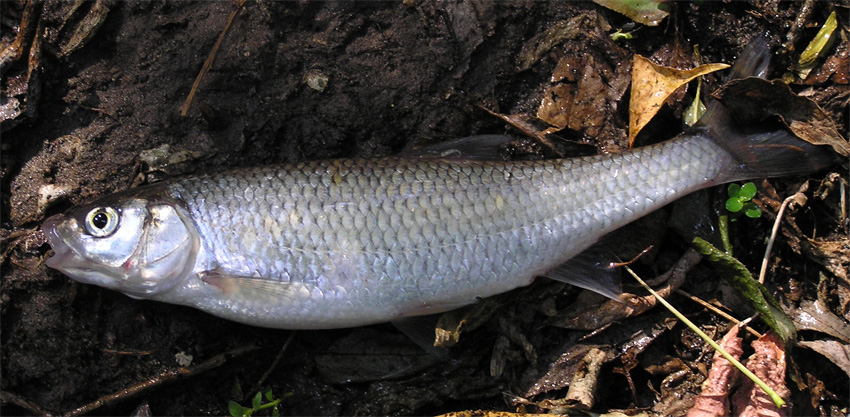

Side by side
| Bearn Beaked Dace | Common Dace | |
|---|---|---|
| Scientific name | Leuciscus bearnensis (Blanchard, 1866) | Leuciscus leuciscus (Linnaeus, 1758) |
| English name | Bearn Beaked Dace | Common Dace |
| Group | Fishes | Fishes |
| Class | Teleostei Teleost | Teleostei Teleost |
| Order | Cypriniformes | Cypriniformes |
| Family | Cyprinidae Carps | Cyprinidae Carps |
| Genus | Leuciscus European Daces | Leuciscus European Daces |
| Named in | 1866 | 1758 |
| Red List category | Near Threatened | Least Concern |
| Environment | freshwater | brackish, freshwater |
| Countries on record | 1 country | 29 countries |
| GBIF occurrence records | 3 records | 182,842 records |
Rows where the two agree are shown in grey.
Where each is found
Both recorded in 1 country
Only Common Dace (28)
- Austria
- Belarus
- Belgium
- Croatia
- Czechia
- Denmark
- Estonia
- Finland
- Germany
- Ireland
- Italy
- Kosovo
- Liechtenstein
- Lithuania
- Luxembourg
- Moldova
- Norway
- Poland
- Romania
- Russia
- Serbia
- Slovakia
- Slovenia
- Sweden
- Switzerland
- The Netherlands
- Ukraine
- United Kingdom
From Catalogue of Life checklists and GBIF occurrence records. A country missing from a list means no record is held, which is not proof of absence.
Checked facts
| Bearn Beaked Dace | Common Dace | |
|---|---|---|
| Appearance |
|
|
| Size |
|
|
| Habitat |
|
|
| Diet | No checked fact yet |
|
| Behaviour | No checked fact yet |
|
| Reproduction | No checked fact yet |
|
| Distribution |
|
|
| Conservation | No checked fact yet |
|
| Uses | No checked fact yet |
|
| Similar species | No checked fact yet |
|
| Name origin |
| No checked fact yet |
| Other |
|
|
In brief
Bearn Beaked Dace
Bearn Beaked Dace is a fish currently classified in the genus Leuciscus. It inhabits streams in the Adour drainage basin in southwestern France. It is distinguished by a projecting snout, thick fleshy lips and a keel extending from the nape to the origin of the dorsal fin. Full profile
Common Dace
The Common Dace is a fish in the family Cyprinidae, order Cypriniformes and class Teleostei. It is native to Europe and northern Asia and occurs in several sea drainage basins and river systems. It has large silvery scales, a yellowish iris and a lateral line containing 49–52 scales. Full profile
Compare something else
Page built on 29 November 2026 from the data on the two species pages, where every source is listed.
Cite this page
ScientificNames.org. (2026). Bearn Beaked Dace vs Common Dace. Retrieved November 29, 2026, from https://scientificnames.org/compare/bearn-beaked-dace-vs-common-dace
“Bearn Beaked Dace vs Common Dace.” ScientificNames.org, 2026, scientificnames.org/compare/bearn-beaked-dace-vs-common-dace. Accessed 29 Nov. 2026.
ScientificNames.org. “Bearn Beaked Dace vs Common Dace.” Accessed November 29, 2026. https://scientificnames.org/compare/bearn-beaked-dace-vs-common-dace.
@misc{scientificnames_bearn_beaked_dace_vs_common_dace,
  author = {{ScientificNames.org}},
  title = {Bearn Beaked Dace vs Common Dace},
  year = {2026},
  url = {https://scientificnames.org/compare/bearn-beaked-dace-vs-common-dace},
  note = {Accessed 2026-11-29}
}