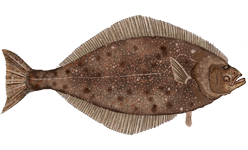
| Appearance | - The yellowfin sole has a deep body, a small mouth, moderately large closely positioned eyes, and a slightly pronounced snout. English Wikipedia
- The upper surface of the yellowfin sole is olive to brown with dark mottling. English Wikipedia
- The dorsal and anal fins are yellowish on both sides and have faint dark bars and a narrow dark basal line. English Wikipedia
- The scales of the yellowfin sole are rough on both sides of its body. English Wikipedia
| - The Pacific halibut has a diamond-shaped body that is more elongated than that of most flatfishes. English Wikipedia
- Its body width is approximately one-third of its length. English Wikipedia
- The lateral line arches prominently above the pectoral fin. English Wikipedia
- Its tail is crescent-shaped. English Wikipedia
- Its small scales are embedded in the skin. English Wikipedia
- Both eyes are normally located on the dark upper side of its body. English Wikipedia
- Its upper coloration tends to match the ocean bottom, while its underside is lighter. English Wikipedia
- Its upper surface is generally gray to brown or nearly black, with mottling and numerous spots. adfg.alaska.gov
- Its underside is typically white. adfg.alaska.gov
- The dorsal fin extends continuously from near the eyes to the base of the tail. adfg.alaska.gov
- Its mouth reaches the middle of the lower eye or farther and is nearly symmetrical. adfg.alaska.gov
- Its tail is broad and symmetrical without a distinct fork. adfg.alaska.gov
|
|---|
| Size | | - Females can exceed 2.4 metres in length and reach approximately 230 kilograms in weight. English Wikipedia
- The maximum reported size exceeds 8 feet in length and 500 pounds in weight. adfg.alaska.gov
- Male Pacific halibut rarely grow longer than three feet. adfg.alaska.gov
- A 20-inch Pacific halibut is predicted to weigh approximately 3 pounds. English Wikipedia
- A 58-inch Pacific halibut is predicted to weigh approximately 100 pounds. English Wikipedia
|
|---|
| Habitat | - The yellowfin sole inhabits soft, sandy seabeds at depths reaching 700 metres. English Wikipedia
- The species is most commonly found at depths of approximately 91 metres. English Wikipedia
- The IUCN document classifies the yellowfin sole as a marine species occurring in marine neritic habitat. iucnredlist.org
| - The species inhabits the continental shelf of the North Pacific Ocean and the Bering Sea. English Wikipedia
- Pacific halibut generally live on or near the seabed. English Wikipedia
- The species prefers water temperatures between 3 and 8 degrees Celsius. English Wikipedia
- Pacific halibut generally inhabit depths of 20 to 1,000 feet, although individuals have been recorded at 3,600 feet. adfg.alaska.gov
- The species occurs over various seabed types. adfg.alaska.gov
- Young halibut settle in shallow nearshore habitats at approximately six months of age. adfg.alaska.gov
|
|---|
| Diet | - The yellowfin sole feeds mainly on zoobenthic organisms. English Wikipedia
- Its diet includes polychaetes, amphipods, hydroids, worms, mollusks, and brittle stars. English Wikipedia
| - Pacific halibut consume cod, turbot and pollock. English Wikipedia
- Their diet includes octopus, crabs and shrimp. English Wikipedia
- They sometimes leave the seabed to feed on pelagic fishes such as salmon, sand lance and herring. English Wikipedia
- Pacific halibut have also been found with seal remains in their stomachs. English Wikipedia
- During their first year, Pacific halibut larvae and juveniles feed on plankton. adfg.alaska.gov
- Halibut aged one to three years consume euphausiids and small fishes. adfg.alaska.gov
- Larger individuals consume herring, sand lance, capelin, smelt, pollock, sablefish, cod and rockfish. adfg.alaska.gov
- Their diet also includes octopuses, crabs and clams. adfg.alaska.gov
|
|---|
| Behaviour | - Yellowfin sole are prey for sculpin, Pacific halibut, Pacific cod, and arrowtooth flounder. English Wikipedia
| - Pacific halibut are strong swimmers capable of migrating long distances. English Wikipedia
- Halibut of different ages and sizes generally migrate clockwise from northwest to southeast. English Wikipedia
- Mature individuals migrate from shallow summer feeding grounds to deeper winter spawning grounds. English Wikipedia
- Juvenile and some adult halibut generally migrate eastward and southward into the Gulf of Alaska coastal current. adfg.alaska.gov
|
|---|
| Reproduction | - Female yellowfin sole reach reproductive maturity at approximately 30 centimetres in length. English Wikipedia
- Female yellowfin sole usually reach reproductive maturity at approximately 10.5 years of age. English Wikipedia
- Yellowfin sole spawn after migrating to shallow waters during spring and summer. English Wikipedia
- Female yellowfin sole can produce between one and three million eggs. English Wikipedia
| - Pacific halibut spawning generally occurs between November and March. adfg.alaska.gov
- Spawning takes place at depths of approximately 300 to 1,500 feet. adfg.alaska.gov
- Most male Pacific halibut reach sexual maturity at approximately eight years of age. adfg.alaska.gov
- Approximately half of female Pacific halibut are sexually mature by twelve years of age. adfg.alaska.gov
- Female Pacific halibut can release from a few thousand to several million eggs depending on their size. adfg.alaska.gov
- Egg fertilization occurs externally. adfg.alaska.gov
- Pacific halibut eggs hatch approximately fifteen days after fertilization. adfg.alaska.gov
- Pacific halibut larvae initially have one eye on each side of the head. adfg.alaska.gov
- The left eye migrates to the right side of the head when the larvae reach approximately one inch in length. adfg.alaska.gov
- Pacific halibut larvae drift with ocean currents after hatching and eventually reach shallower coastal waters. adfg.alaska.gov
|
|---|
| Lifespan | | No checked fact yet |
|---|
| Distribution | - The yellowfin sole is native to temperate waters of the northern Pacific, ranging from Korea and the Sea of Japan to the Sea of Okhotsk, the Bering Sea, and Barkley Sound in western Canada. English Wikipedia
| No checked fact yet |
|---|
| Conservation | - The species is not currently considered overfished according to the document. English Wikipedia
- The estimated biomass of yellowfin sole in the Bering Sea is high and stable above its target level. English Wikipedia
- Commercial yellowfin sole landings are restricted by crab and halibut bycatch limits. English Wikipedia
- Two MSC-certified commercial fisheries for yellowfin sole existed in the northern Pacific in 2021. English Wikipedia
- Yellowfin sole population fluctuations off Sakhalin Island have been amplified by overexploitation during the first two decades of the 2000s. English Wikipedia
- Regulatory changes were introduced in 2014 in response to the fishery situation off Sakhalin Island. English Wikipedia
- The minimum population doubling time of the yellowfin sole is estimated to exceed 14 years. fishbase.se
- The reported vulnerability score for the yellowfin sole is 50 out of 100, categorized as moderate to high. fishbase.se
| - The eastern Pacific population is managed as a single stock for assessment purposes because of extensive juvenile and adult movements. adfg.alaska.gov
- The United States and Canadian commercial Pacific halibut fishery has received Marine Stewardship Council sustainability certification. adfg.alaska.gov
|
|---|
| Uses | - Yellowfin sole is harvested commercially, primarily using demersal trawling. English Wikipedia
- Average annual catches of yellowfin sole were 94,000 tonnes between 1998 and 2010. English Wikipedia
- The 2008 yellowfin sole catch reached 148,894 tonnes, the highest annual catch in eleven years. English Wikipedia
| - Pacific halibut are harvested by commercial, recreational and subsistence fisheries. English Wikipedia
- Pacific halibut provide food for several Indigenous groups along the Pacific Coast. English Wikipedia
- Some Pacific Coast Indigenous communities smoke and dry halibut for winter consumption. English Wikipedia
|
|---|
| Similar species | No checked fact yet | - Inexperienced anglers sometimes mistake Pacific halibut for arrowtooth flounder. adfg.alaska.gov
|
|---|
| Other | - The yellowfin sole was originally described under the scientific name Pleuronectes asper in 1814. English Wikipedia
| No checked fact yet |
|---|