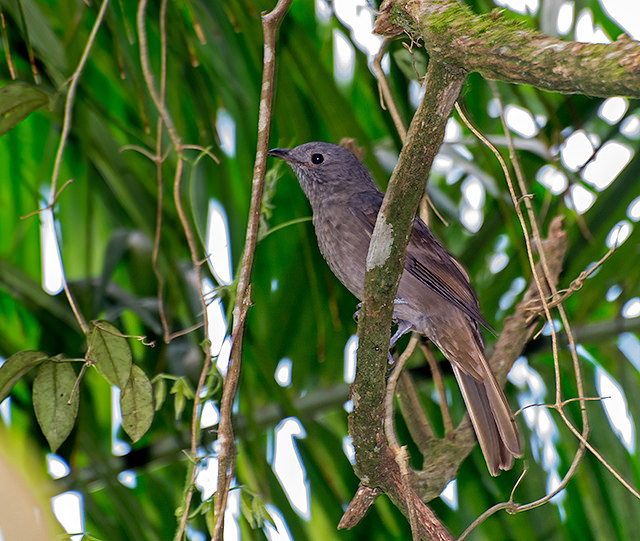
| Appearance | - Adult Cinnamon-vented Pihas have predominantly gray heads and upperparts with a brownish wash and slightly scaly crowns. English Wikipedia
- The wings and tail are gray with a darker brownish wash than the upperparts. English Wikipedia
- The underparts are predominantly pale grayish brown with thin whitish streaks and cinnamon-buff undertail coverts. English Wikipedia
- The species has a dark brown iris, a dark brown or blackish bill with a paler mandibular base, and gray legs and feet. English Wikipedia
- Male and female Cinnamon-vented Pihas have the same plumage. English Wikipedia
- The Cinnamon-vented Piha is described as a relatively large, thrushlike bird with a robust beak. ebird.org
| - Adult males are predominantly black, with a large golden-yellow patch on their wing flight feathers. English Wikipedia
- Adult males have reddish-brown irises, bright orange slightly hooked bills, and dark brown legs and feet. English Wikipedia
- Females are predominantly dull olive-green, with yellower edges to their flight feathers and a yellower belly. English Wikipedia
- Females have duller orange bills than males. English Wikipedia
|
|---|
| Size | | |
|---|
| Habitat | - The Cinnamon-vented Piha inhabits humid montane forest. English Wikipedia
- The species generally occurs at elevations of 500–1,000 m. English Wikipedia
- The species occurs locally at elevations up to 1,400 m. English Wikipedia
- In the southern part of its range, the species occurs at elevations approaching sea level. English Wikipedia
- The species occurs in Atlantic forest between Bahia and Santa Catarina in southeastern Brazil. datazone.birdlife.org
| - The species inhabits humid montane forests in the Atlantic Forest biome. English Wikipedia
- The species occurs in the subcanopy of montane forests. ebird.org
- The species is associated with humid Atlantic Forest in highland areas. inaturalist.org
|
|---|
| Diet | - The Cinnamon-vented Piha feeds primarily on fruits. English Wikipedia
- Large insects are also part of the Cinnamon-vented Piha's diet. English Wikipedia
- Nestlings are fed exclusively insects for approximately their first two weeks after hatching. English Wikipedia
- The Cinnamon-vented Piha takes fruits or insects from leaves and branches. English Wikipedia
| - The species feeds primarily on fruit and also consumes insects. English Wikipedia
- Fruits of the Lauraceae family appear to be important in the species' diet. English Wikipedia
|
|---|
| Behaviour | - The Cinnamon-vented Piha is primarily resident throughout the year. English Wikipedia
- The species may make elevational movements in the southern part of its range. English Wikipedia
- While foraging, the species perches quietly and looks around before moving sideways or making sallies to capture food. English Wikipedia
- The species' song is a low, calm, nasal, staccato series of notes. English Wikipedia
- The middle note of the Cinnamon-vented Piha's song is higher than the other notes. English Wikipedia
- Cinnamon-vented Pihas have exhibited antipredator behaviour at two nests in montane forest in Espírito Santo, Brazil. digitalcommons.usf.edu
| - The species obtains most fruit while perched and sometimes catches fruit during short fluttering flights. English Wikipedia
- The species catches insects mainly by making short flights to foliage. English Wikipedia
- The species is mostly resident throughout the year but apparently makes some movements between elevations. English Wikipedia
- Two or more males alternate vocalizations from treetops, producing a continuous sound that carries over long distances. English Wikipedia
- The male song is described as a high, sharp, eerie sound that rises in strength and pitch midway. English Wikipedia
|
|---|
| Reproduction | - The species' breeding season appears to extend from September through March. English Wikipedia
- The Cinnamon-vented Piha builds small, thin platform nests from twigs. English Wikipedia
- Most recorded nests were placed on horizontal twigs in small trees approximately 7–8 m above the ground. English Wikipedia
- One recorded nest was situated on a dead palm leaf approximately 2.5 m above the ground. English Wikipedia
- The species lays a clutch of one olive-green egg with brown spots. English Wikipedia
- The female alone appears to incubate the egg. English Wikipedia
- The incubation period is approximately 26 days. English Wikipedia
- Young Cinnamon-vented Pihas fledge approximately 25–26 days after hatching. English Wikipedia
| |
|---|
| Distribution | - The Cinnamon-vented Piha is endemic to Brazil. English Wikipedia
- The species occurs in southeastern Brazil from southeastern Bahia south to northeastern Santa Catarina. English Wikipedia
- A few isolated inland records exist outside the species' main southeastern Brazilian distribution. English Wikipedia
| - The species is endemic to Brazil. English Wikipedia
- The species occurs in southeastern Brazil, including extreme eastern São Paulo, extreme eastern Minas Gerais, and southern Rio de Janeiro. English Wikipedia
- The species is restricted to humid Atlantic Forest in the Brazilian highlands. inaturalist.org
|
|---|
| Conservation | - The IUCN classified the Cinnamon-vented Piha as Least Concern from 2022 onward. English Wikipedia
- The species has a somewhat limited and fragmented geographic range. English Wikipedia
- The estimated population comprises at least 50,000 mature individuals. English Wikipedia
- The Cinnamon-vented Piha's population is believed to be decreasing. English Wikipedia
- Extensive destruction and fragmentation of Atlantic forest through agricultural conversion, human settlements, and logging constitute the species' most significant threat. English Wikipedia
- Some sources consider the Cinnamon-vented Piha rare despite the IUCN's relatively large population estimate. English Wikipedia
- The species appears to occupy approximately 10% of its former range. English Wikipedia
- The Cinnamon-vented Piha occurs in several protected areas. English Wikipedia
- The species is described as rare and locally distributed. datazone.birdlife.org
| |
|---|
| Uses | No checked fact yet | |
|---|
| Other | No checked fact yet | - The species was originally described under the scientific name Tijuca atra. English Wikipedia
- The species is monotypic. English Wikipedia
- A molecular phylogenetic study published in 2014 found that the genus Tijuca was embedded within Lipaugus. English Wikipedia
|
|---|