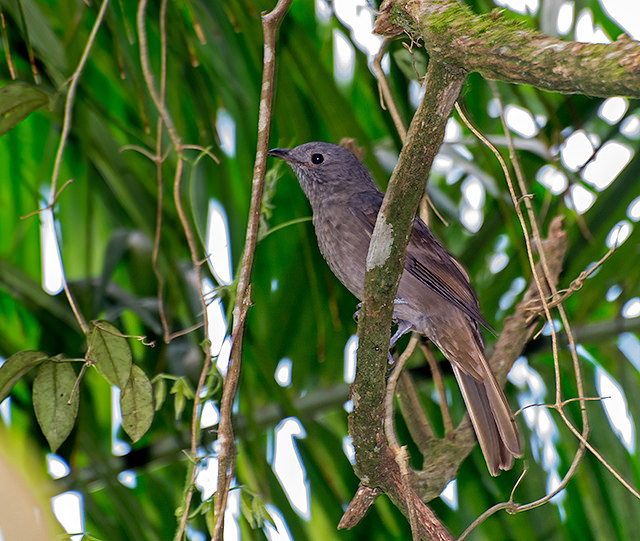
| Appearance | - Adult Cinnamon-vented Pihas have predominantly gray heads and upperparts with a brownish wash and slightly scaly crowns. English Wikipedia
- The wings and tail are gray with a darker brownish wash than the upperparts. English Wikipedia
- The underparts are predominantly pale grayish brown with thin whitish streaks and cinnamon-buff undertail coverts. English Wikipedia
- The species has a dark brown iris, a dark brown or blackish bill with a paler mandibular base, and gray legs and feet. English Wikipedia
- Male and female Cinnamon-vented Pihas have the same plumage. English Wikipedia
- The Cinnamon-vented Piha is described as a relatively large, thrushlike bird with a robust beak. ebird.org
| - The Chestnut-capped Piha has predominantly dark grey plumage, a distinctive chestnut crown on its upper nape, and pale cinnamon-colored undertail coverts. English Wikipedia
- Its upperparts and wing coverts are dark grey, with paler fringes on most feathers. English Wikipedia
- Its underparts are paler grey than its upperparts, particularly around the throat. English Wikipedia
- The species has a dark greyish-brown, noticeably long and forked tail. English Wikipedia
- Its dark grey legs and feet have contrasting yellow soles. English Wikipedia
- Its head has a dark brown iris and a bright yellow narrow orbital ring. English Wikipedia
- Its bill is black, relatively deep and broad at the base, and strongly hooked at the tip. English Wikipedia
- Juveniles have a less conspicuous chestnut crown and brighter, broader rufous fringes on their secondaries and tertials than adults. English Wikipedia
- Males and females have similar plumage, although males are suspected to be slightly larger. English Wikipedia
|
|---|
| Size | | |
|---|
| Habitat | - The Cinnamon-vented Piha inhabits humid montane forest. English Wikipedia
- The species generally occurs at elevations of 500–1,000 m. English Wikipedia
- The species occurs locally at elevations up to 1,400 m. English Wikipedia
- In the southern part of its range, the species occurs at elevations approaching sea level. English Wikipedia
- The species occurs in Atlantic forest between Bahia and Santa Catarina in southeastern Brazil. datazone.birdlife.org
| - The species inhabits a narrow elevation band of extremely humid premontane cloud forest, generally between 1,400 and 1,925 m. English Wikipedia
- It is most commonly encountered at elevations between 1,600 and 1,750 m. English Wikipedia
- Its cloud forest habitat includes trees belonging to the genera Guarea, Pouteria, Protium, Roucheria, Vochysia, Virola, and Clusia. English Wikipedia
- The species prefers undisturbed cloud forest and may require habitat blocks of at least 30 hectares. English Wikipedia
- It can tolerate some selective logging and habitat fragmentation, although its population density decreases in fragmented habitats. English Wikipedia
|
|---|
| Diet | - The Cinnamon-vented Piha feeds primarily on fruits. English Wikipedia
- Large insects are also part of the Cinnamon-vented Piha's diet. English Wikipedia
- Nestlings are fed exclusively insects for approximately their first two weeks after hatching. English Wikipedia
- The Cinnamon-vented Piha takes fruits or insects from leaves and branches. English Wikipedia
| - The Chestnut-capped Piha is primarily frugivorous but also consumes some invertebrates. English Wikipedia
- Its fruit diet includes species from the plant families Myrsinaceae, Euphorbiaceae, Caprifoliaceae, Linaceae, Lauraceae, Aquifoliaceae, and Melastomataceae. English Wikipedia
- Laurel fruits appear to be particularly preferred in its diet. English Wikipedia
|
|---|
| Behaviour | - The Cinnamon-vented Piha is primarily resident throughout the year. English Wikipedia
- The species may make elevational movements in the southern part of its range. English Wikipedia
- While foraging, the species perches quietly and looks around before moving sideways or making sallies to capture food. English Wikipedia
- The species' song is a low, calm, nasal, staccato series of notes. English Wikipedia
- The middle note of the Cinnamon-vented Piha's song is higher than the other notes. English Wikipedia
- Cinnamon-vented Pihas have exhibited antipredator behaviour at two nests in montane forest in Espírito Santo, Brazil. digitalcommons.usf.edu
| - The species typically forages by hover-gleaning during short flights between perches. English Wikipedia
- It occasionally consumes larger fruits after striking them against a branch. English Wikipedia
- It generally occupies the middle and lower canopy levels of its cloud forest habitat. English Wikipedia
- It sometimes joins mixed-species foraging flocks in the upper canopy, generally remaining only while the flock passes through its territory. English Wikipedia
- The species is generally sluggish and relatively inactive. English Wikipedia
- When agitated, it flicks its tail upwards and raises its crown feathers. English Wikipedia
- Male Chestnut-capped Pihas have modified primary feathers with elongated, stiff barbules that produce a whirring sound during wing movements. English Wikipedia
- Its loud, piercing call rises in pitch before descending abruptly. English Wikipedia
- Its calls are normally repeated at one-second intervals but can occur every third of a second when the bird is agitated. English Wikipedia
- Its loud calls can be heard from distances exceeding 100 m. English Wikipedia
- The species vocalizes sporadically throughout the day and throughout the year. English Wikipedia
- It also produces a quiet nasal gluck-gluck vocalization believed to function as a contact call. English Wikipedia
- The Chestnut-capped Piha is non-migratory. English Wikipedia
|
|---|
| Reproduction | - The species' breeding season appears to extend from September through March. English Wikipedia
- The Cinnamon-vented Piha builds small, thin platform nests from twigs. English Wikipedia
- Most recorded nests were placed on horizontal twigs in small trees approximately 7–8 m above the ground. English Wikipedia
- One recorded nest was situated on a dead palm leaf approximately 2.5 m above the ground. English Wikipedia
- The species lays a clutch of one olive-green egg with brown spots. English Wikipedia
- The female alone appears to incubate the egg. English Wikipedia
- The incubation period is approximately 26 days. English Wikipedia
- Young Cinnamon-vented Pihas fledge approximately 25–26 days after hatching. English Wikipedia
| - The species is believed to form leks during breeding, with males potentially using modified primary feathers to generate whirring sounds. English Wikipedia
- A survey in March 2000 found most observed individuals paired and frequently vocalizing, suggesting that the breeding season was approaching. English Wikipedia
- A juvenile collected in early June was estimated to be only a few months old. English Wikipedia
|
|---|
| Distribution | - The Cinnamon-vented Piha is endemic to Brazil. English Wikipedia
- The species occurs in southeastern Brazil from southeastern Bahia south to northeastern Santa Catarina. English Wikipedia
- A few isolated inland records exist outside the species' main southeastern Brazilian distribution. English Wikipedia
| - The species is endemic to Colombia's central Andes, specifically the northern slope of the Cordillera Central in Antioquia Department. English Wikipedia
- Sixteen distinct populations are known from the area east of the Nechí River Valley. English Wikipedia
- Most known populations occur closer to Anorí than to Amalfi. English Wikipedia
- The species is confined to approximately 800 km² of forest on the northern slope of Colombia's Central Andes. datazone.birdlife.org
|
|---|
| Conservation | - The IUCN classified the Cinnamon-vented Piha as Least Concern from 2022 onward. English Wikipedia
- The species has a somewhat limited and fragmented geographic range. English Wikipedia
- The estimated population comprises at least 50,000 mature individuals. English Wikipedia
- The Cinnamon-vented Piha's population is believed to be decreasing. English Wikipedia
- Extensive destruction and fragmentation of Atlantic forest through agricultural conversion, human settlements, and logging constitute the species' most significant threat. English Wikipedia
- Some sources consider the Cinnamon-vented Piha rare despite the IUCN's relatively large population estimate. English Wikipedia
- The species appears to occupy approximately 10% of its former range. English Wikipedia
- The Cinnamon-vented Piha occurs in several protected areas. English Wikipedia
- The species is described as rare and locally distributed. datazone.birdlife.org
| - The Chestnut-capped Piha is classified as Critically Endangered by the IUCN. English Wikipedia
- Its remaining population was estimated in 2014 to number fewer than 250 individuals. English Wikipedia
- Gold mining and soil erosion have affected parts of its former habitat. English Wikipedia
- Climate change is considered a future threat because increasing temperatures may force the species to move upslope beyond the capacity of the forest to follow. English Wikipedia
- The American Bird Conservancy purchased the 5.3 km² Arrierito Antioqueño Bird Reserve in 2006 for management by Fundación ProAves. English Wikipedia
|
|---|
| Uses | No checked fact yet | - The Chestnut-capped Piha was featured on a Colombian postage stamp valued at 1,500 pesos in 2008. English Wikipedia
|
|---|
| Similar species | No checked fact yet | - The Chestnut-capped Piha is considered most closely related to the Dusky Piha. English Wikipedia
- It can be distinguished from the Dusky Piha by its smaller size, greyer plumage, chestnut crown, and yellow orbital ring. English Wikipedia
|
|---|