Comparison

Lobb's Gooseberry vs Blackcurrant

Lobb's Gooseberry (Ribes lobbii) and Blackcurrant (Ribes nigrum) both belong to the genus Ribes (currant) and part ways below it. Both are recorded in 2 countries.

Lobb's Gooseberry

Lobb's Gooseberry

Ribes lobbii

Peter Stevens from Seattle, CC BY 2.0, via Wikimedia Commons

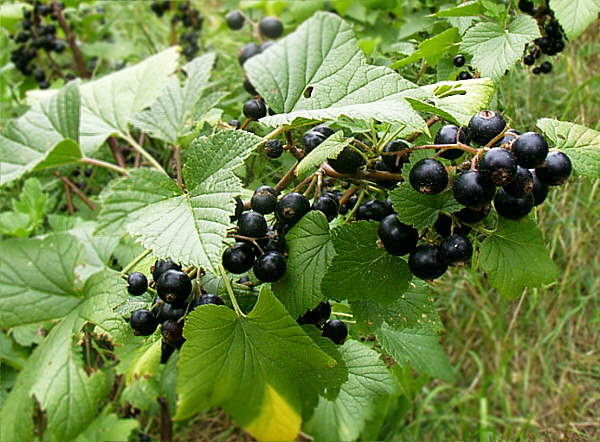
Blackcurrant

Blackcurrant

Ribes nigrum

Unknown author, Public domain, via Wikimedia Commons

Side by side

Lobb's GooseberryBlackcurrant
Scientific nameRibes lobbii A.GrayRibes nigrum L.
English nameLobb's GooseberryBlackcurrant
GroupFlowering plantsFlowering plants
ClassMagnoliopsidaMagnoliopsida
OrderSaxifragalesSaxifragales
FamilyGrossulariaceae Currant FamilyGrossulariaceae Currant Family
GenusRibes CurrantRibes Currant
Countries on record2 countries55 countries
GBIF occurrence records1,906 records123,977 records

Rows where the two agree are shown in grey.

Where each is found

Both recorded in 2 countries

Only Blackcurrant (53)

From Catalogue of Life checklists and GBIF occurrence records. A country missing from a list means no record is held, which is not proof of absence.

Checked facts

Lobb's GooseberryBlackcurrant
Appearance
  • Ribes lobbii is a deciduous shrub with loosely arranged branches. English Wikipedia
  • Its stems spread outward and have fine hairs. English Wikipedia
  • Its stems generally bear three slender spines at each node. English Wikipedia
  • Its bark begins brown and becomes deep greyish-red as it ages. English Wikipedia
  • Its leaves are alternately arranged and ovate, with shallowly heart-shaped bases and three to five rounded lobes. English Wikipedia
  • The upper leaf surface is sticky and hairless or sparsely hairy, while the lower surface is somewhat woolly and glandular. English Wikipedia
  • The flowers are white or light pink, with broad, fan-shaped petals that curl backward. English Wikipedia
  • Its flowers are borne in drooping racemes containing one or two flowers. English Wikipedia
  • The flowers have red, hairy calyces with narrow, pointed lobes. English Wikipedia
  • The flower's hypanthium is typically narrow and bell-shaped. English Wikipedia
  • The flower's anthers extend substantially beyond its petals. English Wikipedia
  • Its fruits are round to elliptic berries that are reddish-brown, roughly bristled, and glandular. English Wikipedia
Size
  • The leaves measure approximately 3–5 centimetres in both length and width. English Wikipedia
  • The flower clusters can reach 8 centimetres in length. English Wikipedia
  • An established shrub can produce approximately 4.5 kilograms of fruit annually. English Wikipedia
Habitat
  • The species grows along moderately moist to dry streambanks. English Wikipedia
  • The species inhabits open woodlands and forests in lowland and montane zones. English Wikipedia
  • The species grows on very dry to moderately dry soils with moderate nitrogen content. English Wikipedia
  • The species occurs sporadically in early-seral communities and open-canopy Douglas-fir forests. English Wikipedia
  • The species occurs in forests and meadows of foothill and subalpine zones. English Wikipedia
  • The species grows naturally in temperate regions with damp, fertile soils. English Wikipedia
  • The shrub can grow in sandy loams, heavy loams, and forest soils when its nutrient requirements are satisfied. English Wikipedia
  • The species prefers moist, fertile soil but does not tolerate waterlogged conditions. English Wikipedia
  • The species is intolerant of drought. English Wikipedia
  • Organically rich, well-drained soil is suitable for growing this shrub. trees.umn.edu
Diet
  • The berries are edible and are consumed raw or cooked in various dishes. English Wikipedia
Behaviour
  • Cold conditions during spring flowering can reduce fruit production. English Wikipedia
  • Cold winds can reduce the number of flying insects visiting and pollinating the flowers. English Wikipedia
ReproductionNo checked fact yet
  • The flowers open sequentially, beginning at the base of each flower cluster. English Wikipedia
  • The flowers are primarily pollinated by insects, although some pollen is distributed by wind. English Wikipedia
  • The species is partly self-pollinating, but cross-pollination between different varieties increases fruit production. English Wikipedia
  • Pollen germination and tube growth to the ovule take approximately 48 hours in warm weather. English Wikipedia
  • In cold weather, pollen tube growth can take up to a week. English Wikipedia
  • Fruit development may fail and the fruit may drop prematurely when fewer than approximately 35 ovules are fertilised. English Wikipedia
  • Frost can damage unopened and open flowers when temperatures fall below approximately −1.9 °C. English Wikipedia
  • The fruits ripen during midsummer. English Wikipedia
Distribution
  • In British Columbia, the species is locally common on the Gulf Islands and Vancouver Island. English Wikipedia
  • In Washington State, the species has been recorded in Wahkiakum, Skamania, Klickitat, Kittitas, Chelan, Pierce, Thurston, and Clallam counties. English Wikipedia
  • In Oregon, the species has been recorded in Curry, Douglas, Lane, Josephine, Jackson, Klamath, Benton, Linn, Jefferson, Marion, Wasco, Yamhill, Hood River, Multnomah, and Columbia counties. English Wikipedia
  • In California, the species is native to northern coastal coniferous and red fir forests in Del Norte, Humboldt, and Mendocino counties. English Wikipedia
  • In California, the species also occurs inland in Siskiyou, Trinity, Shasta, and Glenn counties. English Wikipedia
  • The species has relatively few recorded specimens in Lake, Colusa, and Modoc counties in California. English Wikipedia
  • The species is native to temperate regions of central and northern Europe and northern Asia. English Wikipedia
  • The species is widely cultivated commercially and domestically. English Wikipedia
  • Commercial cultivation is concentrated largely in eastern Europe for juice and juice concentrate production. English Wikipedia
  • New Zealand has become an important centre for blackcurrant research and development since 1991. English Wikipedia
Conservation
  • The species can be locally rare in the wetter Cordilleran portion of its range. English Wikipedia
No checked fact yet
UsesNo checked fact yet
  • The species is cultivated for its edible berries. English Wikipedia
  • The berries are used to produce jams, preserves, and syrups. English Wikipedia
  • The berries are commercially cultivated for juice production. English Wikipedia
  • The berries are also used to produce alcoholic beverages and dyes. English Wikipedia
  • The shrub can be planted as an ornamental plant. trees.umn.edu
  • Raw blackcurrant fruit contains approximately 218% of the daily value of vitamin C per 100 grams. English Wikipedia
  • Blackcurrant seed oil contains vitamin E and unsaturated fatty acids, including alpha-linolenic and gamma-linolenic acids. English Wikipedia
  • The leaves, bark, and roots have historically been used to prepare medicinal decoctions. English Wikipedia
Name originNo checked fact yet
OtherNo checked fact yet
  • The species has been investigated for the potential biological activities of polyphenols found in its fruit, seeds, and leaves. English Wikipedia

In brief

Lobb's Gooseberry

Lobb's gooseberry (Ribes lobbii A.Gray) is a deciduous shrub in the family Grossulariaceae, order Saxifragales, and class Magnoliopsida. It is distinguished by outward-spreading, finely hairy stems with generally three slender spines at each node and sticky leaves with woolly lower surfaces. Full profile

Blackcurrant

Ribes nigrum grows naturally in temperate regions of central and northern Europe and northern Asia. It produces very dark purple, nearly black berries that are edible and used in food and beverage production. Full profile

Compare something else

Page built on 27 November 2026 from the data on the two species pages, where every source is listed.

Cite this page

ScientificNames.org. (2026). Lobb's Gooseberry vs Blackcurrant. Retrieved November 27, 2026, from https://scientificnames.org/compare/lobbs-gooseberry-vs-blackcurrant