Comparison
Lortet Iris vs Siberian Iris
Lortet Iris (Iris lortetii) and Siberian Iris (Iris sibirica) both belong to the genus Iris (irises) and part ways below it.
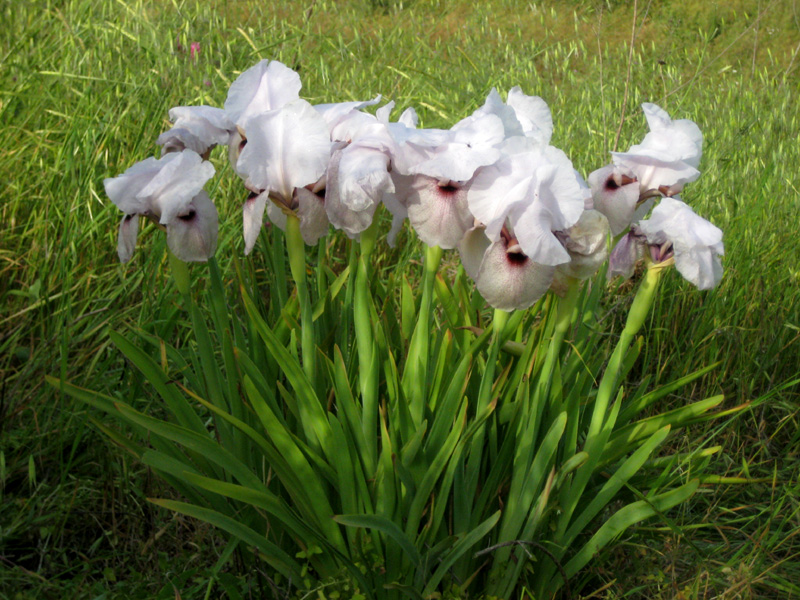


Side by side
| Lortet Iris | Siberian Iris | |
|---|---|---|
| Scientific name | Iris lortetii Barbey | Iris sibirica L. |
| English name | Lortet Iris | Siberian Iris |
| Group | Flowering plants | Flowering plants |
| Class | Liliopsida | Liliopsida |
| Order | Asparagales | Asparagales |
| Family | Iridaceae Iris Family | Iridaceae Iris Family |
| Genus | Iris Irises | Iris Irises |
| Red List category | Endangered | Not recorded |
| Countries on record | 2 countries | 40 countries |
| GBIF occurrence records | 3,129 records | 28,427 records |
Rows where the two agree are shown in grey.
Where each is found
Only Lortet Iris (2)
Only Siberian Iris (40)
- Armenia
- Austria
- Belarus
- Belgium
- Bosnia and Herzegovina
- Bulgaria
- Canada
- China
- Croatia
- Czechia
- Denmark
- Estonia
- Finland
- France
- Georgia
- Germany
- Hungary
- Italy
- Japan
- Kazakhstan
- Latvia
- Liechtenstein
- Lithuania
- Mongolia
- North Korea
- Norway
- Poland
- Romania
- Russia
- Serbia
- Slovakia
- Slovenia
- South Korea
- Sweden
- Switzerland
- The Netherlands
- Turkey
- Ukraine
- United Kingdom
- United States
From Catalogue of Life checklists and GBIF occurrence records. A country missing from a list means no record is held, which is not proof of absence.
Checked facts
| Lortet Iris | Siberian Iris | |
|---|---|---|
| Appearance |
|
|
| Size |
|
|
| Habitat |
|
|
| Behaviour | No checked fact yet |
|
| Reproduction |
|
|
| Distribution |
|
|
| Conservation |
|
|
| Uses |
|
|
| Similar species | No checked fact yet |
|
| Name origin |
| No checked fact yet |
| Other |
| No checked fact yet |
In brief
Lortet Iris
Lortet iris (Iris lortetii Barbey) is a flowering plant in the family Iridaceae, order Asparagales and class Liliopsida. It is endemic to Israel, Palestine, southern Lebanon and Syria, where it grows on rocky limestone slopes and in woodland and shrubland habitats. Full profile
Siberian Iris
Iris sibirica is native to temperate regions of Europe and Central Asia and grows in damp woodland, wet meadows, grasslands, and pastures. It has long, grass-like green leaves and predominantly violet-blue or blue flowers, with occasional white forms. Full profile
Compare something else
Page built on 29 November 2026 from the data on the two species pages, where every source is listed.
Cite this page
ScientificNames.org. (2026). Lortet Iris vs Siberian Iris. Retrieved November 29, 2026, from https://scientificnames.org/compare/lortet-iris-vs-siberian-iris
“Lortet Iris vs Siberian Iris.” ScientificNames.org, 2026, scientificnames.org/compare/lortet-iris-vs-siberian-iris. Accessed 29 Nov. 2026.
ScientificNames.org. “Lortet Iris vs Siberian Iris.” Accessed November 29, 2026. https://scientificnames.org/compare/lortet-iris-vs-siberian-iris.
@misc{scientificnames_lortet_iris_vs_siberian_iris,
  author = {{ScientificNames.org}},
  title = {Lortet Iris vs Siberian Iris},
  year = {2026},
  url = {https://scientificnames.org/compare/lortet-iris-vs-siberian-iris},
  note = {Accessed 2026-11-29}
}