Comparison
Oriental Powderpost Beetle vs African Powderpost Beetle
Oriental Powderpost Beetle (Lyctoxylon dentatum) and African Powderpost Beetle (Lyctus africanus) both belong to the tribe Lyctini and part ways below it. Both are recorded in 1 country.
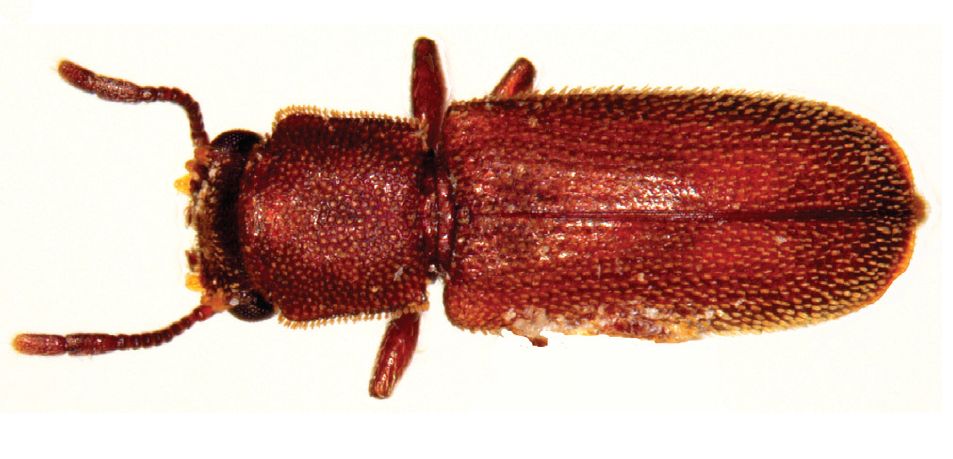
Oriental Powderpost Beetle
Lyctoxylon dentatum
Wisut Sittichaya, Roger A. Beaver, Lan-Yu Liu, Aran Ngampongsai, CC BY 3.0, via Wikimedia Commons


African Powderpost Beetle
Lyctus africanus
Ken Walker, Museum Victoria, CC BY 3.0 au, via Wikimedia Commons

Side by side
| Oriental Powderpost Beetle | African Powderpost Beetle | |
|---|---|---|
| Scientific name | Lyctoxylon dentatum (Pascoe, 1866) | Lyctus africanus Lesne, 1907 |
| English name | Oriental Powderpost Beetle | African Powderpost Beetle |
| Group | Insects | Insects |
| Class | Insecta Insect | Insecta Insect |
| Order | Coleoptera Beetle | Coleoptera Beetle |
| Family | Bostrichidae Bostrichid Beetles | Bostrichidae Bostrichid Beetles |
| Genus | Lyctoxylon | Lyctus |
| Named in | 1866 | 1907 |
| Environment | Not recorded | terrestrial |
| Countries on record | 2 countries | 5 countries |
| GBIF occurrence records | 7 records | 44 records |
Rows where the two agree are shown in grey.
Where each is found
Both recorded in 1 country
Only Oriental Powderpost Beetle (1)
Only African Powderpost Beetle (4)
From Catalogue of Life checklists and GBIF occurrence records. A country missing from a list means no record is held, which is not proof of absence.
Checked facts
| Oriental Powderpost Beetle | African Powderpost Beetle | |
|---|---|---|
| Appearance |
|
|
| Size | No checked fact yet |
|
| Habitat |
|
|
| Diet | No checked fact yet |
|
| Behaviour | No checked fact yet |
|
| Reproduction | No checked fact yet |
|
| Lifespan | No checked fact yet |
|
| Distribution |
|
|
| Conservation | No checked fact yet |
|
| Uses | No checked fact yet |
|
| Similar species |
| No checked fact yet |
| Other |
|
|
In brief
Oriental Powderpost Beetle
The Oriental Powderpost Beetle is a powderpost beetle. It is a woodboring beetle native to Asia and introduced to Europe, East Africa, and North America. It was first described in 1866 by Francis Polkinghorne Pascoe. Full profile
African Powderpost Beetle
Lyctus africanus occurs in Africa, Europe, Northern Asia excluding China, North America, and Southern Asia. Adults are reddish-brown beetles with slender, cylindrical bodies, fine hairs, and a hood-like pronotum. Full profile
Compare something else
Page built on 29 November 2026 from the data on the two species pages, where every source is listed.
Cite this page
ScientificNames.org. (2026). Oriental Powderpost Beetle vs African Powderpost Beetle. Retrieved November 29, 2026, from https://scientificnames.org/compare/oriental-powderpost-beetle-vs-african-powderpost-beetle
“Oriental Powderpost Beetle vs African Powderpost Beetle.” ScientificNames.org, 2026, scientificnames.org/compare/oriental-powderpost-beetle-vs-african-powderpost-beetle. Accessed 29 Nov. 2026.
ScientificNames.org. “Oriental Powderpost Beetle vs African Powderpost Beetle.” Accessed November 29, 2026. https://scientificnames.org/compare/oriental-powderpost-beetle-vs-african-powderpost-beetle.
@misc{scientificnames_oriental_powderpost_beetle_vs_african_powderpost_beetle,
  author = {{ScientificNames.org}},
  title = {Oriental Powderpost Beetle vs African Powderpost Beetle},
  year = {2026},
  url = {https://scientificnames.org/compare/oriental-powderpost-beetle-vs-african-powderpost-beetle},
  note = {Accessed 2026-11-29}
}