Comparison

MacFarlane's Four-o'clock vs Colorado Four O'Clock

MacFarlane's Four-o'clock (Mirabilis macfarlanei) and Colorado Four O'Clock (Mirabilis multiflora) both belong to the genus Mirabilis (four o'clock) and part ways below it. Both are recorded in 1 country.
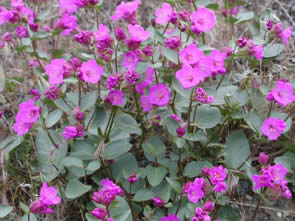
MacFarlane's Four-o'clock

MacFarlane's Four-o'clock

Mirabilis macfarlanei

Gene Yates, Forest Botanist, Wallowa-Whitman National Forest, Public domain, via Wikimedia Commons

Colorado Four O'Clock

Colorado Four O'Clock

Mirabilis multiflora

Stan Shebs, CC BY-SA 3.0, via Wikimedia Commons

Side by side

MacFarlane's Four-o'clockColorado Four O'Clock
Scientific nameMirabilis macfarlanei Constance & RollinsMirabilis multiflora (Torr.) A.Gray
English nameMacFarlane's Four-o'clockColorado Four O'Clock
GroupFlowering plantsFlowering plants
ClassMagnoliopsidaMagnoliopsida
OrderCaryophyllalesCaryophyllales
FamilyNyctaginaceae Four-o’clock FamilyNyctaginaceae Four-o’clock Family
GenusMirabilis Four O'clockMirabilis Four O'clock
Countries on record1 country2 countries
GBIF occurrence records94 records7,475 records

Rows where the two agree are shown in grey.

Where each is found

Both recorded in 1 country

Only Colorado Four O'Clock (1)

From Catalogue of Life checklists and GBIF occurrence records. A country missing from a list means no record is held, which is not proof of absence.

Checked facts

MacFarlane's Four-o'clockColorado Four O'Clock
Appearance
  • The species is a perennial herb that forms rounded clumps of stems. English Wikipedia
  • The flowers lack petals and instead have magenta sepals. English Wikipedia
  • The plant has a deep-seated, thick taproot. fws.gov
  • The plant's leaves are opposite and fleshy, with lower blades ranging from orbicular to ovate-deltoid and upper blades narrowly ovate. swap.oregon.gov
  • The lower leaves have petioles up to 12.5 cm long, while the upper leaves are nearly sessile. swap.oregon.gov
  • The flowers are clustered in groups of four to seven in conspicuous green to purplish involucres. swap.oregon.gov
  • The flowers have a showy magenta, broadly funnel-shaped perianth. swap.oregon.gov
  • The fruits are ellipsoid and light brown to grayish, with slender ribs, a tuberculate surface, and little or no pubescence. swap.oregon.gov
  • The plant has oppositely arranged leaves on its spreading stem branches. English Wikipedia
  • Its fleshy leaves have oval or rounded blades and are hairless or sparsely hairy. English Wikipedia
  • Its flowers emerge in leaf axils on the upper branches. English Wikipedia
  • Its flowers are enclosed by bell-shaped structures formed from five partly fused bracts. English Wikipedia
  • A mature plant can produce hundreds of magenta-pink flowers simultaneously. fs.usda.gov
  • Its flowers emerge from floral cups formed by modified leaves. fs.usda.gov
  • Its stems are somewhat succulent and pliable and grow horizontally along the ground. cwelwnp.usu.edu
SizeNo checked fact yet
Habitat
  • The species grows on warm, dry, open canyon slopes. swap.oregon.gov
  • The species occupies sandy or rocky soils that are often unstable. swap.oregon.gov
  • The species occurs in dry, relatively warm native grassland containing shrubs. English Wikipedia
  • The species' habitat includes bluebunch wheatgrass, sand dropseed, and pine bluegrass. English Wikipedia
Behaviour
  • The species generally survives wildfires because of its large underground rhizome. English Wikipedia
  • The plant dies back to ground level during winter and re-emerges in midwinter or spring. English Wikipedia
  • The plant also dies back during extreme drought. English Wikipedia
  • The flowers tend to close in late morning and reopen in late afternoon. cwelwnp.usu.edu
Reproduction
  • The flowers are pollinated by solitary bees and the bumblebee Bombus fervidus. English Wikipedia
  • The species spreads through long rhizomes. English Wikipedia
  • The species produces ellipsoid fruits measuring 6–9 millimeters in length. swap.oregon.gov
  • Pollination of this species depends on hawkmoths. English Wikipedia
  • Two documented hawkmoth pollinators are Hyles lineata and Manduca quinquemaculata. English Wikipedia
  • The species produces flowers from April through September, particularly following rainfall. fs.usda.gov
  • Its flowers generally open in the late afternoon and wither the following day. fs.usda.gov
  • Cloudy weather causes the flowers to open earlier and remain open longer. fs.usda.gov
  • Each floral cup contains six to eight flowers that open on successive days. fs.usda.gov
  • Its fruit contains at least two seeds enclosed in a papery husk formed by mature sepals. cwelwnp.usu.edu
  • The species can be propagated from seed without cold stratification. cwelwnp.usu.edu
LifespanNo checked fact yet
Distribution
  • The species is native to Idaho and Oregon in the United States. English Wikipedia
  • The species occurs in the canyons of the Snake, Salmon, and Imnaha Rivers in western Idaho and far eastern Oregon. English Wikipedia
  • The species has a narrow geographic distribution. swap.oregon.gov
  • It is distributed throughout the southwestern United States and northern Mexico. fs.usda.gov
  • In California, the species occurs only in the southern part of the state. fs.usda.gov
  • In Texas, the species occurs only in the extreme western part of the state. fs.usda.gov
Conservation
  • The species was federally listed as endangered in 1979. English Wikipedia
  • The species was reclassified from endangered to threatened in 1996. govinfo.gov
  • The species had eleven known populations by 2000. English Wikipedia
  • Monitoring data from federal lands indicated that the total population had neither increased nor decreased by 2008. English Wikipedia
  • Grazing by domestic cattle and sheep threatens the species through trampling and predation. English Wikipedia
  • Invasive plant expansion is considered a primary limiting factor for the species. swap.oregon.gov
  • Off-highway vehicle use, road and trail construction and maintenance, mining, and herbicide drift are additional threats. swap.oregon.gov
  • Inbreeding depression may limit the species. swap.oregon.gov
  • The species is moderately vulnerable to climate change, particularly because of predicted changes in precipitation variability. swap.oregon.gov
  • A revised recovery plan for the species was released in 2000. swap.oregon.gov
  • A five-year review addressing updated conservation needs was released in 2022. swap.oregon.gov
  • The Oregon Department of Agriculture published a habitat management plan covering all Oregon populations in 2025. swap.oregon.gov
No checked fact yet
UsesNo checked fact yet
  • Among the Zuni people, powdered root is mixed with flour and made into bread to decrease appetite. English Wikipedia
  • An infusion of the root is used externally on the abdomen of hungry adults and children. English Wikipedia
  • An infusion of powdered root is taken after overeating by adults and children. English Wikipedia
  • The species is used as a food and medicinal plant by Indigenous peoples. fs.usda.gov
Similar speciesNo checked fact yet
  • The common name desert four-o'clock is also occasionally applied to Mirabilis tenuiloba and Mirabilis laevis var. retrorsa. English Wikipedia

In brief

MacFarlane's Four-o'clock

MacFarlane's four-o'clock is a perennial herb that forms rounded clumps of stems. It occurs in the canyons of the Snake, Salmon, and Imnaha Rivers in western Idaho and far eastern Oregon. The species has a deep-seated taproot and showy magenta, broadly funnel-shaped flowers. Full profile

Colorado Four O'Clock

Colorado Four o'Clock (Mirabilis multiflora) is a perennial herb in the family Nyctaginaceae, order Caryophyllales, and class Magnoliopsida. It grows in mostly dry habitats, including forests, woodlands, and shrub communities, in the southwestern United States and northern Mexico. It has spreading stems, fleshy leaves, and magenta flowers that can appear in large numbers simultaneously. Full profile

Compare something else

Page built on 29 November 2026 from the data on the two species pages, where every source is listed.

Cite this page

ScientificNames.org. (2026). MacFarlane's Four-o'clock vs Colorado Four O'Clock. Retrieved November 29, 2026, from https://scientificnames.org/compare/macfarlanes-four-oclock-vs-colorado-four-oclock