Comparison

Macleay's Dorcopsis vs Eastern Grey Kangaroo

Macleay's Dorcopsis (Dorcopsulus macleayi) and Eastern Grey Kangaroo (Macropus giganteus) both belong to the subfamily Macropodinae and part ways below it. Both are recorded in 1 country.

Macleay's Dorcopsis

Macleay's Dorcopsis

Dorcopsulus macleayi

Daderot, CC0, via Wikimedia Commons

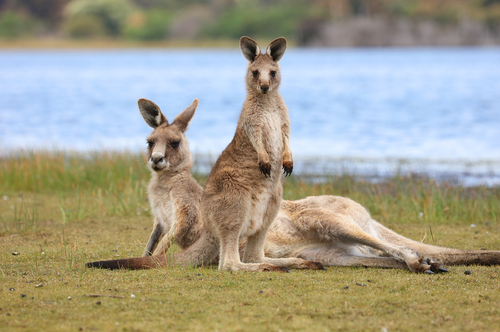
Eastern Grey Kangaroo

Eastern Grey Kangaroo

Macropus giganteus

(c) Shane Walker, some rights reserved (CC BY), uploaded by Shane Walker, CC BY 4.0, via iNaturalist

Side by side

Macleay's DorcopsisEastern Grey Kangaroo
Scientific nameDorcopsulus macleayi (Miklouho-Maclay, 1885)Macropus giganteus Shaw, 1790
English nameMacleay's DorcopsisEastern Grey Kangaroo
GroupMammalsMammals
ClassMammalia MammalMammalia Mammal
OrderDiprotodontiaDiprotodontia
FamilyMacropodidae KangaroosMacropodidae Kangaroos
GenusDorcopsulus Lesser DorcopsisesMacropus Kangaroo
Named in18851790
Red List categoryLeast ConcernLeast Concern
Countries on record2 countries1 country
GBIF occurrence records49 records249,218 records

Rows where the two agree are shown in grey.

Where each is found

Both recorded in 1 country

Only Macleay's Dorcopsis (1)

From Catalogue of Life checklists and GBIF occurrence records. A country missing from a list means no record is held, which is not proof of absence.

Checked facts

Macleay's DorcopsisEastern Grey Kangaroo
Appearance
  • Dorcopsulus macleayi has dense fur ranging in colour from dark brown to black. English Wikipedia
  • Approximately two-thirds to three-quarters of the species' tail is covered with fur. English Wikipedia
  • The Eastern Grey Kangaroo has a light grey woolly coat, a darker face and a dark fur tip on its tail. australian.museum
  • Its hind legs are larger than its forelimbs, and its hind feet are large and powerful. australian.museum
  • Its long muscular tail provides balance during hopping and acts as a fifth limb during slow movement. australian.museum
  • The species has a powerful tail that exceeds one metre in length in adult males. English Wikipedia
Size
  • Adult males commonly weigh between 50 and 66 kilograms. English Wikipedia
  • Adult females commonly weigh between 17 and 40 kilograms. English Wikipedia
  • Male Eastern Grey Kangaroos can reach 1.3 metres in body length and one metre in tail length. australian.museum
  • Female Eastern Grey Kangaroos can reach one metre in body length and 0.84 metres in tail length. australian.museum
Habitat
  • The species inhabits open grasslands with nearby bushland that provides daytime shelter. English Wikipedia
  • Its habitats include coastal areas, woodlands, subtropical forests, mountain forests and inland scrublands. English Wikipedia
  • The species occupies habitats ranging from semi-arid mallee scrub to woodlands and forests. australian.museum
  • Eastern Grey Kangaroos favour denser scrub and forest habitats. australian.museum
  • The species occurs in woodlands at altitudes extending into subalpine areas. australian.museum
DietNo checked fact yet
Behaviour
  • Eastern Grey Kangaroos are primarily nocturnal and crepuscular. English Wikipedia
  • The species rests in tree or scrub shade during the day and moves into open areas to graze from late afternoon until early morning. australian.museum
  • Eastern Grey Kangaroos form social groups that average three individuals. English Wikipedia
  • The species also forms mobs containing ten or more individuals. australian.museum
  • Eastern Grey Kangaroos are not territorial. English Wikipedia
  • The species communicates through a series of clucking sounds. australian.museum
  • Aggressive males and alarmed individuals of either sex produce a guttural cough. australian.museum
ReproductionNo checked fact yet
  • Eastern Grey Kangaroos have a polygynous mating system in which one male mates with multiple females. English Wikipedia
  • Breeding occurs throughout the year, with reproductive activity peaking in summer. australian.museum
  • The gestation period is 36 days after mating. australian.museum
  • Newborn joeys weigh less than one gram. australian.museum
  • Newborn joeys independently climb into their mother's pouch after birth. australian.museum
  • Joeys begin leaving the pouch at approximately nine months of age. australian.museum
  • Young Eastern Grey Kangaroos become independent at approximately 18 months of age. australian.museum
  • Females can suspend embryonic development until an existing joey leaves the pouch. English Wikipedia
  • Female Eastern Grey Kangaroos reach sexual maturity between 17 and 28 months. English Wikipedia
  • Male Eastern Grey Kangaroos reach sexual maturity at approximately 25 months. English Wikipedia
LifespanNo checked fact yet
Distribution
  • The species is endemic to the southeastern part of the island of New Guinea. English Wikipedia
  • The Eastern Grey Kangaroo occurs across the eastern third of Australia. English Wikipedia
  • The species occurs across most eastern Australian states, including Tasmania. australian.museum
Conservation
  • The International Union for Conservation of Nature currently classifies the species as Least Concern. English Wikipedia
  • The species' habitat is largely undisturbed and difficult to access. English Wikipedia
  • The species is described as common, with no particular threats identified. English Wikipedia
  • The Eastern Grey Kangaroo is classified as Least Concern by the IUCN conservation assessment reported by the Australian Museum. australian.museum
  • The species is protected by law in Australia. australian.museum
  • Commercial harvesting of the species for export is permitted only for licensed hunters. australian.museum
Uses
  • Indigenous peoples have hunted Eastern Grey Kangaroos for food and skins for thousands of years. australian.museum
  • Kangaroo meat has been considered as an alternative to beef. English Wikipedia
Similar species
  • Some taxonomic authorities consider Dorcopsulus macleayi to be conspecific with the small dorcopsis (Dorcopsulus vanheurni). English Wikipedia
  • Dorcopsulus macleayi differs from Dorcopsulus vanheurni in having a greater proportion of its tail covered with fur. English Wikipedia
No checked fact yet
Name origin
  • Nicholas Miklouho-Maclay named the species in honour of Australian naturalist William John Macleay. English Wikipedia
  • The scientific name Macropus giganteus is explained as meaning gigantic large-foot. English Wikipedia
Other
  • Nicholas Miklouho-Maclay first described the species. English Wikipedia
  • Dorcopsulus macleayi is the type species of the genus Dorcopsulus. English Wikipedia
  • Dorcopsulus macleayi was formerly considered a vulnerable species. English Wikipedia
  • ITIS recognizes Dorcopsulus macleayi (Miklouho-Maclay, 1885) as a valid taxon. itis.gov
  • George Shaw described the species in 1790. English Wikipedia
  • The species has an estimated Australian-wide population of 11.4 million individuals, based on a 2010 estimate. English Wikipedia

In brief

Macleay's Dorcopsis

Dorcopsulus macleayi inhabits primary and secondary tropical moist forests and subtropical or tropical dry forests in the southeastern part of the island of New Guinea. It has dense dark brown to black fur, and approximately two-thirds to three-quarters of its tail is covered with fur. Full profile

Eastern Grey Kangaroo

The Eastern Grey Kangaroo (Macropus giganteus Shaw, 1790) is a mammal in the family Macropodidae, order Diprotodontia and class Mammalia. It occurs across the eastern third of Australia, including Tasmania. It has a light grey woolly coat, powerful hind legs and a long muscular tail that assists with balance during hopping. Full profile

Compare something else

Page built on 26 November 2026 from the data on the two species pages, where every source is listed.

Cite this page

ScientificNames.org. (2026). Macleay's Dorcopsis vs Eastern Grey Kangaroo. Retrieved November 26, 2026, from https://scientificnames.org/compare/macleays-dorcopsis-vs-eastern-grey-kangaroo