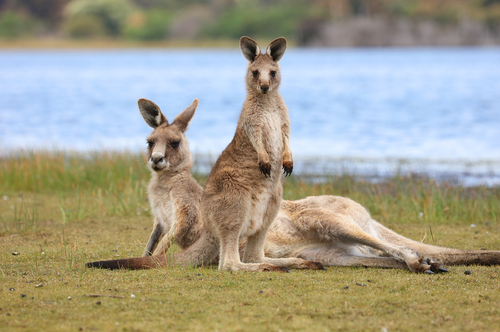
| Appearance | - The Eastern Grey Kangaroo has a light grey woolly coat, a darker face and a dark fur tip on its tail. australian.museum
- Its hind legs are larger than its forelimbs, and its hind feet are large and powerful. australian.museum
- Its long muscular tail provides balance during hopping and acts as a fifth limb during slow movement. australian.museum
- The species has a powerful tail that exceeds one metre in length in adult males. English Wikipedia
| |
|---|
| Size | - Adult males commonly weigh between 50 and 66 kilograms. English Wikipedia
- Adult females commonly weigh between 17 and 40 kilograms. English Wikipedia
- Male Eastern Grey Kangaroos can reach 1.3 metres in body length and one metre in tail length. australian.museum
- Female Eastern Grey Kangaroos can reach one metre in body length and 0.84 metres in tail length. australian.museum
| No checked fact yet |
|---|
| Habitat | - The species inhabits open grasslands with nearby bushland that provides daytime shelter. English Wikipedia
- Its habitats include coastal areas, woodlands, subtropical forests, mountain forests and inland scrublands. English Wikipedia
- The species occupies habitats ranging from semi-arid mallee scrub to woodlands and forests. australian.museum
- Eastern Grey Kangaroos favour denser scrub and forest habitats. australian.museum
- The species occurs in woodlands at altitudes extending into subalpine areas. australian.museum
| - The tenkile inhabits subtropical or tropical dry forests. English Wikipedia
- The species inhabits mid-montane rainforests dominated by Podocarpus, Libocedrus, Araucaria and Rapanea. English Wikipedia
- Tenkiles occur at elevations of approximately 900–1,700 metres above sea level. English Wikipedia
- The species occupies approximately 50 square kilometres of rainforest. animaldiversity.org
- The rainforest habitat described for the species is located at elevations of 900–1,500 metres. animaldiversity.org
|
|---|
| Diet | | |
|---|
| Behaviour | - Eastern Grey Kangaroos are primarily nocturnal and crepuscular. English Wikipedia
- The species rests in tree or scrub shade during the day and moves into open areas to graze from late afternoon until early morning. australian.museum
- Eastern Grey Kangaroos form social groups that average three individuals. English Wikipedia
- The species also forms mobs containing ten or more individuals. australian.museum
- Eastern Grey Kangaroos are not territorial. English Wikipedia
- The species communicates through a series of clucking sounds. australian.museum
- Aggressive males and alarmed individuals of either sex produce a guttural cough. australian.museum
| - Tenkiles can both hop and walk bipedally. English Wikipedia
- Tenkiles can raise their arms above their heads. English Wikipedia
- The species is diurnal and mainly terrestrial, although it climbs to escape predators and danger. animaldiversity.org
- Tenkiles forage for food both in trees and on the ground. English Wikipedia
- Wild tenkiles are now more commonly observed individually than in groups. English Wikipedia
- Female tenkiles may maintain territories covering a few acres, while males maintain larger territories. animaldiversity.org
- Tenkiles are not known to be hostile toward humans and generally avoid human activity while in trees. English Wikipedia
|
|---|
| Reproduction | - Eastern Grey Kangaroos have a polygynous mating system in which one male mates with multiple females. English Wikipedia
- Breeding occurs throughout the year, with reproductive activity peaking in summer. australian.museum
- The gestation period is 36 days after mating. australian.museum
- Newborn joeys weigh less than one gram. australian.museum
- Newborn joeys independently climb into their mother's pouch after birth. australian.museum
- Joeys begin leaving the pouch at approximately nine months of age. australian.museum
- Young Eastern Grey Kangaroos become independent at approximately 18 months of age. australian.museum
- Females can suspend embryonic development until an existing joey leaves the pouch. English Wikipedia
- Female Eastern Grey Kangaroos reach sexual maturity between 17 and 28 months. English Wikipedia
- Male Eastern Grey Kangaroos reach sexual maturity at approximately 25 months. English Wikipedia
| - Tenkiles are believed to reproduce throughout the year. English Wikipedia
- Females are believed to produce one offspring approximately every 12 months. animaldiversity.org
- Female tenkiles carry their offspring in a pouch until the young are approximately 10–12 months old. animaldiversity.org
- Young tenkiles remain with their mothers for approximately two years before becoming independent. English Wikipedia
- Female tenkiles nurse their offspring for more than one year. animaldiversity.org
- The species is gonochoristic, with separate male and female individuals. animaldiversity.org
|
|---|
| Lifespan | | No checked fact yet |
|---|
| Distribution | - The Eastern Grey Kangaroo occurs across the eastern third of Australia. English Wikipedia
- The species occurs across most eastern Australian states, including Tasmania. australian.museum
| - The tenkile is endemic to the Torricelli Mountains of Papua New Guinea. English Wikipedia
- The species is restricted to the Torricelli Range, eastern Bewani Range and Menawa Range in Papua New Guinea. English Wikipedia
|
|---|
| Conservation | - The Eastern Grey Kangaroo is classified as Least Concern by the IUCN conservation assessment reported by the Australian Museum. australian.museum
- The species is protected by law in Australia. australian.museum
- Commercial harvesting of the species for export is permitted only for licensed hunters. australian.museum
| - The tenkile is classified as critically endangered by the International Union for Conservation of Nature. English Wikipedia
- The species has experienced an estimated population decline of 80% over ten years. English Wikipedia
- The Torricelli Mountains subpopulation is believed to contain fewer than 250 individuals. English Wikipedia
- The estimated wild population of tenkiles is fewer than 200 individuals. animaldiversity.org
- Hunting and habitat loss are the principal reported causes of population decline. animaldiversity.org
- The Tenkile Conservation Alliance was established to protect the species and its habitat. English Wikipedia
|
|---|
| Uses | - Indigenous peoples have hunted Eastern Grey Kangaroos for food and skins for thousands of years. australian.museum
- Kangaroo meat has been considered as an alternative to beef. English Wikipedia
| |
|---|
| Similar species | No checked fact yet | |
|---|
| Name origin | - The scientific name Macropus giganteus is explained as meaning gigantic large-foot. English Wikipedia
| No checked fact yet |
|---|
| Other | - George Shaw described the species in 1790. English Wikipedia
- The species has an estimated Australian-wide population of 11.4 million individuals, based on a 2010 estimate. English Wikipedia
| No checked fact yet |
|---|