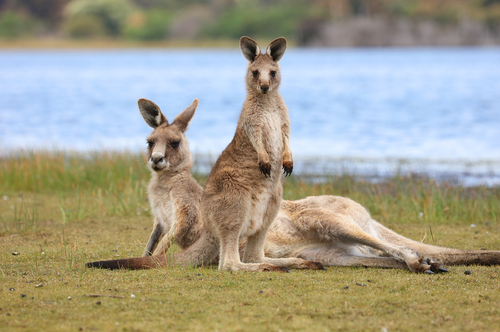
| Appearance | - The Eastern Grey Kangaroo has a light grey woolly coat, a darker face and a dark fur tip on its tail. australian.museum
- Its hind legs are larger than its forelimbs, and its hind feet are large and powerful. australian.museum
- Its long muscular tail provides balance during hopping and acts as a fifth limb during slow movement. australian.museum
- The species has a powerful tail that exceeds one metre in length in adult males. English Wikipedia
| - Adult males have short red-brown fur that fades to pale buff underneath and on the limbs. English Wikipedia
- Females are generally blue-grey with a brown tinge and pale grey undersides, although females in arid areas resemble males in colour. English Wikipedia
- The species has two small-clawed forelimbs, two muscular hindlimbs, and a strong tail. English Wikipedia
|
|---|
| Size | - Adult males commonly weigh between 50 and 66 kilograms. English Wikipedia
- Adult females commonly weigh between 17 and 40 kilograms. English Wikipedia
- Male Eastern Grey Kangaroos can reach 1.3 metres in body length and one metre in tail length. australian.museum
- Female Eastern Grey Kangaroos can reach one metre in body length and 0.84 metres in tail length. australian.museum
| |
|---|
| Habitat | - The species inhabits open grasslands with nearby bushland that provides daytime shelter. English Wikipedia
- Its habitats include coastal areas, woodlands, subtropical forests, mountain forests and inland scrublands. English Wikipedia
- The species occupies habitats ranging from semi-arid mallee scrub to woodlands and forests. australian.museum
- Eastern Grey Kangaroos favour denser scrub and forest habitats. australian.museum
- The species occurs in woodlands at altitudes extending into subalpine areas. australian.museum
| - The species inhabits scrubland, grassland, and desert environments. English Wikipedia
- Red kangaroos typically occupy open habitats containing some trees that provide shade. English Wikipedia
- The species inhabits grassland, shrubland, desert, woodland, and open forest. australian.museum
- Red kangaroos are most common in open savanna woodland. australian.museum
|
|---|
| Diet | | - Red kangaroos primarily consume green vegetation, especially fresh grasses, forbs, and other dicotyledonous flowering plants. English Wikipedia
- In one Central Australian study, green grass constituted 75–95% of the diet, with Eragrostis setifolia accounting for 54%. English Wikipedia
- Enneapogon avenaceus accounted for as much as 21–69% of the diet in a study in western New South Wales. English Wikipedia
- When preferred foods are scarce, red kangaroos also consume chenopods such as Bassia diacantha and Maireana pyramidata. English Wikipedia
- Red kangaroos also browse shrubs when their preferred foods are scarce. English Wikipedia
- The species is herbivorous and primarily grazes on grasses, while also consuming forbs and shrub leaves. australian.museum
|
|---|
| Behaviour | - Eastern Grey Kangaroos are primarily nocturnal and crepuscular. English Wikipedia
- The species rests in tree or scrub shade during the day and moves into open areas to graze from late afternoon until early morning. australian.museum
- Eastern Grey Kangaroos form social groups that average three individuals. English Wikipedia
- The species also forms mobs containing ten or more individuals. australian.museum
- Eastern Grey Kangaroos are not territorial. English Wikipedia
- The species communicates through a series of clucking sounds. australian.museum
- Aggressive males and alarmed individuals of either sex produce a guttural cough. australian.museum
| - Red kangaroos are primarily active around dawn, dusk, and at night, resting in shade during the day. English Wikipedia
- Red kangaroos sometimes move around during daylight hours. English Wikipedia
- Red kangaroos can congregate in groups containing up to 1,500 individuals where forage is abundant. English Wikipedia
- Red kangaroos generally live in groups of two to four individuals. English Wikipedia
- Most red kangaroo groups consist of females and their young. English Wikipedia
- Red kangaroos are mostly sedentary and remain within relatively well-defined home ranges. English Wikipedia
- Red kangaroos can travel 25–30 kilometres to find better feeding grounds when forage is poor and rainfall is patchy. English Wikipedia
- Red kangaroos can reach locomotion speeds of approximately 60 kilometres per hour. English Wikipedia
- Male red kangaroos can cover distances of eight to nine metres in a single leap. English Wikipedia
- Red kangaroos often escape terrestrial predators by swimming into waterways. English Wikipedia
|
|---|
| Reproduction | - Eastern Grey Kangaroos have a polygynous mating system in which one male mates with multiple females. English Wikipedia
- Breeding occurs throughout the year, with reproductive activity peaking in summer. australian.museum
- The gestation period is 36 days after mating. australian.museum
- Newborn joeys weigh less than one gram. australian.museum
- Newborn joeys independently climb into their mother's pouch after birth. australian.museum
- Joeys begin leaving the pouch at approximately nine months of age. australian.museum
- Young Eastern Grey Kangaroos become independent at approximately 18 months of age. australian.museum
- Females can suspend embryonic development until an existing joey leaves the pouch. English Wikipedia
- Female Eastern Grey Kangaroos reach sexual maturity between 17 and 28 months. English Wikipedia
- Male Eastern Grey Kangaroos reach sexual maturity at approximately 25 months. English Wikipedia
| - Red kangaroos can breed throughout the year. English Wikipedia
- Females can delay the development of a new embryo until their previous joey leaves the pouch, a process called embryonic diapause. English Wikipedia
- The gestation period lasts approximately 33 days. australian.museum
- Females usually give birth to one offspring at a time. English Wikipedia
- Newborn joeys are blind, hairless, and only a few centimetres long. English Wikipedia
- Young red kangaroos permanently leave their mother's pouch at approximately 235 days old. English Wikipedia
- Young red kangaroos continue suckling until approximately 12 months of age. australian.museum
- Female red kangaroos may simultaneously support three generations of offspring. English Wikipedia
|
|---|
| Lifespan | | No checked fact yet |
|---|
| Distribution | - The Eastern Grey Kangaroo occurs across the eastern third of Australia. English Wikipedia
- The species occurs across most eastern Australian states, including Tasmania. australian.museum
| - The species occurs throughout the semi-arid and arid regions of mainland Australia. australian.museum
|
|---|
| Conservation | - The Eastern Grey Kangaroo is classified as Least Concern by the IUCN conservation assessment reported by the Australian Museum. australian.museum
- The species is protected by law in Australia. australian.museum
- Commercial harvesting of the species for export is permitted only for licensed hunters. australian.museum
| - The red kangaroo is classified as least concern by Perth Zoo. perthzoo.wa.gov.au
- Competition with livestock and rabbits is identified as a threat to red kangaroos. English Wikipedia
|
|---|
| Uses | - Indigenous peoples have hunted Eastern Grey Kangaroos for food and skins for thousands of years. australian.museum
- Kangaroo meat has been considered as an alternative to beef. English Wikipedia
| - Red kangaroos are commercially harvested for their meat and hides under regulated management plans. English Wikipedia
- Red kangaroo meat is supplied for human consumption and pet food. English Wikipedia
- Red kangaroo skins are used to produce leather. English Wikipedia
|
|---|
| Name origin | - The scientific name Macropus giganteus is explained as meaning gigantic large-foot. English Wikipedia
| No checked fact yet |
|---|
| Other | - George Shaw described the species in 1790. English Wikipedia
- The species has an estimated Australian-wide population of 11.4 million individuals, based on a 2010 estimate. English Wikipedia
| - The red kangaroo is the largest living marsupial. australian.museum
- The initial scientific description of the species was published by A.G. Desmarest in 1822. English Wikipedia
- The species was accepted under the scientific name Osphranter rufus in the Atlas of Living Australia. bie.ala.org.au
|
|---|