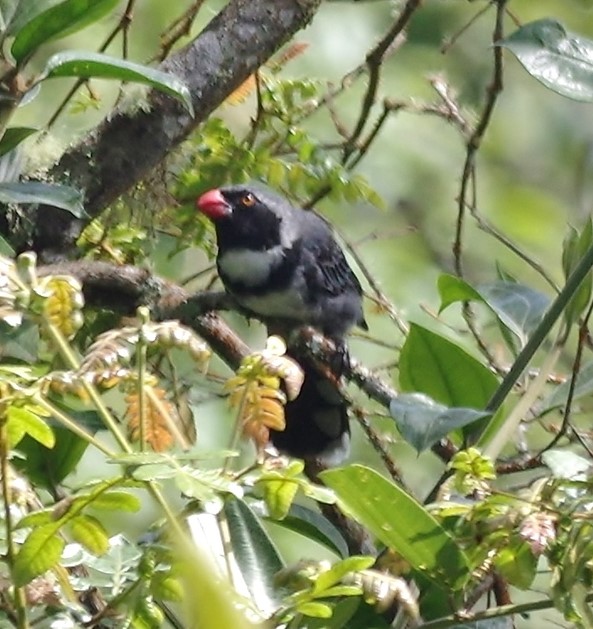
| Appearance | - Adult Masked Saltators from Ecuador and Peru have slate-gray crowns, napes, and upperparts. English Wikipedia
- Adults have black faces and throats bordered by a thin white line that widens below the black area. English Wikipedia
- Adults have a black breast band beneath a white band. English Wikipedia
- The underparts are mostly white, with gray flanks and broad black barring on the vent. English Wikipedia
- The wings are black with broad dark-gray edges on the coverts and flight feathers. English Wikipedia
- The tail is black, with small white tips on its inner two feather pairs and broad white tips on its other four pairs. English Wikipedia
- Adults have orange or golden irises with red inner rings. English Wikipedia
- The bill is mostly red on the upper mandible and black and red on the lower mandible. English Wikipedia
- Juveniles are duller than adults and have smaller black masks and pale-yellow bills. English Wikipedia
- The Colombian population has a minimal pale streak behind the face and a creamy-white belly. English Wikipedia
- The Colombian population has a red eye and an entirely red bill. English Wikipedia
- The sexes have the same plumage. English Wikipedia
| - Adult males and females have the same plumage. English Wikipedia
- Adults of the nominate subspecies have a mostly gray head, a greenish-gray crown, and a short white supercilium. English Wikipedia
- The nominate subspecies has olive-green upperparts, wings, and tail. English Wikipedia
- The nominate subspecies has a white chin and upper throat and a buff-colored lower throat bordered by black lines. English Wikipedia
- The nominate subspecies has gray breast, belly, and flanks, with a buff-colored lower belly and undertail coverts. English Wikipedia
- All subspecies have brown irises, thick blackish or black bills, and blackish or grayish-brown legs and feet. English Wikipedia
- The gigantodes subspecies has a grayish crown, a smaller buff throat patch, and wider black markings on the sides of the throat. English Wikipedia
- The magnoides subspecies has a sooty blackish forecrown and crown, a dusky grayish nape, and bright yellowish olive-green upperparts. English Wikipedia
- The magnoides subspecies has a black band around the sides and bottom of its throat. English Wikipedia
- The intermedius subspecies has a black throat band and a buff tinge on its underparts. English Wikipedia
- The iungens subspecies has an appearance similar to that of the nominate subspecies. English Wikipedia
|
|---|
| Size | | |
|---|
| Habitat | - The Colombian population primarily inhabits Podocarpus forest. English Wikipedia
- In Ecuador and Peru, the species inhabits humid montane forest in subtropical and lower temperate zones. English Wikipedia
- The Colombian population inhabits elevations between 2,000 and 3,000 m. English Wikipedia
- In Ecuador, the species occurs at elevations between 2,000 and 2,700 m. English Wikipedia
- In Peru, the species occurs at elevations between 1,700 and 3,000 m. English Wikipedia
| - The species primarily inhabits the edges of lowland and foothill evergreen forests in tropical and subtropical regions. English Wikipedia
- The species also occurs in the canopy of forest interiors. English Wikipedia
- The species commonly inhabits secondary forests, shady plantations, and brushy pastures and gardens near forests. English Wikipedia
- In northern Central America, the species occurs from sea level to elevations of 1,900 m. English Wikipedia
- In Costa Rica and Colombia, the species occurs up to approximately 1,800 m elevation. English Wikipedia
- In Ecuador, the species occurs mostly below 900 m elevation. English Wikipedia
- In Peru, the species occurs up to approximately 1,750 m elevation. English Wikipedia
- In Brazil, the species occurs up to approximately 1,200 m elevation. English Wikipedia
|
|---|
| Diet | | - The species primarily consumes plant material, including fruit, flowers, and nectar, but also eats insects. English Wikipedia
- In Chiapas, Mexico, the species has been observed eating fruits of Cymbopetalum mayanum. English Wikipedia
- In Chiapas, Mexico, the species has been observed eating fruits of Trophis racemosa. English Wikipedia
- In Chiapas, Mexico, the species has been observed eating gumbo-limbo fruits. English Wikipedia
|
|---|
| Behaviour | - The species is generally resident throughout the year but appears to be somewhat nomadic. English Wikipedia
- Its apparent nomadism may be associated with variation in the abundance of fruiting trees. English Wikipedia
- Individual birds and pairs from both populations occasionally join mixed-species feeding flocks. English Wikipedia
| - The species typically forages along forest edges and moves only short distances into forests to feed. English Wikipedia
- The species is usually observed in pairs and frequently joins mixed-species feeding flocks. English Wikipedia
- The species is a year-round resident. English Wikipedia
|
|---|
| Reproduction | - The breeding season apparently includes April in Colombia. English Wikipedia
- The only documented egg was laid in captivity and was blue with dark-brown blotches. English Wikipedia
| |
|---|
| Distribution | - The species occurs in Colombia, Ecuador, and Peru. English Wikipedia
- One population occurs intermittently along both slopes of Colombia's Central Andes, from southern Antioquia to northern Valle del Cauca. English Wikipedia
- Another population occurs intermittently along the eastern Andean slope from Napo Province in north-central Ecuador south to Huánuco Department in Peru. English Wikipedia
| - The species occurs in Mexico, all Central American countries except El Salvador, and all mainland South American countries except Argentina, Chile, Paraguay, and Uruguay. English Wikipedia
|
|---|
| Conservation | - The species has been classified as Least Concern by the IUCN since 2020. English Wikipedia
- The estimated population is 30,000 mature individuals. English Wikipedia
- The species' population is believed to be decreasing. English Wikipedia
- Podocarpus and northern Andean montane forests face threats from agricultural and cattle-pasture conversion, mining, and logging. English Wikipedia
- The known Colombian localities are situated on the most deforested cordillera. English Wikipedia
- The species is considered uncommon in Colombia. English Wikipedia
- The species is considered rare and apparently local in Ecuador. English Wikipedia
- The species is considered rare and perhaps local in Peru. English Wikipedia
| |
|---|
| Similar species | - The disjunct Colombian population differs from other populations in plumage and bill color. English Wikipedia
| No checked fact yet |
|---|
| Other | | No checked fact yet |
|---|