Comparison

Malayan vs Xerces Blue

Malayan (Megisba malaya) and Xerces Blue (Glaucopsyche xerces) both belong to the tribe Polyommatini and part ways below it.

Malayan

Malayan

Megisba malaya

Pinakinkarve, CC BY-SA 3.0, via Wikimedia Commons

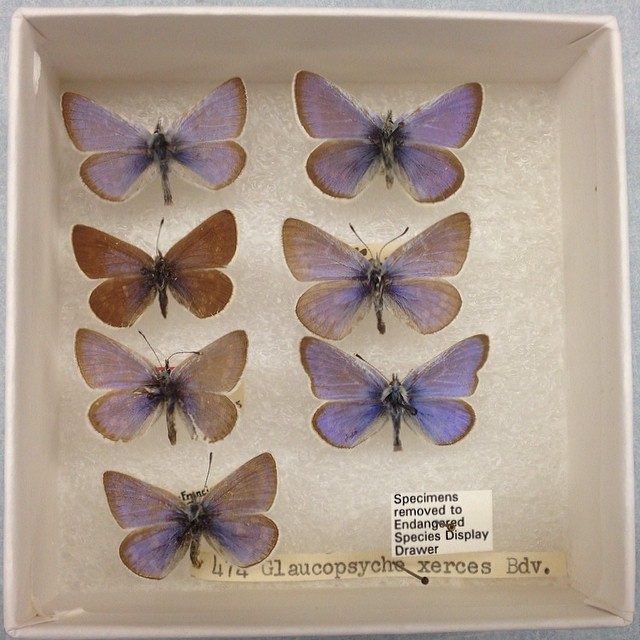
Xerces Blue

Xerces Blue

Glaucopsyche xerces

Brianwray26, CC BY-SA 4.0, via Wikimedia Commons

Side by side

MalayanXerces Blue
Scientific nameMegisba malaya (Horsfield, 1828)Glaucopsyche xerces (Boisduval, 1852)
English nameMalayanXerces Blue
GroupInsectsInsects
ClassInsecta InsectInsecta Insect
OrderLepidopteraLepidoptera
FamilyLycaenidae BluesLycaenidae Blues
GenusMegisbaGlaucopsyche
Named in18281852
Red List categoryNot recordedExtinct
Countries on record17 countries3 countries
GBIF occurrence records2,315 records886 records

Rows where the two agree are shown in grey.

Where each is found

Only Malayan (17)

Only Xerces Blue (3)

From Catalogue of Life checklists and GBIF occurrence records. A country missing from a list means no record is held, which is not proof of absence.

Checked facts

MalayanXerces Blue
Appearance
  • The female has broader and more rounded forewings than the male. English Wikipedia
  • The butterfly has dark brown antennae, head, thorax and abdomen, with narrowly white-ringed antennae. English Wikipedia
  • The underside of its palpi, thorax and abdomen is snow-white. English Wikipedia
  • The third slender joint of its palpi is conspicuously brown. English Wikipedia
  • The dry-season form has a large oval, obliquely positioned conical patch on the upperside of its forewing. English Wikipedia
  • In some dry-season specimens, the white forewing patch continues onto the hindwing. English Wikipedia
  • Males have iridescent blue coloration on the upper surfaces of their wings and pale spots on the undersides. floridamuseum.ufl.edu
  • The species exhibited extensive variation in wing patterns, with several named forms. floridamuseum.ufl.edu
  • The species was characterized by blue wings with white spots. English Wikipedia
Size
Habitat
  • The species inhabited coastal sand dunes on the San Francisco Peninsula in California. English Wikipedia
  • The species preferred stabilized sandy sites where its low-growing larval host plant grew. floridamuseum.ufl.edu
  • The species occupied coastal sand dunes in the upper San Francisco Peninsula, including areas now within the Golden Gate National Recreation Area. floridamuseum.ufl.edu
Diet
  • The caterpillar feeds on Allophyllus cobbe, a plant in the family Sapindaceae. English Wikipedia
  • The caterpillars used Lotus scoparius (Deerweed) as their preferred larval host plant. pmc.ncbi.nlm.nih.gov
  • The butterflies fed on plants belonging to the genera Lotus and Lupinus. English Wikipedia
  • Lupinus was another recorded vegetative food source, but it was unsuitable for the larval stages. English Wikipedia
Behaviour
  • The species had a major flight period documented in historical biological studies. pmc.ncbi.nlm.nih.gov
Reproduction
Distribution
  • The species occurs in Sri Lanka, southern India, Bengal, Kumaon, Assam, Nepal and Myanmar. English Wikipedia
  • The species is also found in the Andaman and Nicobar Islands. English Wikipedia
  • The species was endemic to the coastal sand dunes of the upper San Francisco Peninsula in California. floridamuseum.ufl.edu
Conservation
  • The Xerces blue is extinct, with its extinction associated with habitat loss caused by urban development. English Wikipedia
  • The last known living individuals were observed in the early 1940s. pmc.ncbi.nlm.nih.gov
  • Urban development and disturbance of sandy soils caused the local loss of important host plants, contributing to the species' extinction. pmc.ncbi.nlm.nih.gov
  • The loss of Lotus plants used by the larvae is considered a contributing factor in the species' extinction. English Wikipedia
  • The introduction of the Argentine ant coincided with the species' decline and has been proposed as a possible contributing factor. pmc.ncbi.nlm.nih.gov
  • The invasive Argentine ant was proposed as a possible threat because it may have outcompeted native ants that tend and protect the caterpillars. pmc.ncbi.nlm.nih.gov
  • The species' extinction inspired the establishment of the Xerces Society for Invertebrate Conservation in 1971. floridamuseum.ufl.edu
  • The species is recognized as an important symbol of insect conservation in North America. pmc.ncbi.nlm.nih.gov
Similar species
  • The Malayan resembles the Quaker butterfly, Neopithecops zalmora, particularly during flight. English Wikipedia
  • The closest relatives of the Xerces blue are Glaucopsyche australis and Glaucopsyche pseudoxerces. English Wikipedia
  • The Xerces blue's closest relative group is most closely related to Glaucopsyche lygdamus, commonly called the silvery blue. English Wikipedia
  • Historical researchers considered the Xerces blue and Glaucopsyche lygdamus closely related but separate species. pmc.ncbi.nlm.nih.gov
Other
  • Genetic analyses of museum specimens confirmed that the Xerces blue was a distinct species. pmc.ncbi.nlm.nih.gov
  • DNA analysis was conducted using a museum specimen collected in 1928. pmc.ncbi.nlm.nih.gov
  • The DNA analysis recovered 210,182,214 nucleotides from the museum specimen. pmc.ncbi.nlm.nih.gov
  • Preserved specimens of the species are held by the California Academy of Sciences, Bohart Museum, and Harvard Museum of Natural History. English Wikipedia
  • The Florida Museum of Natural History's McGuire Center holds specimens of the species. floridamuseum.ufl.edu

In brief

Malayan

The Malayan is a butterfly in the family Lycaenidae. It occurs in Sri Lanka, southern India, Bengal, Kumaon, Assam, Nepal, Myanmar and the Andaman and Nicobar Islands. The dry-season form has a large oval, obliquely positioned conical patch on the upperside of its forewing. Full profile

Xerces Blue

Glaucopsyche xerces inhabited coastal sand dunes on the upper San Francisco Peninsula in California. It was a small butterfly characterized by blue wings with white spots. Full profile

Compare something else

Page built on 29 November 2026 from the data on the two species pages, where every source is listed.

Cite this page

ScientificNames.org. (2026). Malayan vs Xerces Blue. Retrieved November 29, 2026, from https://scientificnames.org/compare/malayan-vs-xerces-blue