Comparison

Perrin's Beaked Whale vs Spade-toothed Whale

Perrin's Beaked Whale (Mesoplodon perrini) and Spade-toothed Whale (Mesoplodon traversii) both belong to the genus Mesoplodon (beaked whales) and part ways below it.
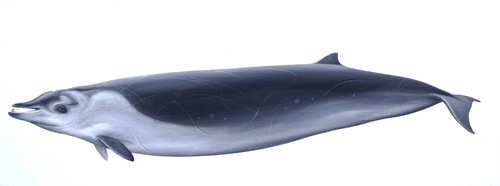
Perrin's Beaked Whale

Perrin's Beaked Whale

Mesoplodon perrini

(c) Jörg Mazur, some rights reserved (CC BY-SA), CC BY-SA 4.0, via iNaturalist

Spade-toothed Whale

Spade-toothed Whale

Mesoplodon traversii

New Zealand Department of Conservation, CC BY 4.0, via Wikimedia Commons

Side by side

Perrin's Beaked WhaleSpade-toothed Whale
Scientific nameMesoplodon perrini Dalebout, Mead, Baker, Baker & van Helden, 2002Mesoplodon traversii (Gray, 1874)
English namePerrin's Beaked WhaleSpade-toothed Whale
GroupMammalsMammals
ClassMammalia MammalMammalia Mammal
OrderCetacea CetaceanCetacea Cetacean
FamilyHyperoodontidae Beaked WhalesHyperoodontidae Beaked Whales
GenusMesoplodon Beaked WhalesMesoplodon Beaked Whales
Named in20021874
Red List categoryEndangeredData Deficient
Environmentmarinemarine
Countries on record1 country2 countries
GBIF occurrence records26 records15 records

Rows where the two agree are shown in grey.

Where each is found

Only Perrin's Beaked Whale (1)

Only Spade-toothed Whale (2)

From Catalogue of Life checklists and GBIF occurrence records. A country missing from a list means no record is held, which is not proof of absence.

Checked facts

Perrin's Beaked WhaleSpade-toothed Whale
Appearance
  • The species has a relatively small head, a long thorax and abdomen, a deep caudal peduncle, and a short tail. English Wikipedia
  • The species has a broad, crescent-shaped blowhole whose tips point forward. English Wikipedia
  • Its mouthline is straight, and grooves are present along its throat. animaldiversity.org
  • Its rostrum is relatively short compared with those of most other species in its genus. English Wikipedia
  • Adult males possess tusk-like teeth originating from the lower jaw, whereas females lack these tusks. animaldiversity.org
  • The teeth are positioned near the tip of the lower jaw. English Wikipedia
  • The adult male has a dark gray facial mask extending from the mouth corner across the eye and rostrum. English Wikipedia
  • The species has a relatively wide rostrum compared with other mesoplodonts. English Wikipedia
  • Its overall shape may resemble an oversized ginkgo-toothed beaked whale. English Wikipedia
  • Its teeth measure approximately 23 centimetres in length. English Wikipedia
  • Its teeth are considerably wider than those of the strap-toothed whale. English Wikipedia
  • The tooth-tip denticle is more pronounced than the corresponding feature in the strap-toothed whale. English Wikipedia
  • The protruding portion of its tooth resembles the tip of a flensing spade. English Wikipedia
  • The adult female examined in 2010 had a spindle-shaped body. English Wikipedia
  • The adult female had a triangular dorsal fin with a concave trailing edge. English Wikipedia
  • The adult female's dorsal fin was positioned approximately two-thirds of the way along her body. English Wikipedia
  • The adult female was dark gray or black on her dorsal surface and white on her ventral surface. English Wikipedia
  • The adult female had a light thoracic patch formed by a diagonal band extending from behind the eye toward the dorsal fin. English Wikipedia
  • The adult female had dark eye patches, a dark rostrum and dark flippers. English Wikipedia
Habitat
  • The species primarily inhabits deep oceanic waters exceeding 1,000 meters in depth. animaldiversity.org
  • Passive acoustic detections attributed to the species occurred at southern California sites between 1,100 and 1,300 meters deep. English Wikipedia
Diet
  • The species feeds primarily on pelagic squid, including Octopoteuthis deletron. English Wikipedia
  • Stomach contents have included unidentified vertebrate remains. English Wikipedia
  • The species is suspected of consuming fish and octopuses in addition to squid. English Wikipedia
  • The species captures prey through deep-diving suction feeding. English Wikipedia
  • The species is presumed to feed on cephalopods and small fish. English Wikipedia
  • Squid beaks and lenses were found in the stomach contents of the specimen examined in 2024. English Wikipedia
Behaviour
  • The species is rarely observed alive by scientists. English Wikipedia
  • The species uses echolocation to locate prey. English Wikipedia
  • The species is thought to produce a species-specific frequency-modulated echolocation pulse designated BW43. English Wikipedia
  • The species has never been observed alive. English Wikipedia
  • The species is presumed to live alone or in small groups. English Wikipedia
  • Males are believed to develop a protruding tooth-tip denticle. English Wikipedia
  • The tooth-tip denticle is believed to become smoother over time through aggressive interactions with other males. English Wikipedia
Reproduction
  • Both adult type specimens were sexually mature at approximately nine years of age. animaldiversity.org
  • The smallest documented juvenile specimen was still suckling when it died. English Wikipedia
  • The largest documented calf appeared to be independent of its mother at 2.45 meters long. English Wikipedia
  • The documented calves were estimated to be approximately one year old. English Wikipedia
  • The available specimen dates suggest that young begin feeding independently during summer. English Wikipedia
  • The species is believed to have a gestation period of approximately one year. English Wikipedia
  • Young are believed to become independent of their mothers at approximately one year of age. English Wikipedia
  • The estimated probability of young surviving beyond their first year is approximately 73%. English Wikipedia
Distribution
  • The species has been recorded in North Pacific waters off central and southern California. English Wikipedia
  • The species is currently known only from the northern Pacific Ocean. animaldiversity.org
  • All seven confirmed specimens recorded between 1872 and 2024 were found in the South Pacific. English Wikipedia
  • The species is assumed to have a remaining population restricted to the Southern Hemisphere. English Wikipedia
  • The species may be restricted to the South Pacific. English Wikipedia
Conservation
  • Bycatch in fishing gear is considered a likely major threat to the species. English Wikipedia
  • Deepwater gill nets used to catch large pelagic fish may entangle this species. English Wikipedia
  • Naval sonar and seismic activity are identified as threats to the species. English Wikipedia
  • Plastic is considered a threat because it has been found in the stomach contents of stranded individuals. English Wikipedia
  • The population status of the species is entirely unknown. English Wikipedia
  • The species is classified as Data Deficient on the IUCN Red List. English Wikipedia
  • The species is covered by the Pacific Islands regional cetacean conservation memorandum of understanding. English Wikipedia
Similar species
  • Perrin's beaked whale closely resembles Hector's beaked whale in external morphology. English Wikipedia
  • Mesoplodon peruvianus is identified as the true sister species of Perrin's beaked whale based on molecular evidence. animaldiversity.org
  • The spade-toothed whale and strap-toothed whale appear to be only distantly related despite their similar dentition. English Wikipedia
  • The skull of the spade-toothed whale resembles that of the ginkgo-toothed beaked whale, although their sizes differ. English Wikipedia
Name originNo checked fact yet
  • The common name refers to the resemblance between the protruding tooth and the tip of a whaling flensing spade. English Wikipedia
Other
  • The species was formally described in 2002 by Dalebout and colleagues. English Wikipedia

In brief

Perrin's Beaked Whale

Perrin's Beaked Whale (Mesoplodon perrini) is a mammal in the family Hyperoodontidae and order Cetacea, formally described in 2002. It is currently known only from the northern Pacific Ocean, with records from waters off central and southern California. It is distinguished by its relatively short rostrum and the tusk-like teeth of adult males, which are absent in females. Full profile

Spade-toothed Whale

The species is presumed to inhabit deep-water environments and may be restricted to the South Pacific. It is distinguished by its relatively wide rostrum and teeth approximately 23 centimetres long, whose protruding tips resemble a flensing spade. Full profile

Compare something else

Page built on 28 November 2026 from the data on the two species pages, where every source is listed.

Cite this page

ScientificNames.org. (2026). Perrin's Beaked Whale vs Spade-toothed Whale. Retrieved November 28, 2026, from https://scientificnames.org/compare/perrins-beaked-whale-vs-spade-toothed-whale