Comparison

Mexican Sootywing vs Silver-spotted Skipper

Mexican Sootywing (Pholisora mejicanus) and Silver-spotted Skipper (Epargyreus clarus) both belong to the subfamily Pyrginae and part ways below it. Both are recorded in 3 countries.

Mexican Sootywing

Mexican Sootywing

Pholisora mejicanus

José Belem Hernández Díaz, CC BY 4.0, via Wikimedia Commons

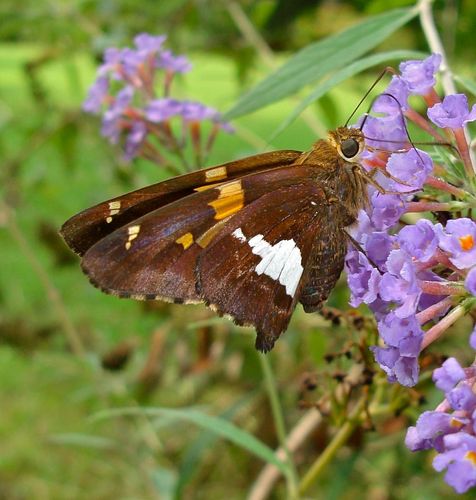
Silver-spotted Skipper

Silver-spotted Skipper

Epargyreus clarus

no rights reserved, uploaded by Elin Pierce, CC0, via iNaturalist

Side by side

Mexican SootywingSilver-spotted Skipper
Scientific namePholisora mejicanus (Reakirt, 1866)Epargyreus clarus (Cramer, 1775)
English nameMexican SootywingSilver-spotted Skipper
GroupInsectsInsects
ClassInsecta InsectInsecta Insect
OrderLepidopteraLepidoptera
FamilyHesperiidae SkipperHesperiidae Skipper
GenusPholisora SootywingsEpargyreus Silverdrops
Named in18661775
Countries on record3 countries3 countries
GBIF occurrence records577 records100,908 records

Rows where the two agree are shown in grey.

Where each is found

Both recorded in 3 countries

From Catalogue of Life checklists and GBIF occurrence records. A country missing from a list means no record is held, which is not proof of absence.

Checked facts

Mexican SootywingSilver-spotted Skipper
Appearance
  • The species has a relatively broad head with widely separated eyes and antennae. English Wikipedia
  • Its antennae have distinctly hooked or recurved tips. English Wikipedia
  • The upper surface of its wings is black with white dots arranged in a characteristic pattern. English Wikipedia
  • The underside of its hindwings is blue-gray with contrasting black veins. English Wikipedia
  • The blue-gray underside of the hindwing and its black veins are useful for distinguishing this species from other Pholisora species. English Wikipedia
SizeNo checked fact yet
Habitat
  • The species inhabits fields, gardens, and forest edges. English Wikipedia
  • The species prefers open habitats containing nectar plants, including swamps, brushy areas, and riparian habitats at lower elevations. English Wikipedia
  • In the western part of its range, the species occurs primarily in mountainous locations. animaldiversity.org
DietNo checked fact yet
  • Larvae consume leaves of plants belonging to the pea family, Fabaceae. English Wikipedia
  • Recorded larval host plants include false indigobush, American hogpeanut, groundnut, and American wisteria. English Wikipedia
  • Larvae have also been recorded feeding on kudzu, black locust, and Chinese wisteria. animaldiversity.org
  • Adults feed on nectar from various flowers, as well as mud and animal feces. English Wikipedia
  • Adults favor blue, red, pink, and purple flowers and rarely visit yellow flowers. English Wikipedia
  • Recorded adult food plants include everlasting pea, common milkweed, red clover, buttonbush, blazing star, and thistles. English Wikipedia
Behaviour
  • Larvae construct leaf shelters using silk and may connect multiple leaves to form larger shelters. animaldiversity.org
  • Larvae generally leave their shelters only to feed or construct larger shelters. animaldiversity.org
  • Larvae can eject their waste as a defensive behaviour to reduce the attraction of parasitic wasps. animaldiversity.org
  • Threatened larvae regurgitate a greenish defensive chemical. English Wikipedia
Reproduction
  • Mexican Sootywings and Common Sootywings rarely occur together in New Mexico and do not interbreed when they encounter one another. English Wikipedia
  • The larvae of Mexican Sootywings and Common Sootywings can occur on the same plant. English Wikipedia
  • Females generally deposit one egg on or occasionally near a host plant. English Wikipedia
  • Females have been recorded laying eggs on least snoutbean. English Wikipedia
  • Each copulation results in a female receiving a spermatophore from the male. English Wikipedia
  • After mating, females appear to reject additional males for at least some time. English Wikipedia
  • The species produces one generation annually in northern and western regions, two in eastern regions, and three to four in the Deep South. English Wikipedia
  • The last generation of the year overwinters in the pupal stage. animaldiversity.org
Distribution
  • The species occurs in the southwestern United States and extends south through most of Mexico. English Wikipedia
  • In the United States, the species is apparently restricted to the eastern foothills of the Rocky Mountains, from southern Colorado southward. English Wikipedia
  • In Mexico, the species occurs in the highlands south of the southern border of western Texas, extending to Oaxaca. English Wikipedia
  • The species ranges from southern Canada through most of the United States to northern Mexico, excluding the Great Basin and western Texas. English Wikipedia
  • The species occurs throughout the United States and in southern Canada. animaldiversity.org
UsesNo checked fact yet
Similar species
  • The Common Sootywing (Pholisora catullus) has a similar appearance and shares much of the Mexican Sootywing's geographic range. English Wikipedia
Other
  • Genetic studies indicate that Mexican Sootywings and Common Sootywings have remained evolutionarily independent species for a long time. English Wikipedia
No checked fact yet

In brief

Mexican Sootywing

Pholisora mejicanus occurs in the southwestern United States and extends south through most of Mexico. Full profile

Silver-spotted Skipper

Epargyreus clarus inhabits fields, gardens, forest edges, swamps, brushy areas, and riparian habitats at lower elevations. Full profile

Compare something else

Page built on 28 November 2026 from the data on the two species pages, where every source is listed.

Cite this page

ScientificNames.org. (2026). Mexican Sootywing vs Silver-spotted Skipper. Retrieved November 28, 2026, from https://scientificnames.org/compare/mexican-sootywing-vs-silver-spotted-skipper