Comparison

Dark Kangaroo Mouse vs Ord's Kangaroo Rat

Dark Kangaroo Mouse (Microdipodops megacephalus) and Ord's Kangaroo Rat (Dipodomys ordii) both belong to the subfamily Dipodomyinae (kangaroo mice) and part ways below it. Both are recorded in 1 country.

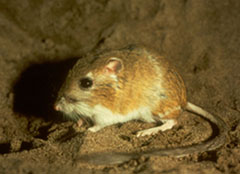
Dark Kangaroo Mouse

Dark Kangaroo Mouse

Microdipodops megacephalus

Renee Regan, CC0, via Wikimedia Commons

Ord's Kangaroo Rat

Ord's Kangaroo Rat

Dipodomys ordii

NPS, Public domain, via Wikimedia Commons

Side by side

Dark Kangaroo MouseOrd's Kangaroo Rat
Scientific nameMicrodipodops megacephalus Merriam, 1891Dipodomys ordii Woodhouse, 1853
English nameDark Kangaroo MouseOrd's Kangaroo Rat
GroupMammalsMammals
ClassMammalia MammalMammalia Mammal
OrderRodentia RodentRodentia Rodent
FamilyHeteromyidae Pocket MiceHeteromyidae Pocket Mice
GenusMicrodipodops Kangaroo MiceDipodomys Kangaroo Rat
Named in18911853
Red List categoryLeast ConcernLeast Concern
Countries on record1 country3 countries
GBIF occurrence records3,672 records37,498 records

Rows where the two agree are shown in grey.

Where each is found

Both recorded in 1 country

Only Ord's Kangaroo Rat (2)

From Catalogue of Life checklists and GBIF occurrence records. A country missing from a list means no record is held, which is not proof of absence.

Checked facts

Dark Kangaroo MouseOrd's Kangaroo Rat
Appearance
  • The species has a dark brown to greyish-black back and greyish or whitish underparts. English Wikipedia
  • The species has a relatively large head, large ears, prominent eyes, a long snout, and long whiskers. English Wikipedia
  • Its coat is long, silky, and soft. English Wikipedia
  • Its tail has a swollen middle containing fat deposits. English Wikipedia
  • The tail's fat deposits increase before winter dormancy and decrease in spring. English Wikipedia
  • The species shows little sexual variation in external characteristics apart from zygomatic breadth. English Wikipedia
  • The species has conspicuous white markings on its feet, upper lip, above its eyes, and across its hips. animaldiversity.org
  • Its tail is dark above, has two white bands along each side, and ends in a grey tuft of longer hairs. animaldiversity.org
  • Ord's kangaroo rat has small forelimbs and long, strong hindlegs adapted for jumping. animaldiversity.org
  • The species has five toes on its hind feet, distinguishing it from Dipodomys elator. English Wikipedia
  • Juveniles have duller and darker fur than adults. depts.ttu.edu
Size
Habitat
  • The species inhabits arid environments with sparse vegetation on sandy ground. animaldiversity.org
  • Ord's kangaroo rats occur in shifting sand dunes and can establish populations in these habitats. animaldiversity.org
  • The species occurs along riverbanks and in the Great Sand Hills of Saskatchewan. animaldiversity.org
  • Ord's kangaroo rats inhabit semiarid grasslands, mixed-grass prairie, shrublands, scrublands, and pinyon-juniper woodlands on sandy soils. English Wikipedia
  • In Utah, the species is associated with open shrublands and grasslands on sandy soils. English Wikipedia
  • Ord's kangaroo rats rarely inhabit hard or gravelly soils. depts.ttu.edu
  • Their burrows are commonly dug into loose sand along natural sand dunes, riverbanks, and road cuts. English Wikipedia
  • Ord's kangaroo rats construct burrows with openings approximately 7.6 cm in diameter. English Wikipedia
Diet
  • The species primarily consumes seeds, green vegetation, and dry vegetation. English Wikipedia
  • Ord's kangaroo rats occasionally consume animal material, particularly arthropods. English Wikipedia
  • In summer, Ord's kangaroo rats also eat grasshoppers and moths. animaldiversity.org
  • The species transports harvested seeds to its burrow in cheek pouches for consumption or storage. English Wikipedia
  • Ord's kangaroo rats can obtain water physiologically from nearly dry seeds. depts.ttu.edu
Behaviour
  • Ord's kangaroo rats are nocturnal and spend daylight hours in burrows. English Wikipedia
  • The species is solitary outside breeding periods. animaldiversity.org
  • Ord's kangaroo rats seal their burrow entrances with sand during the day. animaldiversity.org
  • Individuals can make loud thumping noises with their hind legs when their burrow entrance is disturbed. animaldiversity.org
  • Ord's kangaroo rats regularly bathe in sand to prevent their fur from becoming oily and matted. animaldiversity.org
  • The species can evade predators with jumps reaching approximately 2 m. animaldiversity.org
ReproductionNo checked fact yet
Distribution
  • The species occurs in California, Idaho, Nevada, Oregon, and Utah in the United States. English Wikipedia
  • Ord's kangaroo rat occurs across western North America, from southern Canada to central Mexico. English Wikipedia
  • Its documented range extends from southern Alberta and Saskatchewan to southern Hidalgo, Mexico. English Wikipedia
Conservation
  • The species is classified as Least Concern on the IUCN Red List. animaldiversity.org
  • The species' population is believed to be declining. animaldiversity.org
  • Conversion of natural habitat into agricultural fields and habitat fragmentation may negatively affect the species. animaldiversity.org
  • Some populations have apparently been negatively affected by introduced non-native grasses. animaldiversity.org
  • Several northern populations are now small, fragmented, or locally extinct. pmc.ncbi.nlm.nih.gov
  • Four principal phylogroups have been identified within the species. pmc.ncbi.nlm.nih.gov
  • Ord's kangaroo rat is classified as a species of least concern by the IUCN. depts.ttu.edu
  • The species is common throughout its range in Texas. depts.ttu.edu
  • The Canadian population of Ord's kangaroo rat is considered endangered. English Wikipedia
Uses
  • Laboratory studies of the species provide information that may help improve human water conservation practices. animaldiversity.org
  • In some sandy areas near San Antonio, Ord's kangaroo rats have been reported to consume seeds from watermelons and other cultivated row crops. depts.ttu.edu
Other
  • Ord's kangaroo rats have an oil-secreting gland located between their shoulders. animaldiversity.org
  • Secretions from the shoulder gland help individuals distinguish other individuals and their sexes. animaldiversity.org

In brief

Dark Kangaroo Mouse

Microdipodops megacephalus inhabits open, sandy desert environments in California, Idaho, Nevada, Oregon, and Utah in the United States. It has a swollen tail containing fat deposits that increase before winter dormancy and decrease in spring. Full profile

Ord's Kangaroo Rat

Dipodomys ordii occurs across western North America, from southern Alberta and Saskatchewan to southern Hidalgo, Mexico. It has five toes on its hind feet, conspicuous white markings, and a tail ending in a grey tuft of longer hairs. Full profile

Compare something else

Page built on 28 November 2026 from the data on the two species pages, where every source is listed.

Cite this page

ScientificNames.org. (2026). Dark Kangaroo Mouse vs Ord's Kangaroo Rat. Retrieved November 28, 2026, from https://scientificnames.org/compare/dark-kangaroo-mouse-vs-ords-kangaroo-rat