Comparison
Microptecticus dimidiatus vs Black Soldier Fly
Microptecticus dimidiatus (Microptecticus dimidiatus) and Black Soldier Fly (Hermetia illucens) both belong to the family Stratiomyidae (soldier flies) and part ways below it.
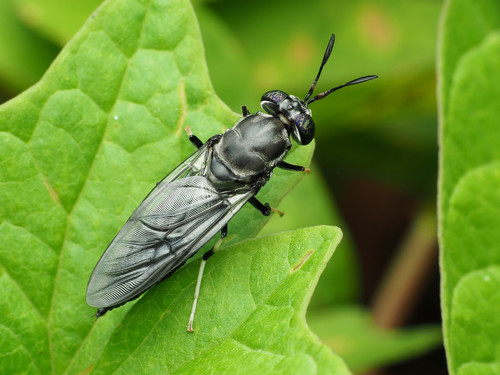
Black Soldier Fly
Hermetia illucens
(c) Katja Schulz, some rights reserved (CC BY), uploaded by Katja Schulz, CC BY 4.0, via iNaturalist
Side by side
| Microptecticus dimidiatus | Black Soldier Fly | |
|---|---|---|
| Scientific name | Microptecticus dimidiatus Lindner, 1936 | Hermetia illucens (Linnaeus, 1758) |
| English name | Not recorded | Black Soldier Fly |
| Group | Insects | Insects |
| Class | Insecta Insect | Insecta Insect |
| Order | Diptera Fly | Diptera Fly |
| Family | Stratiomyidae Soldier Flies | Stratiomyidae Soldier Flies |
| Genus | Microptecticus | Hermetia |
| Named in | 1936 | 1758 |
| Environment | Not recorded | terrestrial |
| Countries on record | Not recorded | 115 countries |
| GBIF occurrence records | Not recorded | 34,898 records |
Rows where the two agree are shown in grey.
Where each is found
Only Black Soldier Fly (115)
- Albania
- Argentina
- Australia
- Austria
- Bahamas
- Bangladesh
- Barbados
- Belgium
- Belize
- Bermuda
- Bhutan
- Bolivia
- Bosnia and Herzegovina
- Brazil
- Bulgaria
- Cambodia
- Canada
- Chile
- China
- Colombia
- Cook Islands
- Costa Rica
- Croatia
- Cuba
- Cyprus
- Czechia
- Denmark
- Dominica
- Dominican Republic
- Ecuador
- El Salvador
- Fiji
- France
- French Guiana
- French Polynesia
- Georgia
- Germany
- Greece
- Grenada
- Guadeloupe
- Guam
- Guatemala
- Guyana
- Haiti
- Honduras
- Hong Kong
- Hungary
- India
- Indonesia
- Iran
- Ireland
- Israel
- Italy
- Jamaica
- Japan
- Laos
- Lebanon
- Macao
- Malaysia
- Maldives
- Malta
- Martinique
- Mexico
- Micronesia
- Montenegro
- Myanmar
- Nepal
- New Caledonia
- New Zealand
- Nicaragua
- Pakistan
- Palau
- Palestinian Territory
- Panama
- Papua New Guinea
- Paraguay
- Peru
- Philippines
- Poland
- Portugal
- Puerto Rico
- Romania
- Russia
- Saint Barthelemy
- Saint Kitts and Nevis
- Saint Vincent and the Grenadines
- Samoa
- Saudi Arabia
- Serbia
- Singapore
- Sint Maarten
- Slovenia
- Solomon Islands
- South Africa
- South Korea
- Spain
- Sri Lanka
- Suriname
- Sweden
- Switzerland
- Syria
- Taiwan
- Thailand
- The Netherlands
- Timor Leste
- Tonga
- Trinidad and Tobago
- Turkey
- Ukraine
- United Kingdom
- United States
- Uruguay
- Vanuatu
- Venezuela
- Vietnam
From Catalogue of Life checklists and GBIF occurrence records. A country missing from a list means no record is held, which is not proof of absence.
Checked facts
| Microptecticus dimidiatus | Black Soldier Fly | |
|---|---|---|
| Appearance | No checked fact yet |
|
| Size | No checked fact yet |
|
| Habitat | No checked fact yet |
|
| Diet | No checked fact yet |
|
| Behaviour | No checked fact yet |
|
| Reproduction | No checked fact yet |
|
| Distribution | No checked fact yet |
|
| Conservation | No checked fact yet |
|
| Uses | No checked fact yet |
|
| Similar species | No checked fact yet |
|
In brief
Black Soldier Fly
The species occurs in urban, rural, and forested environments and has spread across all continents except Antarctica. Adult flies have predominantly black bodies with metallic blue-to-green reflections and resemble wasps because of their elongated antennae and transparent abdominal markings. Full profile
Compare something else
Page built on 26 November 2026 from the data on the two species pages, where every source is listed.
Cite this page
ScientificNames.org. (2026). Microptecticus dimidiatus vs Black Soldier Fly. Retrieved November 26, 2026, from https://scientificnames.org/compare/microptecticus-dimidiatus-vs-black-soldier-fly
“Microptecticus dimidiatus vs Black Soldier Fly.” ScientificNames.org, 2026, scientificnames.org/compare/microptecticus-dimidiatus-vs-black-soldier-fly. Accessed 26 Nov. 2026.
ScientificNames.org. “Microptecticus dimidiatus vs Black Soldier Fly.” Accessed November 26, 2026. https://scientificnames.org/compare/microptecticus-dimidiatus-vs-black-soldier-fly.
@misc{scientificnames_microptecticus_dimidiatus_vs_black_soldier_fly,
  author = {{ScientificNames.org}},
  title = {Microptecticus dimidiatus vs Black Soldier Fly},
  year = {2026},
  url = {https://scientificnames.org/compare/microptecticus-dimidiatus-vs-black-soldier-fly},
  note = {Accessed 2026-11-26}
}