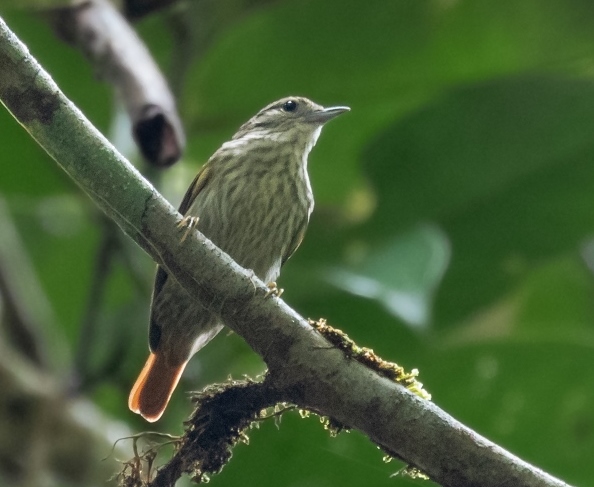
| Appearance | - The Rufous-tailed Xenops has a thin, straight bill. English Wikipedia
- Adult Rufous-tailed Xenops have a predominantly blackish-brown face and a buff-colored supercilium. English Wikipedia
- The crown is blackish brown with golden-buff feather shafts. English Wikipedia
- The back is dark rufescent brown with broad buff streaks that become less distinct toward the lower back. English Wikipedia
- The rump and upper tail coverts are rufescent. English Wikipedia
- The tail is dark rufous. English Wikipedia
- The wing coverts are blackish with rufescent-brown edges. English Wikipedia
- The flight feathers are blackish and have a broad rufous band at their bases. English Wikipedia
- The chin and throat are pale yellowish buff, with dark olive markings on the throat. English Wikipedia
- The breast is bright buff with narrow, sharply defined dark olive-brown streaks. English Wikipedia
- The belly is bright golden buff with extensive light brownish streaking. English Wikipedia
- The undertail coverts are bright buff with light ochraceous-brown streaks. English Wikipedia
- The iris ranges from brown to dark brown. English Wikipedia
- The maxilla ranges in color from black to brownish. English Wikipedia
- The mandible ranges from blue-gray to leaden blue. English Wikipedia
- The legs and feet are yellowish brown to olive. English Wikipedia
- The species has a tan body with extensive streaking and contrasting reddish wings and tail. ebird.org
- The species has a prominent white eyebrow. ebird.org
| - The nominate subspecies has brown plumage with several black lines on its upperparts and generally white underparts. English Wikipedia
- The species has a distinctive elongated tail containing twelve spiny rectrices. English Wikipedia
- Juveniles gradually develop their characteristic spiny tail as they mature. English Wikipedia
- The Chiloé subspecies has a cinnamon-colored throat rather than a white one. English Wikipedia
- The Mocha Island subspecies has entirely brown upperparts without black lines and a white throat. English Wikipedia
|
|---|
| Size | | - The thorn-tailed rayadito measures approximately 14 centimetres in length, including its tail. English Wikipedia
- Adult thorn-tailed rayaditos weigh approximately 11 grams on average. English Wikipedia
- Males weigh approximately 10 percent more than females. English Wikipedia
|
|---|
| Habitat | | - The species inhabits temperate forests and subtropical dry shrubland south of 30°S. English Wikipedia
- Its habitats include tall Nothofagus and Araucaria forests in northern parts of its range. English Wikipedia
- Its southern habitats include low subantarctic forests. English Wikipedia
- The species also inhabits relatively dry Austrocedrus forests in the eastern part of its range. English Wikipedia
|
|---|
| Diet | | |
|---|
| Behaviour | - The Rufous-tailed Xenops remains in its range throughout the year. English Wikipedia
- The species forages both individually and in mixed-species feeding flocks. English Wikipedia
- The Rufous-tailed Xenops usually forages in the sub-canopy and canopy of forests. English Wikipedia
- The species primarily captures prey by gleaning bark, leaves, and moss. English Wikipedia
- While foraging, the species moves along slender branches and vines. English Wikipedia
- The Rufous-tailed Xenops hangs almost upside down to reach the undersides of foraging surfaces. English Wikipedia
- The species produces a short, rapid, high-pitched song with rising and falling volume. English Wikipedia
| - The species forms large mixed-species flocks during the non-breeding season from March to September. English Wikipedia
- Non-breeding individuals typically gather in flocks of four to seven birds. English Wikipedia
- During the breeding season from October to February, individuals strongly defend territories as pairs. English Wikipedia
- The species is highly curious and shows little fear of humans in its forest habitat. English Wikipedia
- Its characteristic thorn-like tail is believed to serve as a courtship attraction rather than an aid to climbing trees. English Wikipedia
- Thorn-tailed rayaditos are core members of mixed-species winter feeding flocks. ebird.org
|
|---|
| Reproduction | - The breeding biology of the Rufous-tailed Xenops has not been documented. English Wikipedia
| |
|---|
| Lifespan | No checked fact yet | - The oldest recorded thorn-tailed rayadito was six years and four months old. English Wikipedia
|
|---|
| Distribution | - The Rufous-tailed Xenops occurs in Bolivia, Brazil, Colombia, Ecuador, Guyana, Peru, Suriname, and Venezuela, with a possible presence in French Guiana. English Wikipedia
| - The species occurs in central Chile and adjacent Argentina, extending south to Tierra del Fuego. English Wikipedia
- The subspecies Aphrastura spinicauda bullocki occurs on Mocha Island off Chile. English Wikipedia
- The subspecies Aphrastura spinicauda fulva occurs on Chiloé Island off Chile. English Wikipedia
- The species remains one of the most common native birds in the temperate forests of southern and southern-central Chile. English Wikipedia
|
|---|
| Conservation | - The Rufous-tailed Xenops is classified as Least Concern by the IUCN. English Wikipedia
- The species has a very large geographic range. English Wikipedia
- The population of the Rufous-tailed Xenops is believed to be stable, although its size is unknown. English Wikipedia
- No immediate threats to the Rufous-tailed Xenops have been identified. English Wikipedia
- The species is described as rare to locally fairly common and has an apparently patchy distribution. English Wikipedia
- The Rufous-tailed Xenops occurs in numerous protected areas. English Wikipedia
- The species is rated rare relative to other Aves observations on iNaturalist. birdnet.cornell.edu
| - The IUCN Red List classifies Aphrastura spinicauda as Least Concern. iucnredlist.org
|
|---|
| Other | | - Four subspecies of the thorn-tailed rayadito are recognized in the document. English Wikipedia
|
|---|