Comparison

MacFarlane's Four-o'clock vs Wild Four O'Clock

MacFarlane's Four-o'clock (Mirabilis macfarlanei) and Wild Four O'Clock (Mirabilis nyctaginea) both belong to the genus Mirabilis (four o'clock) and part ways below it. Both are recorded in 1 country.
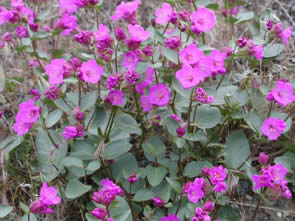
MacFarlane's Four-o'clock

MacFarlane's Four-o'clock

Mirabilis macfarlanei

Gene Yates, Forest Botanist, Wallowa-Whitman National Forest, Public domain, via Wikimedia Commons

Wild Four O'Clock

Wild Four O'Clock

Mirabilis nyctaginea

Jim Pisarowicz, Public domain, via Wikimedia Commons

Side by side

MacFarlane's Four-o'clockWild Four O'Clock
Scientific nameMirabilis macfarlanei Constance & RollinsMirabilis nyctaginea (Michx.) MacMill.
English nameMacFarlane's Four-o'clockWild Four O'Clock
GroupFlowering plantsFlowering plants
ClassMagnoliopsidaMagnoliopsida
OrderCaryophyllalesCaryophyllales
FamilyNyctaginaceae Four-o’clock FamilyNyctaginaceae Four-o’clock Family
GenusMirabilis Four O'clockMirabilis Four O'clock
Countries on record1 country12 countries
GBIF occurrence records94 records10,412 records

Rows where the two agree are shown in grey.

Where each is found

Both recorded in 1 country

Only Wild Four O'Clock (11)

From Catalogue of Life checklists and GBIF occurrence records. A country missing from a list means no record is held, which is not proof of absence.

Checked facts

MacFarlane's Four-o'clockWild Four O'Clock
Appearance
  • The species is a perennial herb that forms rounded clumps of stems. English Wikipedia
  • The flowers lack petals and instead have magenta sepals. English Wikipedia
  • The plant has a deep-seated, thick taproot. fws.gov
  • The plant's leaves are opposite and fleshy, with lower blades ranging from orbicular to ovate-deltoid and upper blades narrowly ovate. swap.oregon.gov
  • The lower leaves have petioles up to 12.5 cm long, while the upper leaves are nearly sessile. swap.oregon.gov
  • The flowers are clustered in groups of four to seven in conspicuous green to purplish involucres. swap.oregon.gov
  • The flowers have a showy magenta, broadly funnel-shaped perianth. swap.oregon.gov
  • The fruits are ellipsoid and light brown to grayish, with slender ribs, a tuberculate surface, and little or no pubescence. swap.oregon.gov
  • The plant is a perennial herb that can range from hairy to hairless. English Wikipedia
  • Its leaves are arranged oppositely, mainly along the lower two-thirds of the plant. English Wikipedia
  • Its thin green leaves have oval or heart-shaped blades reaching up to 10 centimeters long. English Wikipedia
  • Its flowers grow in the leaf axils of the upper branches. English Wikipedia
  • Its flowers occur in clusters of three to five within a bell-shaped involucre formed by five partly fused bracts. English Wikipedia
  • Each flower has five lobes and a funnel-shaped structure. English Wikipedia
  • Its flowers range in color from magenta or pink to nearly white. English Wikipedia
  • After flowering, its developing fruits are shaggy-haired and remain inside the drying, papery cup of bracts. English Wikipedia
  • The plant has a thick, fleshy taproot. English Wikipedia
Size
Habitat
  • The species grows on warm, dry, open canyon slopes. swap.oregon.gov
  • The species occupies sandy or rocky soils that are often unstable. swap.oregon.gov
  • The species occurs in dry, relatively warm native grassland containing shrubs. English Wikipedia
  • The species' habitat includes bluebunch wheatgrass, sand dropseed, and pine bluegrass. English Wikipedia
  • The species occurs in old fields, pastures, and prairies. mdc.mo.gov
  • The species spreads readily into disturbed habitats. English Wikipedia
Behaviour
  • The species generally survives wildfires because of its large underground rhizome. English Wikipedia
Reproduction
  • The flowers are pollinated by solitary bees and the bumblebee Bombus fervidus. English Wikipedia
  • The species spreads through long rhizomes. English Wikipedia
  • The species produces ellipsoid fruits measuring 6–9 millimeters in length. swap.oregon.gov
No checked fact yet
Distribution
  • The species is native to Idaho and Oregon in the United States. English Wikipedia
  • The species occurs in the canyons of the Snake, Salmon, and Imnaha Rivers in western Idaho and far eastern Oregon. English Wikipedia
  • The species has a narrow geographic distribution. swap.oregon.gov
No checked fact yet
Conservation
  • The species was federally listed as endangered in 1979. English Wikipedia
  • The species was reclassified from endangered to threatened in 1996. govinfo.gov
  • The species had eleven known populations by 2000. English Wikipedia
  • Monitoring data from federal lands indicated that the total population had neither increased nor decreased by 2008. English Wikipedia
  • Grazing by domestic cattle and sheep threatens the species through trampling and predation. English Wikipedia
  • Invasive plant expansion is considered a primary limiting factor for the species. swap.oregon.gov
  • Off-highway vehicle use, road and trail construction and maintenance, mining, and herbicide drift are additional threats. swap.oregon.gov
  • Inbreeding depression may limit the species. swap.oregon.gov
  • The species is moderately vulnerable to climate change, particularly because of predicted changes in precipitation variability. swap.oregon.gov
  • A revised recovery plan for the species was released in 2000. swap.oregon.gov
  • A five-year review addressing updated conservation needs was released in 2022. swap.oregon.gov
  • The Oregon Department of Agriculture published a habitat management plan covering all Oregon populations in 2025. swap.oregon.gov
No checked fact yet
UsesNo checked fact yet
  • The plant was called Kactáhkata in the Skiri Pawnee language. English Wikipedia
  • The plant's yellow, sweet root was traditionally used to treat coughs. English Wikipedia
  • The root was traditionally powdered and used as a remedy for sore mouths in babies. English Wikipedia
  • The root was traditionally prepared as a tea for women after childbirth to reduce abdominal swelling. English Wikipedia

In brief

MacFarlane's Four-o'clock

MacFarlane's four-o'clock is a perennial herb that forms rounded clumps of stems. It occurs in the canyons of the Snake, Salmon, and Imnaha Rivers in western Idaho and far eastern Oregon. The species has a deep-seated taproot and showy magenta, broadly funnel-shaped flowers. Full profile

Wild Four O'Clock

Wild Four o'Clock is a perennial herb in the family Nyctaginaceae and order Caryophyllales. It occurs in old fields, pastures, and prairies and spreads readily into disturbed habitats. Its flowers grow in clusters of three to five, range from magenta or pink to nearly white, and open for only a few hours before dropping. Full profile

Compare something else

Page built on 27 November 2026 from the data on the two species pages, where every source is listed.

Cite this page

ScientificNames.org. (2026). MacFarlane's Four-o'clock vs Wild Four O'Clock. Retrieved November 27, 2026, from https://scientificnames.org/compare/macfarlanes-four-oclock-vs-wild-four-oclock