Comparison

Salvin's Curassow vs Crestless Curassow

Salvin's Curassow (Mitu salvini) and Crestless Curassow (Mitu tomentosum) both belong to the genus Mitu (crestless curassows) and part ways below it. Both are recorded in 1 country.
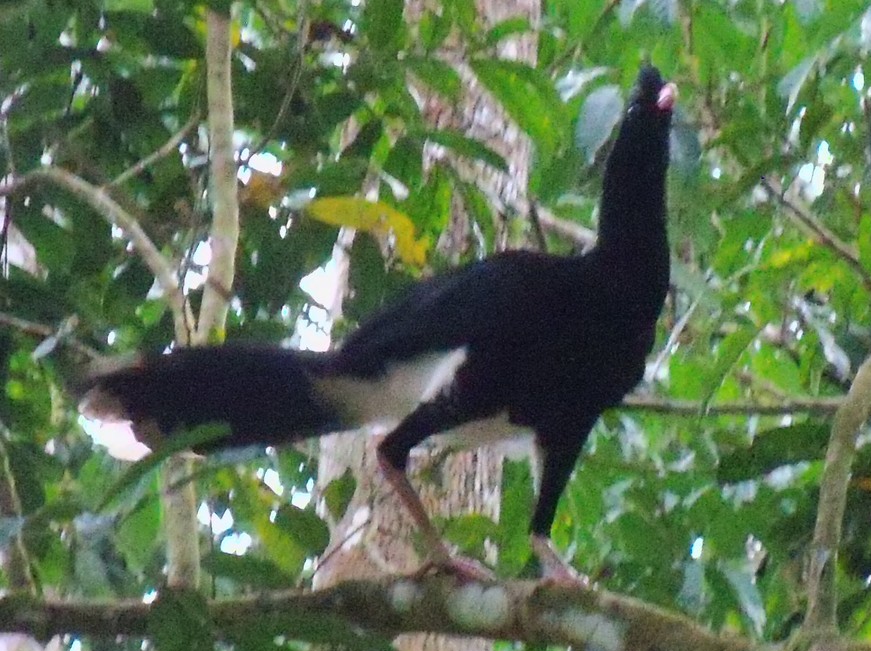
Salvin's Curassow

Salvin's Curassow

Mitu salvini

gsexauer, CC0, via Wikimedia Commons

Crestless Curassow

Crestless Curassow

Mitu tomentosum

Biodiversity Heritage Library, CC BY 4.0, via Wikimedia Commons

Side by side

Salvin's CurassowCrestless Curassow
Scientific nameMitu salvini Reinhardt, 1879Mitu tomentosum (Spix, 1825)
English nameSalvin's CurassowCrestless Curassow
GroupBirdsBirds
ClassAves BirdAves Bird
OrderGalliformes FowlsGalliformes Fowls
FamilyCracidae GuansCracidae Guans
GenusMitu Crestless CurassowsMitu Crestless Curassows
Named in18791825
Red List categoryLeast ConcernLeast Concern
Countries on record3 countries4 countries
GBIF occurrence records2,065 records7,070 records

Rows where the two agree are shown in grey.

Where each is found

Both recorded in 1 country

Only Salvin's Curassow (2)

Only Crestless Curassow (3)

From Catalogue of Life checklists and GBIF occurrence records. A country missing from a list means no record is held, which is not proof of absence.

Checked facts

Salvin's CurassowCrestless Curassow
Appearance
  • The species is predominantly black with little gloss, a white belly, and white tips on its tail feathers. English Wikipedia
  • The species has an erectile crest that it usually carries flat. English Wikipedia
  • The species has a bright red bill, a white lower belly, and a white tail tip. ebird.org
  • The Crestless Curassow is predominantly black with a dark blue to purplish gloss. English Wikipedia
  • The Crestless Curassow has a rich chestnut belly and tail tip. English Wikipedia
  • The Crestless Curassow lacks a crest and has no swelling on its red bill. English Wikipedia
Size
Habitat
  • The species inhabits humid terra firme forest mainly during March and April, at the beginning of the wet season. English Wikipedia
  • The species occupies várzea forest outside the beginning-of-wet-season period. English Wikipedia
  • The species prefers primary forest. English Wikipedia
  • In Ecuador, the species occurs at elevations reaching approximately 400 m. English Wikipedia
  • In Colombia, the species occurs at elevations reaching approximately 600 m. English Wikipedia
  • Historical records document the species at elevations of approximately 900 m. English Wikipedia
  • The Crestless Curassow primarily inhabits rainforest along rivers. English Wikipedia
  • The Crestless Curassow also occurs in gallery forest in the llanos of Colombia and Venezuela. English Wikipedia
  • The Crestless Curassow tends to prefer habitats with thick undergrowth. English Wikipedia
  • The Crestless Curassow is a lowland bird. English Wikipedia
  • In Colombia, the Crestless Curassow occurs at elevations up to 500 m. English Wikipedia
  • In Venezuela, the Crestless Curassow occurs at elevations up to 600 m. English Wikipedia
  • The Crestless Curassow inhabits subtropical or tropical moist lowland forest. inaturalist.org
Diet
  • The Crestless Curassow's diet is reported to consist almost entirely of fallen fruits. English Wikipedia
Behaviour
  • The species is generally sedentary. English Wikipedia
  • Pairs may seasonally relocate their territories in response to food availability. English Wikipedia
  • The species forages individually, in pairs, or in family groups, primarily on the ground. English Wikipedia
  • Pairs appear to remain together throughout the year and are not strongly territorial. English Wikipedia
  • The male produces its characteristic booming song mostly at dawn and at night. English Wikipedia
  • Females also sing, producing a huskier version of the male's song. English Wikipedia
  • The species uses a vocalization described as a pieew, pieew alarm note. English Wikipedia
  • The species produces a goorh, goorh vocalization in response to threats. English Wikipedia
  • The species produces a coh coh contact call. English Wikipedia
  • The Crestless Curassow usually forages alone or in pairs. English Wikipedia
  • The Crestless Curassow very rarely forages in groups of up to ten individuals. English Wikipedia
  • The Crestless Curassow obtains most of its food while on the ground. English Wikipedia
  • The Crestless Curassow performs its song throughout the year, with greater frequency during the breeding season. English Wikipedia
  • The Crestless Curassow's song is described as a low humming or booming vocalization. English Wikipedia
  • The Crestless Curassow's alarm call consists of a series of sharp, reedy whistles. English Wikipedia
Reproduction
  • The Crestless Curassow's breeding season appears to coincide with the rainy season. English Wikipedia
  • The Crestless Curassow builds its nest low in trees. English Wikipedia
Distribution
  • Its geographic range extends east of the Andes through southern Colombia, eastern Ecuador, and northern Peru. English Wikipedia
  • The Crestless Curassow occurs in Brazil, Colombia, Guyana, and Venezuela. English Wikipedia
  • The Crestless Curassow is endemic to north-central South America. iucnredlist.org
  • The Crestless Curassow is considered locally common in Venezuela. iucnredlist.org
Conservation
  • The IUCN reclassified the Crestless Curassow from Least Concern to Near Threatened in 2012. English Wikipedia
  • The Crestless Curassow's population is unknown. English Wikipedia
  • The Crestless Curassow's population is projected to decline because of habitat fragmentation and hunting. English Wikipedia
Similar speciesNo checked fact yet
  • The Alagoas Curassow is the sister species of the Crestless Curassow according to mitochondrial gene sequence analyses. English Wikipedia
  • The Crestless Curassow and Alagoas Curassow together form the sister group to the remaining species in the genus Mitu. English Wikipedia
OtherNo checked fact yet

In brief

Salvin's Curassow

The geographic range extends east of the Andes through southern Colombia, eastern Ecuador, and northern Peru. It is predominantly black, with a bright red bill, a white belly, white tail tips, and an erectile crest. Full profile

Crestless Curassow

Mitu tomentosum occurs in Brazil, Colombia, Guyana, and Venezuela. It is predominantly black with a dark blue to purplish gloss, a rich chestnut belly and tail tip, and no crest. Full profile

Compare something else

Page built on 27 November 2026 from the data on the two species pages, where every source is listed.

Cite this page

ScientificNames.org. (2026). Salvin's Curassow vs Crestless Curassow. Retrieved November 27, 2026, from https://scientificnames.org/compare/salvins-curassow-vs-crestless-curassow