Comparison
Salvin's Curassow vs Razor-billed Curassow
Salvin's Curassow (Mitu salvini) and Razor-billed Curassow (Mitu tuberosum) both belong to the genus Mitu (crestless curassows) and part ways below it. Both are recorded in 2 countries.


Side by side
| Salvin's Curassow | Razor-billed Curassow | |
|---|---|---|
| Scientific name | Mitu salvini Reinhardt, 1879 | Mitu tuberosum (Spix, 1825) |
| English name | Salvin's Curassow | Razor-billed Curassow |
| Group | Birds | Birds |
| Class | Aves Bird | Aves Bird |
| Order | Galliformes Fowls | Galliformes Fowls |
| Family | Cracidae Guans | Cracidae Guans |
| Genus | Mitu Crestless Curassows | Mitu Crestless Curassows |
| Named in | 1879 | 1825 |
| Red List category | Least Concern | Near Threatened |
| Countries on record | 3 countries | 4 countries |
| GBIF occurrence records | 2,065 records | 6,872 records |
Rows where the two agree are shown in grey.
Where each is found
Both recorded in 2 countries
Only Salvin's Curassow (1)
Only Razor-billed Curassow (2)
From Catalogue of Life checklists and GBIF occurrence records. A country missing from a list means no record is held, which is not proof of absence.
Checked facts
| Salvin's Curassow | Razor-billed Curassow | |
|---|---|---|
| Appearance |
|
|
| Size |
|
|
| Habitat |
|
|
| Diet |
|
|
| Behaviour |
|
|
| Reproduction |
|
|
| Distribution |
|
|
| Conservation |
|
|
| Similar species | No checked fact yet |
|
| Other | No checked fact yet |
|
In brief
Salvin's Curassow
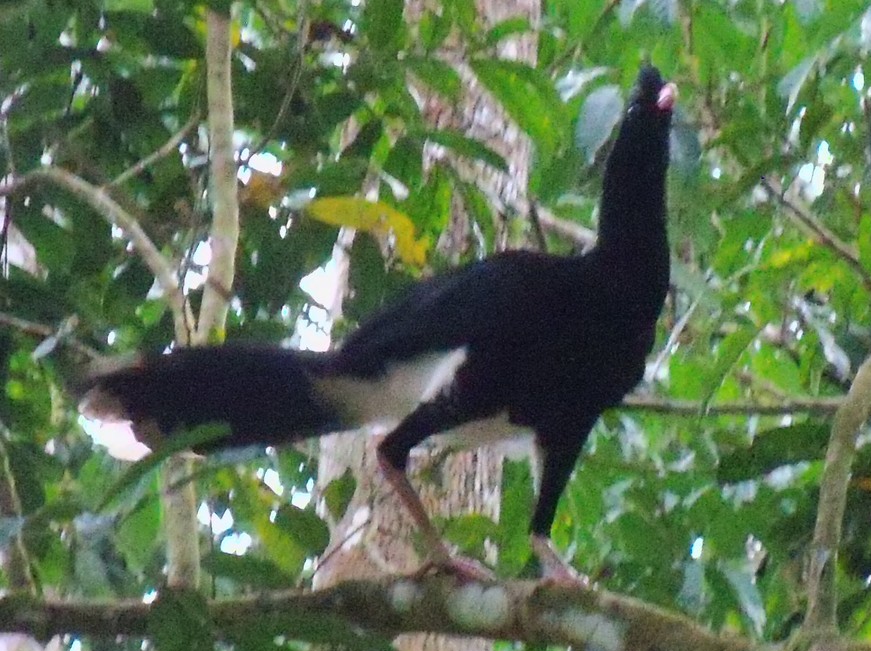
The geographic range extends east of the Andes through southern Colombia, eastern Ecuador, and northern Peru. It is predominantly black, with a bright red bill, a white belly, white tail tips, and an erectile crest. Full profile
Razor-billed Curassow
Mitu tuberosum occurs in Bolivia, Brazil, Colombia, and Peru, across much of Amazonia. It is distinguished by predominantly black plumage with a purplish-blue gloss, a tall ragged crest, and a large bright-red bill. Full profile
Compare something else
Page built on 26 November 2026 from the data on the two species pages, where every source is listed.
Cite this page
ScientificNames.org. (2026). Salvin's Curassow vs Razor-billed Curassow. Retrieved November 26, 2026, from https://scientificnames.org/compare/salvins-curassow-vs-razor-billed-curassow
“Salvin's Curassow vs Razor-billed Curassow.” ScientificNames.org, 2026, scientificnames.org/compare/salvins-curassow-vs-razor-billed-curassow. Accessed 26 Nov. 2026.
ScientificNames.org. “Salvin's Curassow vs Razor-billed Curassow.” Accessed November 26, 2026. https://scientificnames.org/compare/salvins-curassow-vs-razor-billed-curassow.
@misc{scientificnames_salvins_curassow_vs_razor_billed_curassow,
  author = {{ScientificNames.org}},
  title = {Salvin's Curassow vs Razor-billed Curassow},
  year = {2026},
  url = {https://scientificnames.org/compare/salvins-curassow-vs-razor-billed-curassow},
  note = {Accessed 2026-11-26}
}