Comparison

Kauaʻi ʻōʻō vs Oʻahu ʻōʻō

Kauaʻi ʻōʻō (Moho braccatus) and Oʻahu ʻōʻō (Moho apicalis) both belong to the genus Moho ('o'os) and part ways below it.
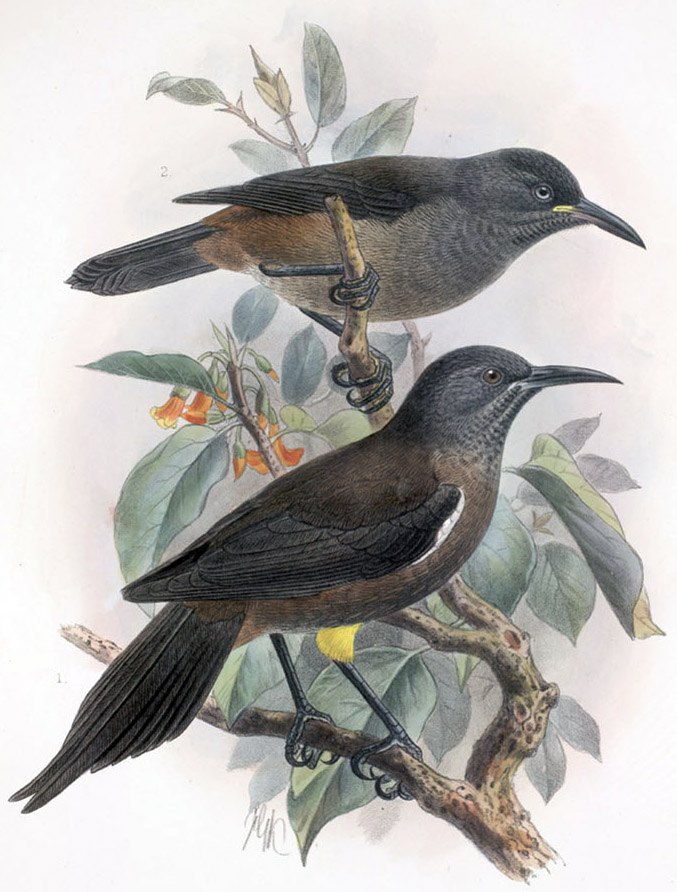
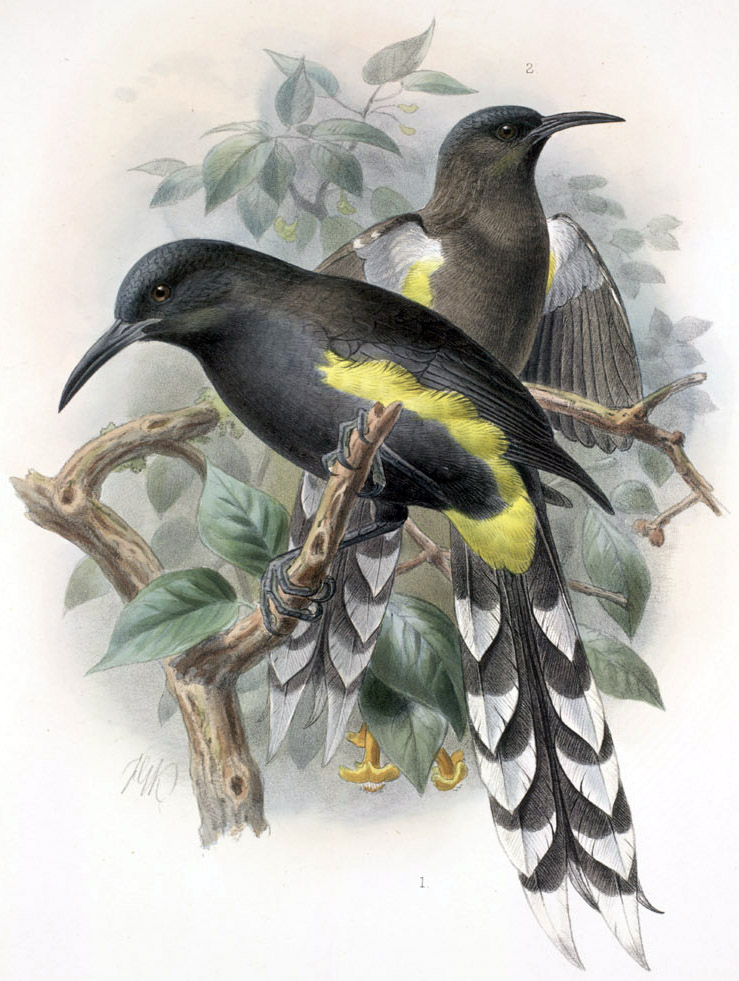
Kauaʻi ʻōʻō

Kauaʻi ʻōʻō

Moho braccatus

John Gerrard Keulemans, Public domain, via Wikimedia Commons

Oʻahu ʻōʻō

Oʻahu ʻōʻō

Moho apicalis

John Gerrard Keulemans, Public domain, via Wikimedia Commons

Side by side

Kauaʻi ʻōʻōOʻahu ʻōʻō
Scientific nameMoho braccatus Cassin, 1855Moho apicalis Gould, 1861
English nameKauaʻi ʻōʻōOʻahu ʻōʻō
GroupBirdsBirds
ClassAves BirdAves Bird
OrderPasseriformes PasserinePasseriformes Passerine
FamilyMohoidae Hawaiian HoneyeatersMohoidae Hawaiian Honeyeaters
GenusMoho 'O'osMoho 'O'os
Named in18551861
Red List categoryExtinctExtinct

Rows where the two agree are shown in grey.

Checked facts

Kauaʻi ʻōʻōOʻahu ʻōʻō
Appearance
Size
Habitat
  • The species inhabited densely forested canyons on Kauaʻi. English Wikipedia
  • The species eventually became confined to montane forests in the Alakaʻi Wilderness Preserve. English Wikipedia
  • The ʻieʻie plant was abundant in lowland forests but absent from upper-elevation forests. dlnr.hawaii.gov
  • The last observations of the species were in stream valleys of the central Alakaʻi Wilderness Preserve. dlnr.hawaii.gov
  • The last sightings occurred in dense ʻōhiʻa forests of the Alakaʻi swamp. dlnr.hawaii.gov
Diet
  • The bird also ate small invertebrates and fruit. English Wikipedia
  • The Kauaʻi ʻōʻō ate a variety of arthropods, snails, fruits and nectar. dlnr.hawaii.gov
  • The species consumed nectar from ʻōhiʻa flowers. dlnr.hawaii.gov
  • Lobelia flowers were among the species' nectar sources. dlnr.hawaii.gov
  • Early naturalists reported that the species fed extensively on the flower bracts of ʻieʻie. dlnr.hawaii.gov
  • The species used a specialized tongue to extract floral nectar from different flower species. English Wikipedia
Behaviour
Reproduction
  • The Kauaʻi ʻōʻō nested in cavities. English Wikipedia
  • The only known nests of the species were located in cavities in large ʻōhiʻa snags. dlnr.hawaii.gov
No checked fact yet
Distribution
  • The Kauaʻi ʻōʻō was endemic to the Hawaiian island of Kauaʻi. English Wikipedia
  • The species' range became restricted to higher elevations following mosquito-transmitted diseases. English Wikipedia
  • The species historically occurred in forest habitat throughout Kauaʻi. dlnr.hawaii.gov
  • The species was endemic to the Hawaiian island of Oʻahu. English Wikipedia
  • Specimens were collected at scattered locations throughout the Koʻolau Range. English Wikipedia
  • Subfossils discovered at Barber's Point suggest that the species' historical range may have extended across the entire island of Oʻahu. English Wikipedia
  • The last reliable evidence consisted of three specimens collected from Nuʻuanu Valley between 11 and 15 January 1837. English Wikipedia
  • The species was restricted to forests on Oʻahu, Hawaiʻi, USA. datazone.birdlife.org
Conservation
  • The species was declared extinct by the IUCN in 2000. English Wikipedia
  • The species was officially declared extinct in October 2023. English Wikipedia
  • The last confirmed sighting of a male occurred in 1985. English Wikipedia
  • The last known vocal recording of the species was made in 1987. English Wikipedia
  • The species' population was estimated at approximately 34 individuals by the early 1960s. English Wikipedia
  • Introduced predators, mosquito-borne diseases and habitat destruction contributed to the species' extinction. English Wikipedia
  • Hurricanes Iwa and Iniki contributed significantly to the species' decline. English Wikipedia
  • Hurricanes in 1982 and 1992 extensively damaged forests used by the species. dlnr.hawaii.gov
  • Disease was considered a likely contributor to the decline of the Kauaʻi ʻōʻō. dlnr.hawaii.gov
  • Hunting by Native Hawaiians was considered a likely minimal contributor to the species' decline. dlnr.hawaii.gov
  • The species was already considered extinct by the time Gould described it in 1860. English Wikipedia
  • Surveys conducted between 1880 and 1890 failed to find the species, after which it was described as extinct. English Wikipedia
UsesNo checked fact yet
  • Early Hawaiians used feathers from the species for clothing, including royal capes and headdresses. English Wikipedia
  • Feathers were gathered into small tied bunches by common people for tax payments to the ruling class. English Wikipedia
OtherNo checked fact yet
  • John Gould scientifically named and described the species in 1860. English Wikipedia
  • Seven specimens of the species are held in museum collections in Berlin, London, New York City, and Cambridge, Massachusetts. English Wikipedia
  • The species is known from approximately seven specimens. datazone.birdlife.org

In brief

Kauaʻi ʻōʻō

The Kauaʻi ʻōʻō was a bird endemic to the Hawaiian island of Kauaʻi. It inhabited densely forested canyons on Kauaʻi. It was the only known ʻōʻō with yellow irises. Full profile

Oʻahu ʻōʻō

The species was endemic to the Hawaiian island of Oʻahu. It had predominantly sooty-black plumage, deeply yellow flanks and undertail coverts, and brown tail feathers with white tips on all except the two central feathers. Full profile

Compare something else

Page built on 26 November 2026 from the data on the two species pages, where every source is listed.

Cite this page

ScientificNames.org. (2026). Kauaʻi ʻōʻō vs Oʻahu ʻōʻō. Retrieved November 26, 2026, from https://scientificnames.org/compare/kaua-i-o-o-vs-moho-apicalis