Comparison

Morant's Orange vs Silver-spotted Skipper

Morant's Orange (Parosmodes morantii) and Silver-spotted Skipper (Epargyreus clarus) both belong to the family Hesperiidae (skipper) and part ways below it.

Morant's Orange

Morant's Orange

Parosmodes morantii

(c) suncana, some rights reserved (CC BY), CC BY 4.0, via Wikimedia Commons

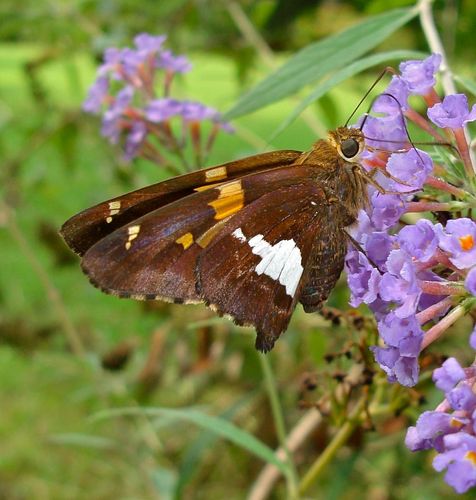
Silver-spotted Skipper

Silver-spotted Skipper

Epargyreus clarus

no rights reserved, uploaded by Elin Pierce, CC0, via iNaturalist

Side by side

Morant's OrangeSilver-spotted Skipper
Scientific nameParosmodes morantii (Trimen, 1873)Epargyreus clarus (Cramer, 1775)
English nameMorant's OrangeSilver-spotted Skipper
GroupInsectsInsects
ClassInsecta InsectInsecta Insect
OrderLepidopteraLepidoptera
FamilyHesperiidae SkipperHesperiidae Skipper
GenusParosmodes Morant’s SkippersEpargyreus Silverdrops
Named in18731775
Red List categoryLeast ConcernNot recorded
Countries on record9 countries3 countries
GBIF occurrence records243 records100,908 records

Rows where the two agree are shown in grey.

Where each is found

Only Morant's Orange (9)

Only Silver-spotted Skipper (3)

From Catalogue of Life checklists and GBIF occurrence records. A country missing from a list means no record is held, which is not proof of absence.

Checked facts

Morant's OrangeSilver-spotted Skipper
Appearance
  • Parosmodes morantii is a butterfly belonging to the family Hesperiidae. English Wikipedia
Size
HabitatNo checked fact yet
  • The species inhabits fields, gardens, and forest edges. English Wikipedia
  • The species prefers open habitats containing nectar plants, including swamps, brushy areas, and riparian habitats at lower elevations. English Wikipedia
  • In the western part of its range, the species occurs primarily in mountainous locations. animaldiversity.org
Diet
  • Larvae consume leaves of plants belonging to the pea family, Fabaceae. English Wikipedia
  • Recorded larval host plants include false indigobush, American hogpeanut, groundnut, and American wisteria. English Wikipedia
  • Larvae have also been recorded feeding on kudzu, black locust, and Chinese wisteria. animaldiversity.org
  • Adults feed on nectar from various flowers, as well as mud and animal feces. English Wikipedia
  • Adults favor blue, red, pink, and purple flowers and rarely visit yellow flowers. English Wikipedia
  • Recorded adult food plants include everlasting pea, common milkweed, red clover, buttonbush, blazing star, and thistles. English Wikipedia
Behaviour
  • Adults are active from July through early October. English Wikipedia
  • Adults are also active from December through May during the stronger summer brood. English Wikipedia
  • The stronger summer brood reaches its peak between February and March. English Wikipedia
  • Larvae construct leaf shelters using silk and may connect multiple leaves to form larger shelters. animaldiversity.org
  • Larvae generally leave their shelters only to feed or construct larger shelters. animaldiversity.org
  • Larvae can eject their waste as a defensive behaviour to reduce the attraction of parasitic wasps. animaldiversity.org
  • Threatened larvae regurgitate a greenish defensive chemical. English Wikipedia
Reproduction
  • Females generally deposit one egg on or occasionally near a host plant. English Wikipedia
  • Females have been recorded laying eggs on least snoutbean. English Wikipedia
  • Each copulation results in a female receiving a spermatophore from the male. English Wikipedia
  • After mating, females appear to reject additional males for at least some time. English Wikipedia
  • The species produces one generation annually in northern and western regions, two in eastern regions, and three to four in the Deep South. English Wikipedia
  • The last generation of the year overwinters in the pupal stage. animaldiversity.org
Distribution
  • The species occurs in KwaZulu-Natal, Eswatini, Mozambique, Botswana and Zimbabwe. English Wikipedia
  • The species also occurs across a range extending from western Kenya to Ghana. English Wikipedia
  • The subspecies Parosmodes morantii morantii occurs along the coast of Kenya. English Wikipedia
  • The subspecies Parosmodes morantii morantii occurs in Tanzania. English Wikipedia
  • The subspecies Parosmodes morantii morantii occurs in the Shaba region of the Democratic Republic of the Congo. English Wikipedia
  • The subspecies Parosmodes morantii morantii occurs in Angola, Malawi and Zambia. English Wikipedia
  • The subspecies Parosmodes morantii morantii occurs in Mozambique, Zimbabwe, Botswana and Eswatini. English Wikipedia
  • The subspecies Parosmodes morantii morantii occurs in Limpopo Province, Mpumalanga, Gauteng and KwaZulu-Natal in South Africa. English Wikipedia
  • The subspecies Parosmodes morantii axis occurs in Senegal, Gambia and Guinea. English Wikipedia
  • The subspecies Parosmodes morantii axis occurs in northern Ivory Coast and Ghana. English Wikipedia
  • The subspecies Parosmodes morantii axis occurs in western Kenya and western Tanzania. English Wikipedia
  • The species ranges from southern Canada through most of the United States to northern Mexico, excluding the Great Basin and western Texas. English Wikipedia
  • The species occurs throughout the United States and in southern Canada. animaldiversity.org
UsesNo checked fact yet
Similar speciesNo checked fact yet
Other
  • Parosmodes morantii morantii is listed under the English name Morant's Orange in a document discussing host plants, butterflies and conservation ecotourism in KwaZulu-Natal, South Africa. academia.edu
No checked fact yet

In brief

Morant's Orange

Morant's Orange is a butterfly belonging to the family Hesperiidae. The species occurs in KwaZulu-Natal, Eswatini, Mozambique, Botswana and Zimbabwe, and across a range extending from western Kenya to Ghana. It produces two generations annually, with the stronger summer brood reaching its peak between February and March. Full profile

Silver-spotted Skipper

Epargyreus clarus inhabits fields, gardens, forest edges, swamps, brushy areas, and riparian habitats at lower elevations. Full profile

Compare something else

Page built on 28 November 2026 from the data on the two species pages, where every source is listed.

Cite this page

ScientificNames.org. (2026). Morant's Orange vs Silver-spotted Skipper. Retrieved November 28, 2026, from https://scientificnames.org/compare/morants-orange-vs-silver-spotted-skipper