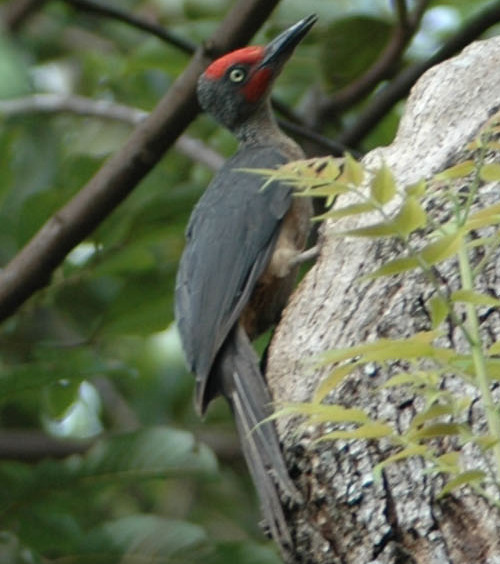
| Appearance | - The male has a red face extending to the middle of the crown, with a grey back of the head and neck. English Wikipedia
- The male has a buff-coloured throat, front of the neck, and belly. English Wikipedia
- The male's back and wings range in colour from grey-brown to dark slate grey. English Wikipedia
- The species has a long black bill. English Wikipedia
- The species has a yellow iris and a grey eye-ring. English Wikipedia
- The female has an entirely grey head with faint spotting, except on the forehead. English Wikipedia
- The wallacei subspecies has red colouring covering most of the head. English Wikipedia
- The wallacei subspecies has slightly longer wings and tail but a slightly shorter bill than the nominate subspecies. English Wikipedia
| - Adults have brown plumage with black bars across their backs and wings. English Wikipedia
- The upper breast has a black necklace-like marking, while the lower breast and belly are beige with black spots. English Wikipedia
- Males have either a black or red mustachial stripe at the base of the beak, depending on their geographic location. English Wikipedia
- Females lack the mustachial stripe found in males. English Wikipedia
- The bird has a dark upper tail that transitions into a conspicuous white rump visible during flight. English Wikipedia
|
|---|
| Size | - The Ashy Woodpecker measures approximately 40 centimetres in length. English Wikipedia
| |
|---|
| Habitat | - The species inhabits tropical moist lowland forests and tropical moist montane forests. English Wikipedia
- The species prefers closed forest but also occurs in secondary forest and forest patches within savannah. English Wikipedia
- The species occurs from sea level to elevations of 2,000 metres. English Wikipedia
| - The species occurs in open habitats near trees, including woodlands, woodland edges, yards, and parks. English Wikipedia
- In the western United States, the species occurs in mountain forests up to the tree line. English Wikipedia
- The species can occupy almost any habitat containing trees across its geographic range. audubon.org
- The species occasionally nests in abandoned earthen burrows previously occupied by belted kingfishers or sand martins. English Wikipedia
|
|---|
| Diet | - The species predominantly feeds on trees but also breaks into termite nests on the ground. English Wikipedia
- The species feeds on termites, caterpillars, and other insects and arthropods. English Wikipedia
| - Insects constitute the primary food of the northern flicker. English Wikipedia
- Ants can account for approximately 45% of the species' diet. English Wikipedia
- Other recorded invertebrate foods include flies, butterflies, moths, beetles, and snails. English Wikipedia
- The species consumes berries and seeds from plants including poison ivy, poison oak, dogwood, sumac, wild cherry, and grape. English Wikipedia
- The species also eats sunflower and thistle seeds. English Wikipedia
- Northern flickers obtain ant larvae by breaking into underground ant colonies. English Wikipedia
- The species sometimes breaks apart cow dung to consume insects living inside it. English Wikipedia
- The tongue can extend 50 mm beyond the end of the bill when catching prey. English Wikipedia
- Northern flickers are natural predators of the European corn borer. English Wikipedia
|
|---|
| Behaviour | | - Northern flickers frequently forage on the ground, unlike other woodpeckers. English Wikipedia
- The species probes the ground with its beak and sometimes catches insects while flying. English Wikipedia
- Northern flickers use formic acid from ants during preening to help control parasites. English Wikipedia
- The species drums on trees and metal objects to communicate and defend its territory. English Wikipedia
- Its flight follows an undulating pattern of rapid wingbeats alternating with pauses. English Wikipedia
- The species produces a sustained laughing call described as ki ki ki ki. English Wikipedia
- Northern flickers may form flocks during migration. English Wikipedia
- Approximately 75% of individuals spend their nights in cavities during migration. English Wikipedia
|
|---|
| Reproduction | - Little information is available about the nesting habits of the species. English Wikipedia
- One observed breeding pair excavated a nest hole, with the male performing most of the work. English Wikipedia
- The species nests in holes in dead trees or dead sections of living trees. English Wikipedia
- The species lays clutches of two to three eggs. English Wikipedia
| - Northern flickers typically nest in tree cavities but may also use suitably sized and positioned posts and birdhouses. English Wikipedia
- Both sexes participate in excavating nesting cavities. English Wikipedia
- The entrance to a typical nesting cavity is approximately 8 cm in diameter. English Wikipedia
- The species commonly breeds between February and July, depending on local temperatures. English Wikipedia
- A breeding season typically produces one or two clutches. English Wikipedia
- A typical clutch contains six to eight eggs. English Wikipedia
- Both sexes incubate the eggs for approximately 11 to 12 days. English Wikipedia
- Young birds leave the nest approximately 25 to 28 days after hatching. English Wikipedia
|
|---|
| Distribution | - The Ashy Woodpecker is endemic to Sulawesi and surrounding islands in Indonesia. English Wikipedia
- The nominate subspecies Mulleripicus fulvus fulvus occurs in northern Sulawesi, Lembeh, Manterawu, and the Togian and Banggai archipelagos. English Wikipedia
- The subspecies Mulleripicus fulvus wallacei occurs in southern Sulawesi and the islands of Muna and Buton. English Wikipedia
| - The northern flicker is native to most of North America, parts of Central America, Cuba, and the Cayman Islands. English Wikipedia
- The northern flicker's overall range extends from Alaska to Nicaragua. audubon.org
|
|---|
| Other | - The scientific name of the species is Mulleripicus fulvus. fws.gov
- The common name recorded by the United States Fish and Wildlife Service is Ashy Woodpecker. fws.gov
| No checked fact yet |
|---|