Comparison
Chinese Whistling Thrush vs Javan Whistling Thrush
Chinese Whistling Thrush (Myophonus caeruleus) and Javan Whistling Thrush (Myophonus glaucinus) both belong to the genus Myophonus (whistling thrush) and part ways below it. Both are recorded in 2 countries.

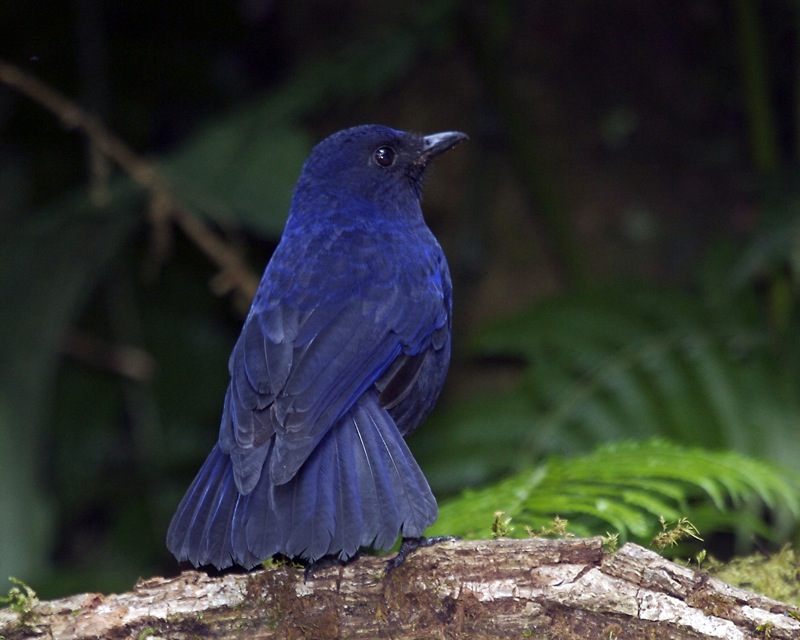
Chinese Whistling Thrush
Myophonus caeruleus
JJ Harrison (jjharrison89@facebook.com), CC BY-SA 3.0, via Wikimedia Commons


Side by side
| Chinese Whistling Thrush | Javan Whistling Thrush | |
|---|---|---|
| Scientific name | Myophonus caeruleus (Scopoli, 1786) | Myophonus glaucinus (Temminck, 1823) |
| English name | Chinese Whistling Thrush | Javan Whistling Thrush |
| Group | Birds | Birds |
| Class | Aves Bird | Aves Bird |
| Order | Passeriformes Passerine | Passeriformes Passerine |
| Family | Muscicapidae Old World Flycatcher | Muscicapidae Old World Flycatcher |
| Genus | Myophonus Whistling Thrush | Myophonus Whistling Thrush |
| Named in | 1786 | 1823 |
| Red List category | Least Concern | Least Concern |
| Countries on record | 22 countries | 2 countries |
| GBIF occurrence records | 156,797 records | 445 records |
Rows where the two agree are shown in grey.
Where each is found
Both recorded in 2 countries
Only Chinese Whistling Thrush (20)
- Afghanistan
- Bangladesh
- Bhutan
- Cambodia
- China
- Hong Kong
- India
- Kazakhstan
- Kyrgyzstan
- Laos
- Macao
- Myanmar
- Nepal
- Pakistan
- Singapore
- Taiwan
- Tajikistan
- Thailand
- Uzbekistan
- Vietnam
From Catalogue of Life checklists and GBIF occurrence records. A country missing from a list means no record is held, which is not proof of absence.
Checked facts
| Chinese Whistling Thrush | Javan Whistling Thrush | |
|---|---|---|
| Appearance |
| |
| Size |
| No checked fact yet |
| Habitat |
|
|
| Diet |
| No checked fact yet |
| Behaviour |
|
|
| Reproduction |
| No checked fact yet |
| Distribution |
| No checked fact yet |
| Conservation | No checked fact yet |
|
| Similar species | No checked fact yet |
|
In brief
Chinese Whistling Thrush
The species breeds in central and eastern China. It has dark violet-blue plumage with shiny pale blue to white spots on the tips of most body feathers. Full profile
Javan Whistling Thrush
Myophonus glaucinus inhabits forests at elevations of 800–2,400 metres, occurring at somewhat lower elevations in parts of Bali. It has a chunky body shape, dark blue plumage, brightest blue coloration on the nape and shoulder, and a dark bill. Full profile
Compare something else
Page built on 28 November 2026 from the data on the two species pages, where every source is listed.
Cite this page
ScientificNames.org. (2026). Chinese Whistling Thrush vs Javan Whistling Thrush. Retrieved November 28, 2026, from https://scientificnames.org/compare/chinese-whistling-thrush-vs-javan-whistling-thrush
“Chinese Whistling Thrush vs Javan Whistling Thrush.” ScientificNames.org, 2026, scientificnames.org/compare/chinese-whistling-thrush-vs-javan-whistling-thrush. Accessed 28 Nov. 2026.
ScientificNames.org. “Chinese Whistling Thrush vs Javan Whistling Thrush.” Accessed November 28, 2026. https://scientificnames.org/compare/chinese-whistling-thrush-vs-javan-whistling-thrush.
@misc{scientificnames_chinese_whistling_thrush_vs_javan_whistling_thrush,
  author = {{ScientificNames.org}},
  title = {Chinese Whistling Thrush vs Javan Whistling Thrush},
  year = {2026},
  url = {https://scientificnames.org/compare/chinese-whistling-thrush-vs-javan-whistling-thrush},
  note = {Accessed 2026-11-28}
}