| Appearance | - Adult males are predominantly very dark gray, with blackish heads, necks, throats, and wing coverts. English Wikipedia
- Male wing coverts have narrow white tips. English Wikipedia
- Some male individuals have a white patch between their scapulars. English Wikipedia
- Adult females have a dull reddish-brown crown and a medium-brown back and rump. English Wikipedia
- Female flight feathers are dusky brown, and their wing coverts are black with narrow white edges. English Wikipedia
- Female tail feathers are dusky with medium-brown edges. English Wikipedia
- Females have gray lores and faces. English Wikipedia
- Females have mostly white throats and underparts, with a buff breast band, buff flanks, and a buff crissum. English Wikipedia
- Both sexes have red irises and blue-gray to gray legs and feet. English Wikipedia
- Males have black bills, whereas females have black maxillae and gray mandibles. English Wikipedia
- The male has uniform dark grayish plumage and a blackish head. ebird.org
- The female is generally brownish and darker in coloration. ebird.org
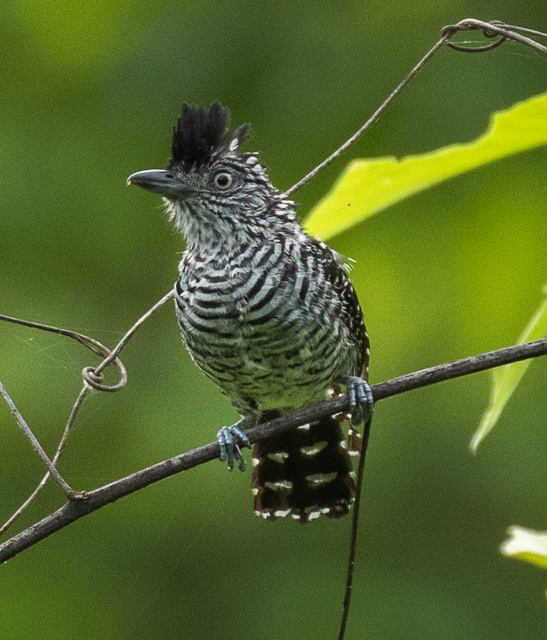
| - Both sexes possess a bushy crest and exhibit pronounced sexual dimorphism. English Wikipedia
- Adult males of the nominate subspecies have predominantly black-and-white barred plumage. English Wikipedia
- Adult females of the nominate subspecies have cinnamon-rufous crests and upperparts. English Wikipedia
- Adults of both sexes have pale yellow irises, black upper mandibles, bluish-gray lower mandibles, and lead-gray legs and feet. English Wikipedia
- Juvenile males have black and light yellowish-brown barring. English Wikipedia
|
|---|
| Size | | |
|---|
| Habitat | - The species inhabits seasonally flooded várzea forests along waterways and oxbow lakes. English Wikipedia
- The species favors dense vine thickets and other vegetation close to water. English Wikipedia
- The species occurs at elevations between 100 and 250 m above sea level. English Wikipedia
| - The Coiba Island subspecies inhabits tropical deciduous forest. English Wikipedia
- The Tobago subspecies inhabits mature humid forest. English Wikipedia
- The eastern Brazilian subspecies T. d. capistratus primarily inhabits caatinga and restinga. English Wikipedia
- In eastern Colombia, the species frequently occurs on river islands. English Wikipedia
- In Ecuador, northern Peru, and much of Brazilian Amazonia, the species occurs almost exclusively on river islands. English Wikipedia
- In southern Bolivia, Paraguay, and Argentina, its habitats include savanna, scrub, secondary forest, and riverine belts. English Wikipedia
- In Mexico, Central America, and Colombia, the species occurs from sea level to approximately 1,500 m elevation. English Wikipedia
- In Venezuela, the species reaches elevations of 2,000 m, although most records are below 1,250 m. English Wikipedia
- In Ecuador, the species occurs only below 250 m elevation. English Wikipedia
|
|---|
| Diet | - The black-tailed antbird feeds on insects, although its diet has not been documented in detail. English Wikipedia
| - Its diet consists primarily of mature and larval insects, supplemented by other arthropods, small lizards, fruit, and seeds. English Wikipedia
- The species also feeds on prey escaping army ant swarms. English Wikipedia
|
|---|
| Behaviour | - The species typically forages in pairs within dense vegetation. English Wikipedia
- While foraging, individuals hop between feeding stops on or near the ground. English Wikipedia
- The species is not known to participate in mixed-species feeding flocks. English Wikipedia
- The black-tailed antbird is described as shy and secretive. ebird.org
- The black-tailed antbird remains resident throughout its geographical range year-round. English Wikipedia
| - The species remains resident throughout its geographical range year-round. English Wikipedia
- Individuals typically forage in closely associated pairs within dense foliage from ground level to approximately 3 m, occasionally reaching 10 m. English Wikipedia
- The species almost never participates in mixed-species feeding flocks. English Wikipedia
- It captures prey by rapidly stabbing at leaves, stems, branches, and trunks. English Wikipedia
- Both sexes sing while stretching their necks, bowing forward, and pumping their tails up and down. English Wikipedia
|
|---|
| Reproduction | - The species' breeding season includes July, although its complete breeding season is unknown. English Wikipedia
- The species builds a globe-shaped nest from dried leaves on the ground. English Wikipedia
| - The species is monogamous, and breeding pairs vigorously defend territories throughout the year. English Wikipedia
- Territory sizes measured in one study ranged from approximately 2,500 to 4,200 square metres. English Wikipedia
- Breeding has been recorded in every month of the year somewhere within the species' range. English Wikipedia
- In Trinidad and Tobago, the species apparently breeds throughout the year. English Wikipedia
- The nest is an open, tightly woven cup with thin walls constructed from fungal and vegetable fibers, vines, grasses, and twigs. English Wikipedia
- The nest is generally suspended by its rim from a branch fork at heights reaching 10 m above the ground. English Wikipedia
- Both sexes participate in nest construction. English Wikipedia
- The usual clutch contains two eggs, although clutches of three have been reported in Trinidad. English Wikipedia
- Both parents incubate eggs during daylight, while only the female incubates at night. English Wikipedia
- A Costa Rican study recorded an incubation period of 13 days after the second egg was laid. English Wikipedia
- Studies in multiple countries recorded a period of 10–13 days between hatching and fledging. English Wikipedia
- Both parents brood and feed the nestlings. English Wikipedia
|
|---|
| Distribution | - The black-tailed antbird occurs in the far western Amazon Basin of Peru, Brazil, and Colombia. English Wikipedia
- In Peru, the species occurs along the upper Amazon and several major tributaries in the departments of Loreto and Ucayali. English Wikipedia
- Its range extends across extreme southern Colombia and into extreme western Amazonas state in Brazil. English Wikipedia
| - The species occurs in Mexico, every Central American country, Trinidad and Tobago, and all mainland South American countries except Chile and Uruguay. English Wikipedia
- One accepted occurrence record exists from southern Texas. English Wikipedia
- The subspecies T. d. intermedius occurs from San Luis Potosí and Tamaulipas in east-central Mexico south through Central America to Costa Rica and possibly Panama. English Wikipedia
- The subspecies T. d. nesiotes occurs on the Pearl Islands in the Gulf of Panama. English Wikipedia
- The subspecies T. d. eremnus occurs on Coiba Island off western Panama. English Wikipedia
|
|---|
| Conservation | - The black-tailed antbird is classified as Near Threatened. English Wikipedia
- The IUCN assessed the species as Vulnerable in 1994, Near Threatened in 2004, Vulnerable again in 2012, and Near Threatened in 2023. English Wikipedia
- The species has a restricted geographical range and specialized habitat requirements. English Wikipedia
- The population size is unknown and is believed to be declining. English Wikipedia
- Habitat degradation threats include oil exploration and extraction, logging, and increasing human colonization. English Wikipedia
- Deforestation is particularly intense along larger rivers and in east-central Peru. English Wikipedia
- The species is considered rare to uncommon. English Wikipedia
| - The IUCN classifies the species as Least Concern. English Wikipedia
- The estimated population comprises at least 50 million mature individuals and is considered stable. English Wikipedia
- Deforestation, habitat destruction, and habitat fragmentation are identified as challenges to the species' survival. English Wikipedia
|
|---|
| Similar species | - The black-tailed antbird and the white-lined antbird are sister species. English Wikipedia
| No checked fact yet |
|---|
| Name origin | No checked fact yet | - The specific epithet doliatus derives from Neo-Latin and means barred. English Wikipedia
|
|---|