| Appearance | - The white-nosed coati has a long tail that accounts for approximately half its total body length. English Wikipedia
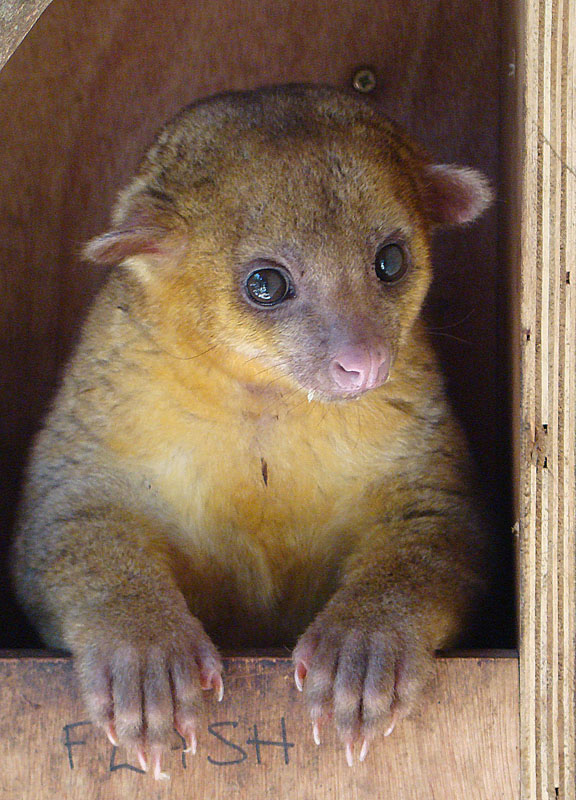
| - The kinkajou has a rounded head, large eyes, a short pointed snout, short limbs, and a long prehensile tail. English Wikipedia
- Its fur is short, woolly, and dense. English Wikipedia
- Its coat can have tawny olive, wood brown, and yellowish tawny shades on the upper body. English Wikipedia
- The kinkajou has a long, thick, highly extensible tongue. English Wikipedia
- Its claws are short and sharp. English Wikipedia
- Its eyes reflect green or bright yellow when exposed to light. English Wikipedia
- The kinkajou has small, rounded ears that distinguish it from other procyonids. English Wikipedia
- Its coat is generally thick, woolly, and honey-brown. animaldiversity.org
|
|---|
| Size | | |
|---|
| Habitat | - The white-nosed coati inhabits wooded areas in tropical and subtropical dry broadleaf forests. English Wikipedia
- The white-nosed coati inhabits tropical and subtropical moist broadleaf forests. English Wikipedia
- The white-nosed coati occurs at elevations ranging from sea level to 3,000 m. English Wikipedia
| - Kinkajous inhabit closed-canopy tropical forests, including lowland rainforests, montane forests, dry forests, gallery forests, and secondary forests. English Wikipedia
- Kinkajous occupy tropical dry forests, secondary forests, Amazonian rainforests, Atlantic coastal forests, tropical evergreen forests, and savannah-region forests in Suriname. animaldiversity.org
- Kinkajous are rarely found in palm jungles, cloud forests, or thorn forests. animaldiversity.org
- Kinkajous spend their daytime resting in tree hollows or shaded foliage. English Wikipedia
- Kinkajous usually sleep in tree crotches or holes, often alongside members of their social group. animaldiversity.org
- Kinkajous generally occupy the rainforest canopy and rarely descend to the forest floor. lamar.edu
|
|---|
| Diet | | - Approximately 90% of the kinkajou's diet consists primarily of fruit. English Wikipedia
- Figs are a particularly important food for kinkajous. English Wikipedia
- Kinkajous also consume leaves, flowers, nectar, and various herbs. English Wikipedia
- Kinkajous sometimes eat ants and other insects. English Wikipedia
- Kinkajous occasionally consume bird eggs and small vertebrates. English Wikipedia
- The kinkajou uses its extensible tongue to obtain nectar from flowers. English Wikipedia
- Kinkajous have been documented eating figs, grapes, bananas, melons, apples, and mangoes. lamar.edu
- Kinkajous obtain water from fruit and from water collected in tree notches and on leaves. lamar.edu
|
|---|
| Behaviour | - The white-nosed coati is diurnal and performs much of its foraging during daylight. English Wikipedia
- The white-nosed coati can climb trees easily. English Wikipedia
- The white-nosed coati uses its tail for balance when climbing. English Wikipedia
- Adult male white-nosed coatis generally live alone outside the mating season. English Wikipedia
- Female white-nosed coatis live in groups called bands with their offspring. English Wikipedia
- Female white-nosed coati groups also include males younger than two years. English Wikipedia
| - Kinkajous use their prehensile tails as an additional limb when climbing. English Wikipedia
- Kinkajous can rotate their ankles and feet by 180 degrees, enabling them to climb down trees headfirst. English Wikipedia
- Kinkajous mark their territories and travel routes using scent glands near their mouths, throats, and bellies. English Wikipedia
- Kinkajous sleep in family units and groom one another. English Wikipedia
- Kinkajous generally forage alone but sometimes feed in large groups. English Wikipedia
- Kinkajous are capable of hanging upside down while feeding, supporting themselves with their tails and hind legs. animaldiversity.org
- Kinkajous exhibit complex social groups that commonly contain two males, one female, and offspring. animaldiversity.org
- Kinkajous maintain territorial boundaries through scent marking. animaldiversity.org
|
|---|
| Reproduction | | |
|---|
| Distribution | - The white-nosed coati's range extends north to Flagstaff, Arizona, and New Mexico. English Wikipedia
- The white-nosed coati occurs in Mexico and Central America. English Wikipedia
- The white-nosed coati's native distribution extends into northwestern Colombia near the Panamanian border. English Wikipedia
| No checked fact yet |
|---|
| Conservation | - The IUCN lists the white-nosed coati as a species of least concern. English Wikipedia
- The white-nosed coati is classified as endangered in New Mexico. English Wikipedia
- Habitat loss and hunting are primary threats to the white-nosed coati. English Wikipedia
- White-nosed coatis are hunted for their meat and pelts. English Wikipedia
- White-nosed coatis can be accidentally captured in traps set for other species. English Wikipedia
- White-nosed coati populations are affected by distemper and rabies. English Wikipedia
| - Deforestation is identified as a potential threat to kinkajous. English Wikipedia
- Honduras has included the kinkajou in Appendix III of CITES. English Wikipedia
- Exports of kinkajous from Honduras require an export permit. English Wikipedia
- Exports of kinkajous from other countries require a certificate of origin or re-export under the stated CITES listing. English Wikipedia
|
|---|
| Uses | No checked fact yet | |
|---|
| Similar species | No checked fact yet | - Olingos are sufficiently similar in appearance to kinkajous that some native cultures do not distinguish between them. English Wikipedia
- Kinkajous are larger than olingos and have shorter muzzles. English Wikipedia
- The binturong shares the kinkajou's prehensile-tail characteristic but is substantially larger. English Wikipedia
|
|---|
| Other | - The Smithsonian National Zoo reports that white-nosed coatis have strong claws. nationalzoo.si.edu
| |
|---|