| Appearance | - The South American coati has highly variable fur coloration, ranging from dark brown and gray to rust-colored shades. English Wikipedia
- The South American coati lacks the largely white snout characteristic of the white-nosed coati. English Wikipedia
- Its underparts are white, while its upperparts can be dark brown, gray, or rust-colored. animaldiversity.org
- Its elongated, flexible muzzle has a slightly upturned nose. animaldiversity.org
- Its long tail is dark-colored with yellow rings. animaldiversity.org
- Its ears are small and have white fringes along their inner rims. animaldiversity.org
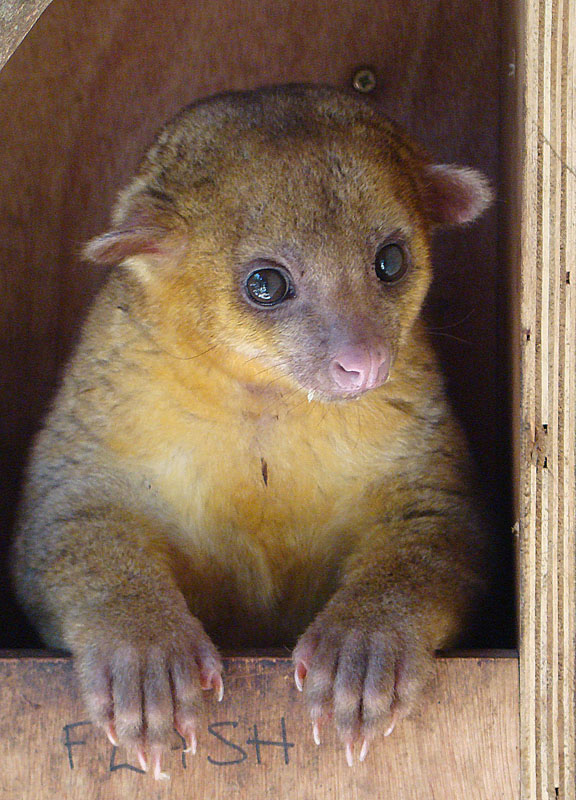
| - The kinkajou has a rounded head, large eyes, a short pointed snout, short limbs, and a long prehensile tail. English Wikipedia
- Its fur is short, woolly, and dense. English Wikipedia
- Its coat can have tawny olive, wood brown, and yellowish tawny shades on the upper body. English Wikipedia
- The kinkajou has a long, thick, highly extensible tongue. English Wikipedia
- Its claws are short and sharp. English Wikipedia
- Its eyes reflect green or bright yellow when exposed to light. English Wikipedia
- The kinkajou has small, rounded ears that distinguish it from other procyonids. English Wikipedia
- Its coat is generally thick, woolly, and honey-brown. animaldiversity.org
|
|---|
| Size | | |
|---|
| Habitat | - The species inhabits lowland forests east of the Andes at elevations reaching 2,500 meters. English Wikipedia
- It occupies deciduous, evergreen, cloud, riverine gallery, xeric, Chaco, cerrado, and dry scrub forests. animaldiversity.org
- The species tends to prefer secondary forests and forest edges in areas affected by human activity. animaldiversity.org
| - Kinkajous inhabit closed-canopy tropical forests, including lowland rainforests, montane forests, dry forests, gallery forests, and secondary forests. English Wikipedia
- Kinkajous occupy tropical dry forests, secondary forests, Amazonian rainforests, Atlantic coastal forests, tropical evergreen forests, and savannah-region forests in Suriname. animaldiversity.org
- Kinkajous are rarely found in palm jungles, cloud forests, or thorn forests. animaldiversity.org
- Kinkajous spend their daytime resting in tree hollows or shaded foliage. English Wikipedia
- Kinkajous usually sleep in tree crotches or holes, often alongside members of their social group. animaldiversity.org
- Kinkajous generally occupy the rainforest canopy and rarely descend to the forest floor. lamar.edu
|
|---|
| Diet | - The South American coati is omnivorous and primarily consumes fruits, invertebrates, small animals, and bird eggs. English Wikipedia
- Its recorded foods include palms, eggs, beetle larvae, scorpions, centipedes, spiders, ants, and termites. animaldiversity.org
- It also eats lizards, small mammals, rodents, and carrion when available. animaldiversity.org
- The species searches for animal prey by turning over rocks and opening logs with its claws. English Wikipedia
- Its flexible snout allows it to search for food beneath leaf litter and overturned debris. animaldiversity.org
| - Approximately 90% of the kinkajou's diet consists primarily of fruit. English Wikipedia
- Figs are a particularly important food for kinkajous. English Wikipedia
- Kinkajous also consume leaves, flowers, nectar, and various herbs. English Wikipedia
- Kinkajous sometimes eat ants and other insects. English Wikipedia
- Kinkajous occasionally consume bird eggs and small vertebrates. English Wikipedia
- The kinkajou uses its extensible tongue to obtain nectar from flowers. English Wikipedia
- Kinkajous have been documented eating figs, grapes, bananas, melons, apples, and mangoes. lamar.edu
- Kinkajous obtain water from fruit and from water collected in tree notches and on leaves. lamar.edu
|
|---|
| Behaviour | | - Kinkajous use their prehensile tails as an additional limb when climbing. English Wikipedia
- Kinkajous can rotate their ankles and feet by 180 degrees, enabling them to climb down trees headfirst. English Wikipedia
- Kinkajous mark their territories and travel routes using scent glands near their mouths, throats, and bellies. English Wikipedia
- Kinkajous sleep in family units and groom one another. English Wikipedia
- Kinkajous generally forage alone but sometimes feed in large groups. English Wikipedia
- Kinkajous are capable of hanging upside down while feeding, supporting themselves with their tails and hind legs. animaldiversity.org
- Kinkajous exhibit complex social groups that commonly contain two males, one female, and offspring. animaldiversity.org
- Kinkajous maintain territorial boundaries through scent marking. animaldiversity.org
|
|---|
| Reproduction | | |
|---|
| Conservation | - The South American coati is classified as being of least concern for extinction by the IUCN. nationalgeographic.com
- The species is protected under CITES Appendix III in Uruguay. animaldiversity.org
- The South American coati has been included on the European Union's list of Invasive Alien Species of Union concern since 2016. English Wikipedia
| - Deforestation is identified as a potential threat to kinkajous. English Wikipedia
- Honduras has included the kinkajou in Appendix III of CITES. English Wikipedia
- Exports of kinkajous from Honduras require an export permit. English Wikipedia
- Exports of kinkajous from other countries require a certificate of origin or re-export under the stated CITES listing. English Wikipedia
|
|---|
| Uses | | |
|---|
| Similar species | No checked fact yet | - Olingos are sufficiently similar in appearance to kinkajous that some native cultures do not distinguish between them. English Wikipedia
- Kinkajous are larger than olingos and have shorter muzzles. English Wikipedia
- The binturong shares the kinkajou's prehensile-tail characteristic but is substantially larger. English Wikipedia
|
|---|
| Other | No checked fact yet | |
|---|