Comparison

Green Water Snake vs Common Watersnake

Green Water Snake (Nerodia cyclopion) and Common Watersnake (Nerodia sipedon) both belong to the genus Nerodia (water snakes) and part ways below it. Both are recorded in 1 country.

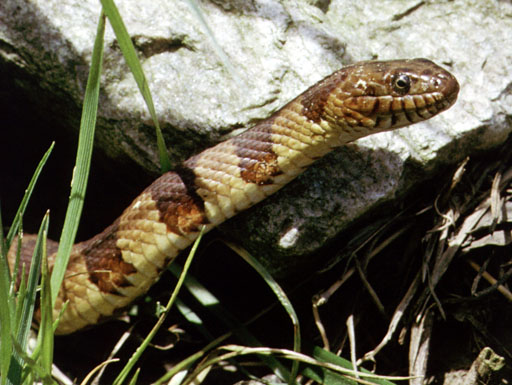
Green Water Snake

Green Water Snake

Nerodia cyclopion

John Sullivan, CC BY-SA 3.0, via Wikimedia Commons

Common Watersnake

Common Watersnake

Nerodia sipedon

Patrick Coin (Patrick Coin), CC BY-SA 2.5, via Wikimedia Commons

Side by side

Green Water SnakeCommon Watersnake
Scientific nameNerodia cyclopion (Duméril, Bibron & Duméril, 1854)Nerodia sipedon (Linnaeus, 1758)
English nameGreen Water SnakeCommon Watersnake
GroupReptilesReptiles
ClassReptilia ReptileReptilia Reptile
OrderSquamata SnakesSquamata Snakes
FamilyColubridae ColubridColubridae Colubrid
GenusNerodia Water SnakesNerodia Water Snakes
Named in18541758
Red List categoryLeast ConcernLeast Concern
Environmentfreshwater, terrestrialfreshwater, marine
Countries on record2 countries4 countries
GBIF occurrence records3,303 records84,794 records

Rows where the two agree are shown in grey.

Where each is found

Both recorded in 1 country

Only Green Water Snake (1)

Only Common Watersnake (3)

From Catalogue of Life checklists and GBIF occurrence records. A country missing from a list means no record is held, which is not proof of absence.

Checked facts

Green Water SnakeCommon Watersnake
Appearance
  • The species has a brown, gray, reddish, or brownish-black body with dark crossbands on the neck and dark blotches along the rest of the body. English Wikipedia
  • The species' coloration generally darkens with age, and its body pattern may become difficult to distinguish. English Wikipedia
  • The belly can be white, yellow, or gray and usually has reddish or black crescent-shaped markings. English Wikipedia
  • Adult individuals can become almost entirely black. English Wikipedia
  • The species has keeled scales and a divided anal plate. animaldiversity.org
  • Juveniles have reddish-brown saddles against a tan, brown, or gray background. animaldiversity.org
  • The species has 21–25 scales at midbody. animaldiversity.org
  • Juvenile individuals have dark crossbands against a light-brown, tan, or gray background. in.gov
Habitat
  • Nerodia cyclopion prefers still-water habitats including bayous, lakes, marshes, ponds, sluggish streams, and swamps. English Wikipedia
  • Nerodia cyclopion is occasionally found in brackish water. English Wikipedia
  • In Illinois, Nerodia cyclopion inhabits quiet backwater sloughs and cypress-tupelo swamps in extreme southwestern counties. herpetology.inhs.illinois.edu
  • The species inhabits streams, lakes, ponds, and wetlands. English Wikipedia
  • Juveniles typically occupy smaller streams adjacent to the larger waterways inhabited by adults. English Wikipedia
  • The species uses rivers, streams, sloughs, lakes, ponds, bogs, marshes, and impoundments. animaldiversity.org
  • Northern water snakes prefer open areas with basking opportunities and relatively still water. animaldiversity.org
  • Individuals may shelter beneath flat rocks, logs, and boards when not basking or searching for food. animaldiversity.org
  • The species prefers warm, permanent, shallow water with access to basking locations. in.gov
Diet
  • The species feeds on small fish, tadpoles, frogs, worms, leeches, crayfish, large insects, mollusks, annelids, salamanders, other snakes, turtles, small birds, and mammals. English Wikipedia
  • The species is both carnivorous and a scavenger. animaldiversity.org
  • Northern water snakes swallow their prey alive rather than constricting it. animaldiversity.org
  • The species also consumes frogs, toads, salamanders, and carrion in Indiana. in.gov
Behaviour
  • The species is active both during daylight and nighttime. English Wikipedia
  • The species commonly basks on rocks, stumps, and brush. English Wikipedia
  • The species uses smell and sight to locate prey. English Wikipedia
  • The species commonly dives into the water when disturbed while basking. English Wikipedia
  • When cornered or captured, the species generally defends itself. English Wikipedia
  • Northern water snakes are more active during daylight hours despite being observed both day and night. animaldiversity.org
  • When escaping predators, northern water snakes may dive and anchor themselves to vegetation or logs underwater. animaldiversity.org
  • When threatened, northern water snakes flatten their bodies and jaws and strike and bite. animaldiversity.org
  • The species may release foul-smelling musk and defecate when threatened. animaldiversity.org
  • The species may flatten its head and strike when cornered or restrained. in.gov
Reproduction
Distribution
  • Nerodia cyclopion occurs in the southeastern United States, from the Florida panhandle westward to Louisiana and northward through the Mississippi Valley into southern Illinois. English Wikipedia
  • Except for three specimens collected at Horseshoe Lake in Alexander County in 1907, Illinois specimens of Nerodia cyclopion are from LaRue-Pine Hills. herpetology.inhs.illinois.edu
No checked fact yet
Conservation
  • Introduced common watersnakes in California are considered invasive and may compete with the threatened giant garter snake. English Wikipedia
  • The species may threaten vulnerable fish and amphibians through excessive predation. English Wikipedia
  • The Lake Erie watersnake subspecies was removed from the United States Federal List of Endangered and Threatened Wildlife on August 16, 2011. English Wikipedia
  • The Lake Erie watersnake population increased to 11,980 individuals by 2009. English Wikipedia
UsesNo checked fact yet
  • The species may benefit sport fishing by consuming diseased and dying fish and reducing fish overpopulation. animaldiversity.org
  • The species may cause problems for fish hatcheries and fish farms. animaldiversity.org
Similar speciesNo checked fact yet
  • The common watersnake is frequently mistaken for the venomous cottonmouth. English Wikipedia
  • The common watersnake has round pupils and lacks heat-sensing pits, distinguishing it from the cottonmouth. English Wikipedia
OtherNo checked fact yet
  • The species is nonvenomous and harmless to humans. English Wikipedia
  • The saliva contains a mild hemotoxic anticoagulant that can increase bleeding from bites. English Wikipedia

In brief

Green Water Snake

Nerodia cyclopion occurs in the southeastern United States, from the Florida panhandle westward to Louisiana and northward through the Mississippi Valley into southern Illinois. It has a heavy-bodied build, greenish to olive or brown dorsal coloration, and a dark belly with pale semicircular markings. Full profile

Common Watersnake

Nerodia sipedon has a brown, gray, reddish, or brownish-black body with dark crossbands on the neck and dark blotches along the rest of the body. Full profile

Compare something else

Page built on 27 November 2026 from the data on the two species pages, where every source is listed.

Cite this page

ScientificNames.org. (2026). Green Water Snake vs Common Watersnake. Retrieved November 27, 2026, from https://scientificnames.org/compare/green-water-snake-vs-common-watersnake