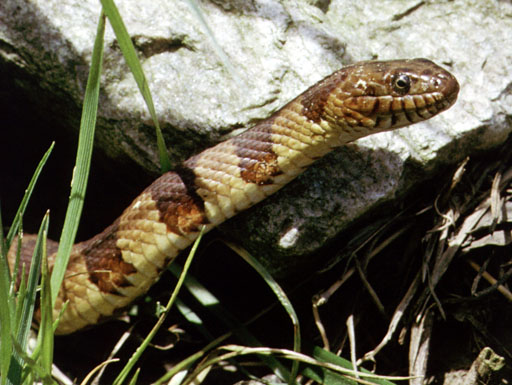
| Appearance | - Adults are generally large, thick-bodied snakes with mostly uniform dorsal coloration and an unmarked belly. English Wikipedia
- Dorsal coloration varies among dark brown, gray, olive-green, greenish-gray, and blackish shades. English Wikipedia
- The belly typically lacks distinctive markings and ranges from light reddish hues to beige. English Wikipedia
- Some individuals have a thin white line separating their pale belly from their darker dorsal scales. English Wikipedia
- Juveniles have dorsal patterns resembling those of banded water snakes but have unmarked bellies. English Wikipedia
- Juveniles have alternating mid-dorsal and lateral blotches and lighter dorsal coloration than adults. animaldiversity.org
- The belly and subcaudal scales are generally uniformly colored. animaldiversity.org
- Missouri populations are generally gray, greenish gray, or brownish black, with a plain yellow belly that occasionally has orange coloration. mdc.mo.gov
| - The species has a brown, gray, reddish, or brownish-black body with dark crossbands on the neck and dark blotches along the rest of the body. English Wikipedia
- The species' coloration generally darkens with age, and its body pattern may become difficult to distinguish. English Wikipedia
- The belly can be white, yellow, or gray and usually has reddish or black crescent-shaped markings. English Wikipedia
- Adult individuals can become almost entirely black. English Wikipedia
- The species has keeled scales and a divided anal plate. animaldiversity.org
- Juveniles have reddish-brown saddles against a tan, brown, or gray background. animaldiversity.org
- The species has 21–25 scales at midbody. animaldiversity.org
- Juvenile individuals have dark crossbands against a light-brown, tan, or gray background. in.gov
|
|---|
| Habitat | - The species inhabits freshwater wetlands, including creeks, rivers, swamps, floodplains, lakes, and ponds. English Wikipedia
- Individuals are commonly found near permanent freshwater sources that are several feet deep. English Wikipedia
- The species uses terrestrial habitats including forests, grasslands, and scrublands. animaldiversity.org
- Aquatic habitats include temporary pools, permanent lakes and ponds, swamps, bogs, marshes, small rivers, and riverine sloughs. animaldiversity.org
- Individuals use terrestrial habitats as travel corridors, aestivation sites, hibernation sites, and occasional feeding areas. animaldiversity.org
- Hibernation primarily occurs in crayfish burrows near wetlands. animaldiversity.org
- Missouri populations prefer quiet freshwater habitats such as swamps, sloughs, oxbows, slow-moving rivers, streams, and drainage ditches. mdc.mo.gov
| - The species inhabits streams, lakes, ponds, and wetlands. English Wikipedia
- Juveniles typically occupy smaller streams adjacent to the larger waterways inhabited by adults. English Wikipedia
- The species uses rivers, streams, sloughs, lakes, ponds, bogs, marshes, and impoundments. animaldiversity.org
- Northern water snakes prefer open areas with basking opportunities and relatively still water. animaldiversity.org
- Individuals may shelter beneath flat rocks, logs, and boards when not basking or searching for food. animaldiversity.org
- The species prefers warm, permanent, shallow water with access to basking locations. in.gov
|
|---|
| Diet | - The species feeds on tadpoles, amphibians, fish, crayfish, other crustaceans, aquatic insects, hatchling turtles, and carrion. English Wikipedia
- Toads and frogs constitute a substantial portion of the diet. English Wikipedia
- Missouri populations consume fish, toads, frogs, tadpoles, salamanders, and crayfish. mdc.mo.gov
- Feeding primarily occurs in or near temporary wetlands where frogs and toads are abundant. animaldiversity.org
| - The species feeds on small fish, tadpoles, frogs, worms, leeches, crayfish, large insects, mollusks, annelids, salamanders, other snakes, turtles, small birds, and mammals. English Wikipedia
- The species is both carnivorous and a scavenger. animaldiversity.org
- Northern water snakes swallow their prey alive rather than constricting it. animaldiversity.org
- The species also consumes frogs, toads, salamanders, and carrion in Indiana. in.gov
|
|---|
| Behaviour | - The species is active during the warmest months and may be active both day and night during the hottest summer periods. English Wikipedia
- Individuals are mostly solitary outside mating aggregations. animaldiversity.org
- The species captures and swallows prey alive without constriction or envenomation. English Wikipedia
- When threatened, individuals may strike toward the perceived threat or release foul-smelling musk. English Wikipedia
- Individuals may escape threats by leaving the water and moving over land. English Wikipedia
- The species hibernates during the coldest winter months. English Wikipedia
- In Missouri, seasonal activity generally extends from late March through October. mdc.mo.gov
| - The species is active both during daylight and nighttime. English Wikipedia
- The species commonly basks on rocks, stumps, and brush. English Wikipedia
- The species uses smell and sight to locate prey. English Wikipedia
- The species commonly dives into the water when disturbed while basking. English Wikipedia
- When cornered or captured, the species generally defends itself. English Wikipedia
- Northern water snakes are more active during daylight hours despite being observed both day and night. animaldiversity.org
- When escaping predators, northern water snakes may dive and anchor themselves to vegetation or logs underwater. animaldiversity.org
- When threatened, northern water snakes flatten their bodies and jaws and strike and bite. animaldiversity.org
- The species may release foul-smelling musk and defecate when threatened. animaldiversity.org
- The species may flatten its head and strike when cornered or restrained. in.gov
|
|---|
| Reproduction | | |
|---|
| Distribution | - The species is distributed across the southeastern United States, excluding higher elevations of the Appalachian Mountains. English Wikipedia
- The subspecies Nerodia erythrogaster bogerti occurs in Durango, Mexico. animaldiversity.org
- The subspecies Nerodia erythrogaster alta occurs in Zacatecas, Mexico. animaldiversity.org
| No checked fact yet |
|---|
| Conservation | - Wetland loss and other human-related factors are identified as conservation threats to the species. English Wikipedia
- Loss of wetlands and terrestrial corridors has placed many populations under severe stress. animaldiversity.org
- The species is not protected in the southeastern United States. English Wikipedia
| - Introduced common watersnakes in California are considered invasive and may compete with the threatened giant garter snake. English Wikipedia
- The species may threaten vulnerable fish and amphibians through excessive predation. English Wikipedia
- The Lake Erie watersnake subspecies was removed from the United States Federal List of Endangered and Threatened Wildlife on August 16, 2011. English Wikipedia
- The Lake Erie watersnake population increased to 11,980 individuals by 2009. English Wikipedia
|
|---|
| Uses | - The species helps regulate populations of the animals it consumes through predation. mdc.mo.gov
| - The species may benefit sport fishing by consuming diseased and dying fish and reducing fish overpopulation. animaldiversity.org
- The species may cause problems for fish hatcheries and fish farms. animaldiversity.org
|
|---|
| Similar species | No checked fact yet | - The common watersnake is frequently mistaken for the venomous cottonmouth. English Wikipedia
- The common watersnake has round pupils and lacks heat-sensing pits, distinguishing it from the cottonmouth. English Wikipedia
|
|---|
| Other | No checked fact yet | - The species is nonvenomous and harmless to humans. English Wikipedia
- The saliva contains a mild hemotoxic anticoagulant that can increase bleeding from bites. English Wikipedia
|
|---|