Comparison

Night Smelt vs Longfin Smelt

Night Smelt (Spirinchus starksi) and Longfin Smelt (Spirinchus thaleichthys) both belong to the genus Spirinchus (longfin smelts) and part ways below it. Both are recorded in 2 countries.

Night Smelt

Spirinchus starksi
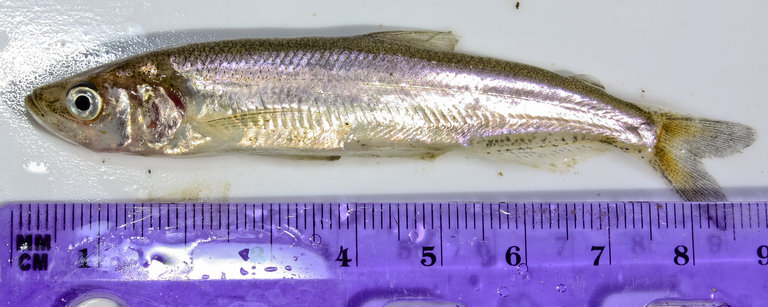
Longfin Smelt

Longfin Smelt

Spirinchus thaleichthys

Bill Stagnaro, CC BY-SA 3.0, via Wikimedia Commons

Side by side

Night SmeltLongfin Smelt
Scientific nameSpirinchus starksi (Fisk, 1913)Spirinchus thaleichthys (Ayres, 1860)
English nameNight SmeltLongfin Smelt
GroupFishesFishes
ClassTeleostei TeleostTeleostei Teleost
OrderOsmeriformesOsmeriformes
FamilyOsmeridae SmeltOsmeridae Smelt
GenusSpirinchus Longfin SmeltsSpirinchus Longfin Smelts
Named in19131860
Red List categoryNot recordedLeast Concern
Environmentmarinebrackish, freshwater, marine
Countries on record2 countries2 countries
GBIF occurrence records270 records1,012 records

Rows where the two agree are shown in grey.

Where each is found

Both recorded in 2 countries

From Catalogue of Life checklists and GBIF occurrence records. A country missing from a list means no record is held, which is not proof of absence.

Checked facts

Night SmeltLongfin Smelt
Appearance
  • The species has an elongated, streamlined body that is compressed laterally. English Wikipedia
  • Its sides and underside are generally silver-white, while its back ranges from olive-green or brown to pinkish. English Wikipedia
  • Its pectoral fins extend nearly to the bases of its pelvic fins. English Wikipedia
  • The species has a forked tail with two equally sized lobes. English Wikipedia
  • Its lateral line is incomplete and extends only to just below the dorsal fin. English Wikipedia
  • Its dorsal fin has 8–10 rays and its anal fin has 15–19 rays. English Wikipedia
  • Its lower jaw projects beyond its upper jaw when compressed. English Wikipedia
  • Teeth occur on the tongue and in both jaws. English Wikipedia
  • Males generally have a more angular anal fin, sometimes with a small protruding bump, whereas females have a rounder anal fin. English Wikipedia
  • Spawning males are generally darker than females and have extensive stippling on their backs and along their scale margins. adfg.alaska.gov
  • During spawning, males develop enlarged and stiffened portions of their pectoral, pelvic, anal, and dorsal fins. adfg.alaska.gov
Size
Habitat
  • The night smelt inhabits surface waters and has been recorded at depths of up to 420 feet. English Wikipedia
  • The night smelt occurs over sandy substrates in marine coastal environments. English Wikipedia
  • The night smelt spawns along sandy open coasts and coarse sandy beaches, often near river or creek mouths. English Wikipedia
  • The night smelt has been observed on beaches with coarser sand. English Wikipedia
  • The species generally inhabits bays and estuaries while spawning in coastal rivers. English Wikipedia
  • The species can occupy marine, estuarine, and freshwater environments. English Wikipedia
  • The species inhabits open water across most of the water column. English Wikipedia
  • Marine populations prefer relatively shallow areas. English Wikipedia
  • Spawning rivers are typically slow-moving because the fish cannot swim effectively through long stretches of fast-flowing water. adfg.alaska.gov
  • Spawning sites are generally located in lower river or stream elevations. adfg.alaska.gov
  • The species requires salinity levels between 2 and 18 parts per thousand. English Wikipedia
  • Larvae require salinity between 0.4 and 10 parts per thousand and develop best at 5–10 parts per thousand. English Wikipedia
  • Successful embryonic development requires water temperatures between 10 and 12 °C. English Wikipedia
Diet
  • Juveniles younger than one year feed on chironomids, copepods, and cladocerans. English Wikipedia
  • Amphipods and cladocerans remain important food sources during winter. English Wikipedia
  • Juveniles and adults mainly consume small crustaceans, particularly copepods, cumaceans, and euphausiids. adfg.alaska.gov
  • Newly hatched juveniles feed mainly on copepod larvae, other plankton, and insect larvae. adfg.alaska.gov
Behaviour
  • The species forms large shoals. English Wikipedia
  • Individuals generally remain deeper during daylight and ascend at night to feed. English Wikipedia
  • Individuals gather in large groups near river mouths before migrating upstream to spawn. English Wikipedia
  • Males generally migrate to spawning grounds before females. English Wikipedia
  • The species does not consistently return to one particular spawning stream and instead appears to select suitable streams in its general natal area. adfg.alaska.gov
Reproduction
Distribution
  • The night smelt is native to the Pacific coast of North America, ranging from Point Arguello in California to Shelikof Bay in southeast Alaska. English Wikipedia
No checked fact yet
Conservation
  • Potential losses of spawning habitat caused by sea-level rise are identified as a threat to night smelt populations. English Wikipedia
  • The species is classified as Least Concern on the IUCN Red List. English Wikipedia
  • Watershed destruction and freshwater diversion, primarily for agriculture, threaten the species. English Wikipedia
  • The San Francisco Bay-Delta population was listed as Endangered by the U.S. Fish and Wildlife Service on July 29, 2024. English Wikipedia
  • Potential overharvesting by commercial, personal-use, and subsistence fisheries is identified as the main threat to the Alaskan resource. adfg.alaska.gov
Uses
  • Night smelt are commercially sold for human consumption. English Wikipedia
  • Night smelt are occasionally caught for use as fishing bait. English Wikipedia
  • Indigenous communities in Humboldt and Del Norte counties have harvested night smelt for subsistence and cultural purposes for hundreds of years. English Wikipedia
No checked fact yet
Similar species
  • The night smelt resembles the longfin smelt in appearance. English Wikipedia
  • The night smelt is frequently caught alongside surf smelt because of their similar appearance and overlapping habitats. English Wikipedia
No checked fact yet
Other
  • The night smelt is one of three extant species in the genus Spirinchus. English Wikipedia
No checked fact yet

In brief

Night Smelt

Night Smelt (Spirinchus starksi) is one of three extant species in the genus Spirinchus. It is native to the Pacific coast of North America, ranging from Point Arguello in California to Shelikof Bay in southeast Alaska. It has bright golden to silvery coloration and a distinctive cucumber-like odor. Full profile

Longfin Smelt

Spirinchus thaleichthys inhabits marine, estuarine, and freshwater environments, generally occupying bays and estuaries while spawning in coastal rivers. Full profile

Compare something else

Page built on 29 November 2026 from the data on the two species pages, where every source is listed.

Cite this page

ScientificNames.org. (2026). Night Smelt vs Longfin Smelt. Retrieved November 29, 2026, from https://scientificnames.org/compare/night-smelt-vs-longfin-smelt