Comparison

Bangka Slow Loris vs Javan Slow Loris

Bangka Slow Loris (Nycticebus bancanus) and Javan Slow Loris (Nycticebus javanicus) both belong to the genus Nycticebus (slow loris) and part ways below it.
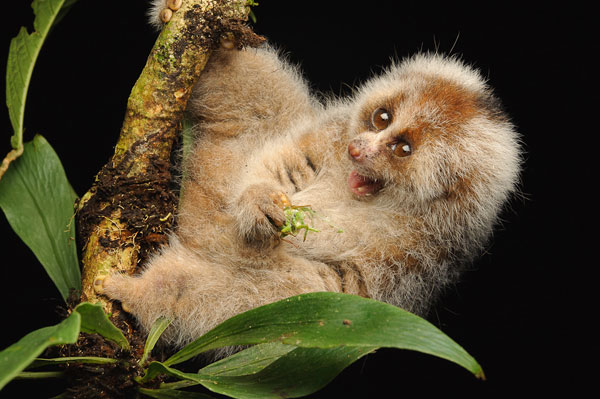
Bangka Slow Loris

Bangka Slow Loris

Nycticebus bancanus

Gunay M.E., CC BY-SA 4.0, via Wikimedia Commons

Javan Slow Loris

Javan Slow Loris

Nycticebus javanicus

Aprisonsan, CC BY-SA 4.0, via Wikimedia Commons

Side by side

Bangka Slow LorisJavan Slow Loris
Scientific nameNycticebus bancanus Lyon, 1906Nycticebus javanicus É. Geoffroy Saint-Hilaire, 1812
English nameBangka Slow LorisJavan Slow Loris
GroupMammalsMammals
ClassMammalia MammalMammalia Mammal
OrderPrimates PrimatePrimates Primate
FamilyLorisidae PottosLorisidae Pottos
GenusNycticebus Slow LorisNycticebus Slow Loris
Named in19061812
Red List categoryCritically EndangeredCritically Endangered
Countries on recordNot recorded1 country
GBIF occurrence recordsNot recorded112 records

Rows where the two agree are shown in grey.

Where each is found

Only Javan Slow Loris (1)

From Catalogue of Life checklists and GBIF occurrence records. A country missing from a list means no record is held, which is not proof of absence.

Checked facts

Bangka Slow LorisJavan Slow Loris
Appearance
  • The Javan slow loris has a prominent white diamond-shaped marking on its forehead formed by a stripe extending over the crown and branching toward the eyes and ears. English Wikipedia
  • Its coat is yellowish-gray, with cream-colored hues on the head, neck, and shoulders. English Wikipedia
  • The species has two forms distinguished mainly by differences in hair length. English Wikipedia
  • The ornatus form has longer fur, averaging 26.8 mm compared with 22.4 mm in the javanicus form. English Wikipedia
  • The ornatus form is generally light brown, whereas the javanicus form ranges from brown to reddish. English Wikipedia
  • The Javan slow loris lacks the second incisor in its dentition. English Wikipedia
Size
  • The average body length of the Bangka slow loris is 258.05 mm (10.159 inches). English Wikipedia
Habitat
  • The species inhabits both primary and secondary forests. English Wikipedia
  • The Javan slow loris also occurs in bamboo forests, mangrove forests, and chocolate plantations. English Wikipedia
  • The species has been observed occupying mixed-crop home gardens in West Java. English Wikipedia
  • It occurs at elevations ranging from sea level to 1,600 m. English Wikipedia
  • The species moves through the forest canopy at heights between 3 and 22 m. English Wikipedia
  • The Javan slow loris has been recorded in montane cloud forests in Gunung Gede Pangrango National Park. English Wikipedia
Diet
Behaviour
  • The Bangka slow loris is nocturnal. English Wikipedia
  • The species uses its curved second hind-toe claw for scratching and grooming. English Wikipedia
  • The species uses its toothcomb for grooming. English Wikipedia
  • The Bangka slow loris uses secretions from its brachial gland defensively by wiping them onto its toothcomb. English Wikipedia
  • The species has a toxic bite, a distinctive characteristic among primates. English Wikipedia
  • The species activates its brachial gland toxin by mixing the secretion with saliva. English Wikipedia
  • The species applies toxin to its fur during grooming to protect its infants. English Wikipedia
Distribution
  • The Bangka slow loris occurs in southwestern Borneo and on Bangka Island. English Wikipedia
  • The Javan slow loris is restricted to the western and central portions of Java, Indonesia. English Wikipedia
  • The species occurs at low population densities in Gunung Gede Pangrango National Park. English Wikipedia
Conservation
  • The Bangka slow loris was assessed by the IUCN in 2015 as Critically Endangered. iucnredlist.org
  • Habitat loss is one of the greatest threats to the survival of the Bangka slow loris. English Wikipedia
  • Illegal wildlife trade is a major threat to the species. English Wikipedia
  • The species is protected from commercial trade under Appendix I of CITES. English Wikipedia
  • Tin mining and oil palm plantations have caused extensive habitat destruction on Bangka Island. English Wikipedia
  • Reported population densities range from 0.02 to 0.20 individuals per square kilometre. English Wikipedia
  • Poaching for the exotic pet trade is a major cause of population decline. English Wikipedia
  • Habitat loss is a major threat to the species. English Wikipedia
  • The species has been listed in CITES Appendix I since June 2007. English Wikipedia
  • The Javan slow loris is protected under Indonesian law. English Wikipedia
  • The species was included in the 2008–2010 list of the World's 25 Most Endangered Primates. English Wikipedia
UsesNo checked fact yet
  • The Javan slow loris is sometimes used in traditional medicine in Indonesia. English Wikipedia
  • The species is more frequently sold as an exotic pet than used in traditional medicine. English Wikipedia
Similar species
  • The Bangka slow loris was formerly classified as a subspecies or synonym of the Bornean slow loris, Nycticebus menagensis. English Wikipedia
  • Nycticebus bancanus was elevated to full species status in 2013 following examination of museum specimens and photographs. English Wikipedia
  • The Javan slow loris is most closely related to the Sunda slow loris and Bengal slow loris. English Wikipedia
  • The Javan slow loris is larger than the Sunda slow loris and Bornean slow loris. English Wikipedia
Name originNo checked fact yet
OtherNo checked fact yet

In brief

Bangka Slow Loris

The Bangka Slow Loris belongs to the family Lorisidae. It occurs in southwestern Borneo and on Bangka Island. It has a toxic bite, a distinctive characteristic among primates. Full profile

Javan Slow Loris

Nycticebus javanicus is restricted to the western and central portions of Java, Indonesia. It has a prominent white diamond-shaped marking on its forehead, formed by a stripe extending over the crown and branching toward the eyes and ears. Full profile

Compare something else

Page built on 27 November 2026 from the data on the two species pages, where every source is listed.

Cite this page

ScientificNames.org. (2026). Bangka Slow Loris vs Javan Slow Loris. Retrieved November 27, 2026, from https://scientificnames.org/compare/bangka-slow-loris-vs-javan-slow-loris