Comparison

Bornean Slow Loris vs Bangka Slow Loris

Bornean Slow Loris (Nycticebus borneanus) and Bangka Slow Loris (Nycticebus bancanus) both belong to the genus Nycticebus (slow loris) and part ways below it.

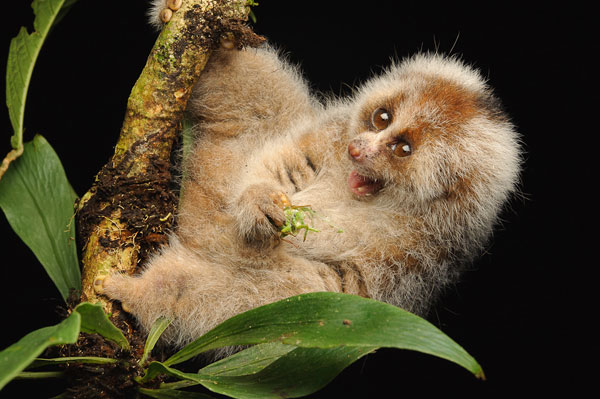
Bornean Slow Loris

Bornean Slow Loris

Nycticebus borneanus

Daderot, CC0, via Wikimedia Commons

Bangka Slow Loris

Bangka Slow Loris

Nycticebus bancanus

Gunay M.E., CC BY-SA 4.0, via Wikimedia Commons

Side by side

Bornean Slow LorisBangka Slow Loris
Scientific nameNycticebus borneanus Lyon, 1906Nycticebus bancanus Lyon, 1906
English nameBornean Slow LorisBangka Slow Loris
GroupMammalsMammals
ClassMammalia MammalMammalia Mammal
OrderPrimates PrimatePrimates Primate
FamilyLorisidae PottosLorisidae Pottos
GenusNycticebus Slow LorisNycticebus Slow Loris
Named in19061906
Red List categoryVulnerableCritically Endangered
Countries on record1 countryNot recorded
GBIF occurrence records6 recordsNot recorded

Rows where the two agree are shown in grey.

Where each is found

Only Bornean Slow Loris (1)

From Catalogue of Life checklists and GBIF occurrence records. A country missing from a list means no record is held, which is not proof of absence.

Checked facts

Bornean Slow LorisBangka Slow Loris
Appearance
  • The species has dark, contrasting facial markings that distinguish it from other slow lorises. English Wikipedia
  • The dark rings around the eyes are usually rounded at the top and do not extend below the zygomatic arch. English Wikipedia
  • The stripe between the eyes varies in width, and the ears are covered with hair. English Wikipedia
  • The colored patch on the top of the head is generally round but can sometimes form a narrower band. English Wikipedia
  • The species has a vestigial tail, a round head, short ears, a broad flat face, and large eyes. English Wikipedia
  • The species lacks a second upper incisor, a characteristic shared with other Bornean slow loris species. English Wikipedia
  • Its second front digit is smaller than the other digits, while its hind-foot big toe opposes the other toes. English Wikipedia
  • The second toe on each hind foot has a curved grooming claw, while the other nails are straight. English Wikipedia
  • The species has a toothcomb formed by specialized lower front teeth. English Wikipedia
  • The species has a brachial gland on the underside of its elbow. English Wikipedia
Size
  • The average body length of the Bangka slow loris is 258.05 mm (10.159 inches). English Wikipedia
Habitat
Diet
  • The species primarily consumes insects, tree gum, nectar, and fruit. English Wikipedia
Behaviour
  • The species is nocturnal. English Wikipedia
  • The species has a toxic bite, a characteristic described as unique among primates. English Wikipedia
  • The species activates its brachial gland toxin by licking the gland and mixing its secretion with saliva. English Wikipedia
  • The toxic bite helps deter predators. English Wikipedia
  • The species applies toxin to its fur during grooming to help protect its infants. English Wikipedia
  • When threatened, the species may lick its brachial glands and bite an aggressor. English Wikipedia
  • Slow lorises may maintain their bite for an extended period, possibly to maximize toxin transfer. English Wikipedia
  • The facial mask may help individuals recognize potential mates belonging to the same species. English Wikipedia
  • The facial mask may function as an anti-predator adaptation by making the eyes appear larger. English Wikipedia
  • The Bangka slow loris is nocturnal. English Wikipedia
  • The species uses its curved second hind-toe claw for scratching and grooming. English Wikipedia
  • The species uses its toothcomb for grooming. English Wikipedia
  • The Bangka slow loris uses secretions from its brachial gland defensively by wiping them onto its toothcomb. English Wikipedia
  • The species has a toxic bite, a distinctive characteristic among primates. English Wikipedia
  • The species activates its brachial gland toxin by mixing the secretion with saliva. English Wikipedia
  • The species applies toxin to its fur during grooming to protect its infants. English Wikipedia
Distribution
  • The species occurs in central southern Borneo, Indonesia. English Wikipedia
  • The species is recorded from the Indonesian provinces of West Kalimantan, South Kalimantan, and Central Kalimantan. English Wikipedia
  • Its geographical range extends south of the Kapuas River and eastward to the Barito River. English Wikipedia
  • The species does not occur in the extreme southwestern part of Borneo. English Wikipedia
  • The species may occur alongside Nycticebus bancanus in West Kalimantan. English Wikipedia
  • The Bangka slow loris occurs in southwestern Borneo and on Bangka Island. English Wikipedia
Conservation
  • The Bangka slow loris was assessed by the IUCN in 2015 as Critically Endangered. iucnredlist.org
  • Habitat loss is one of the greatest threats to the survival of the Bangka slow loris. English Wikipedia
  • Illegal wildlife trade is a major threat to the species. English Wikipedia
  • The species is protected from commercial trade under Appendix I of CITES. English Wikipedia
  • Tin mining and oil palm plantations have caused extensive habitat destruction on Bangka Island. English Wikipedia
UsesNo checked fact yet
Similar species
  • Nycticebus borneanus was formerly classified as a synonym of Nycticebus menagensis. English Wikipedia
  • Nycticebus borneanus was elevated to full species status following a 2013 review of museum specimens and photographs. English Wikipedia
  • Differences in facial coloration patterns distinguish Nycticebus borneanus from other newly recognized Bornean slow loris species. English Wikipedia
  • The Bangka slow loris was formerly classified as a subspecies or synonym of the Bornean slow loris, Nycticebus menagensis. English Wikipedia
  • Nycticebus bancanus was elevated to full species status in 2013 following examination of museum specimens and photographs. English Wikipedia
Name origin
  • Marcus Ward Lyon Jr. first described the species in 1906 using the scientific name Nycticebus borneanus. English Wikipedia
Other
  • The species belongs to the family Lorisidae. English Wikipedia
  • The IUCN Red List record identifies the species as having been most recently assessed in 2015. iucnredlist.org

In brief

Bornean Slow Loris

The Bornean Slow Loris is a mammal belonging to the family Lorisidae. It occurs in central southern Borneo, Indonesia. It has dark, contrasting facial markings that distinguish it from other slow lorises. Full profile

Bangka Slow Loris

The Bangka Slow Loris belongs to the family Lorisidae. It occurs in southwestern Borneo and on Bangka Island. It has a toxic bite, a distinctive characteristic among primates. Full profile

Compare something else

Page built on 27 November 2026 from the data on the two species pages, where every source is listed.

Cite this page

ScientificNames.org. (2026). Bornean Slow Loris vs Bangka Slow Loris. Retrieved November 27, 2026, from https://scientificnames.org/compare/bornean-slow-loris-vs-bangka-slow-loris