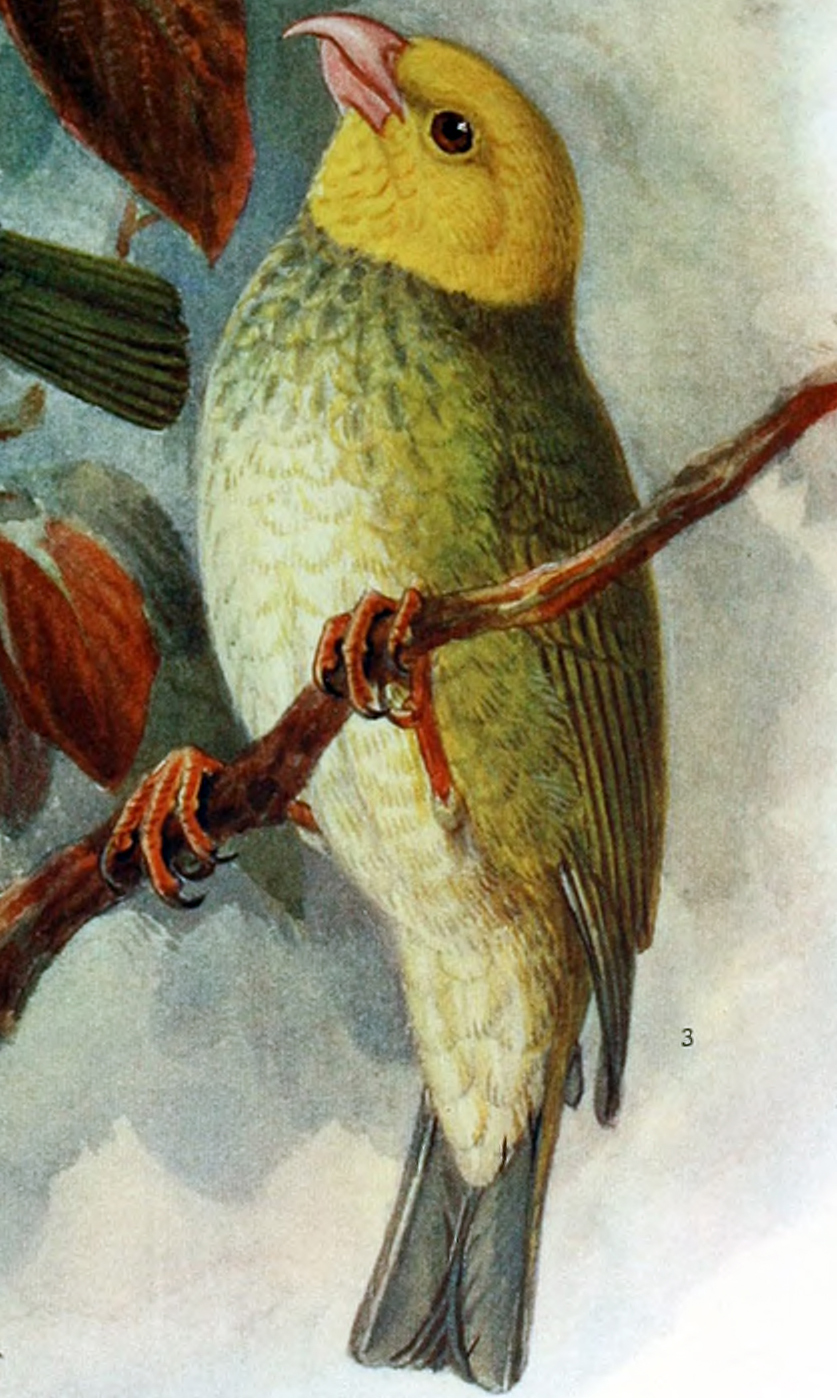
| Appearance | | |
|---|
| Size | | |
|---|
| Habitat | - The species occupied forests at elevations between 900 and 1,500 metres on Kauaʻi and Hawaiʻi. dlnr.hawaii.gov
- Recent observations occurred in mid-elevation mesic to wet ʻōhiʻa forests. dlnr.hawaii.gov
- Recent forest habitats contained an understory of ʻieʻie, tree ferns, ʻōlapa, kāwaʻu, kolea and pilo. dlnr.hawaii.gov
| - The species favours mixed woodland containing some conifers for breeding. English Wikipedia
- Parkland and gardens are among the breeding habitats of the Eurasian bullfinch. English Wikipedia
- In Japan and Britain, Eurasian bullfinches inhabit deciduous woodland and cultivated grounds. animaldiversity.org
- Outside Japan and Britain, the species inhabits coniferous or mixed woodlands. animaldiversity.org
|
|---|
| Diet | - The species fed on the fruits of ʻieʻie (Freycinetia arborea). English Wikipedia
- The species also consumed insects, buds, flowers and other fruits. English Wikipedia
- The species fed on fruits of Clermontia species. dlnr.hawaii.gov
- Geometrid caterpillars were an important food source during the breeding season. dlnr.hawaii.gov
- The species consumed buds and blossoms of ʻōhiʻa lehua (Metrosideros polymorpha). English Wikipedia
| - The Eurasian bullfinch feeds mainly on seeds and fruit-tree buds. English Wikipedia
- Ash and hawthorn are favoured food sources during autumn and early winter. English Wikipedia
- Adult Eurasian bullfinches feed their chicks with invertebrates. English Wikipedia
- The species preferentially feeds on dock, nettle, privet, bramble, birch, and ash seeds in deciduous woodland. animaldiversity.org
- Fruit-tree buds are eaten exclusively during spring according to the Animal Diversity Web account. animaldiversity.org
- Chicks receive a mixture of seeds and insects. animaldiversity.org
|
|---|
| Behaviour | - The species was a nomadic forager that travelled considerable distances to follow seasonal fruit crops. English Wikipedia
- The species moved both uphill and downhill when its preferred fruit was unavailable. English Wikipedia
- The species was relatively inactive and usually moved slowly despite having remarkable flight stamina. English Wikipedia
- The species produced ascending or descending whistles that could develop into a distinct canary-like song. English Wikipedia
| - Outside the breeding season, Eurasian bullfinches generally occur in pairs or family groups rather than large flocks. English Wikipedia
- During spring, Eurasian bullfinches may form flocks of approximately fifty individuals, rarely exceeding one hundred. animaldiversity.org
- Eurasian bullfinches are generally shy and tend to perch within tree cover. animaldiversity.org
- The species communicates through a low-pitched whistling call. English Wikipedia
- The Eurasian bullfinch's song consists of weak warbling alternating with soft whistles. English Wikipedia
- Tamed Eurasian bullfinches can learn to repeat particular melodies. English Wikipedia
- When feeding on buds, Eurasian bullfinches land at branch tips and gradually move towards the trunk. animaldiversity.org
|
|---|
| Reproduction | - The breeding biology of the species remains unknown. English Wikipedia
- Juveniles observed in June suggested that breeding occurred between March and May. English Wikipedia
- The nesting and breeding habits of the species have not been described. dlnr.hawaii.gov
| - Eurasian bullfinches construct nests in bushes, mature scrub, or trees. English Wikipedia
- The species lays between four and seven pale blue eggs marked with red-brown mottling. English Wikipedia
- Eurasian bullfinches produce two or three broods per breeding season. English Wikipedia
- The breeding season extends from early May to mid-July. English Wikipedia
- Eurasian bullfinch nests are constructed from fine twigs interwoven with moss and lichen. animaldiversity.org
- The nests have a lining made of black roots and shrubs. animaldiversity.org
- Eurasian bullfinch nests are generally positioned a few feet above the ground. animaldiversity.org
- The female may lay up to three clutches of four to five eggs during the breeding season. animaldiversity.org
- Eurasian bullfinch chicks hatch approximately two weeks after the eggs are laid. animaldiversity.org
- The male helps the female incubate the eggs and provides her with food while she remains on the nest. animaldiversity.org
- The male assists the female in gathering food for the young. animaldiversity.org
|
|---|
| Distribution | - The species was historically widespread across all the Main Hawaiian Islands. dlnr.hawaii.gov
- The species was formerly widespread across six major Hawaiian islands. English Wikipedia
- The last recorded sighting of the species occurred on Kauaʻi in 1989. English Wikipedia
- The species was not observed on Kauaʻi after 1992 according to the Hawaiʻi wildlife factsheet. dlnr.hawaii.gov
| - The Eurasian bullfinch breeds across most of Europe and temperate Asia. English Wikipedia
- The species occurs across Europe and Asia, extending from the British Isles to Japan. animaldiversity.org
|
|---|
| Conservation | - The species was listed as endangered under the Endangered Species Act in 1967. English Wikipedia
- The species was listed as Critically Endangered by the IUCN beginning in 1994. English Wikipedia
- The IUCN assessed the species as Extinct in 2024. iucnredlist.org
- The species experienced a dramatic population decline during the twentieth century. English Wikipedia
- Mosquito-borne avian malaria and fowlpox were significant threats to the species. English Wikipedia
- Habitat loss and introduced predators were additional significant threats to the species. English Wikipedia
- Feral cats and small Indian mongooses hunted the species, while rats ate its eggs. English Wikipedia
- Feral pigs degraded wet forest understories and destroyed food plants used by the species. dlnr.hawaii.gov
- Rats potentially preyed on nests and reduced fruit availability through competition. dlnr.hawaii.gov
- A 1984 lava flow from Mauna Loa destroyed important habitat in Upper Waiākea Forest Reserve. dlnr.hawaii.gov
- Two strong hurricanes in 1982 and 1992 devastated native forest habitat on Kauaʻi. dlnr.hawaii.gov
| No checked fact yet |
|---|
| Uses | No checked fact yet | - The Eurasian bullfinch has historically been considered an agricultural pest because it feeds on fruit-tree buds. English Wikipedia
- In England, parishes historically paid rewards for killing Eurasian bullfinches. English Wikipedia
|
|---|