Comparison

Yucatan Brown Brocket vs Moose

Yucatan Brown Brocket (Odocoileus pandora) and Moose (Alces alces) both belong to the subfamily Capreolinae and part ways below it.
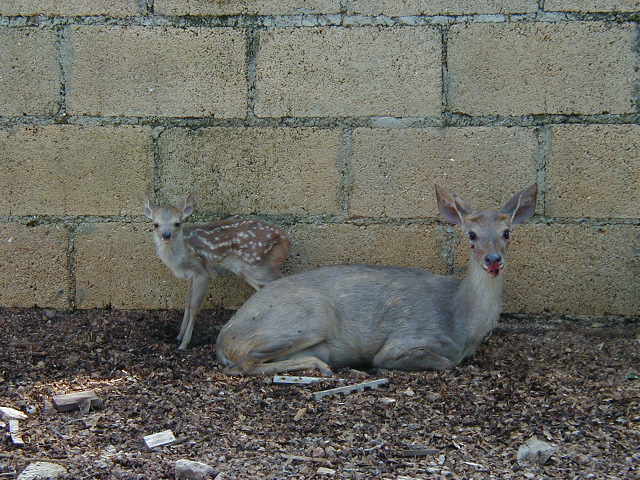
Yucatan Brown Brocket

Yucatan Brown Brocket

Odocoileus pandora

Soparamens, CC BY-SA 4.0, via Wikimedia Commons

Moose

Moose

Alces alces

Ryan Hagerty, Public domain, via Wikimedia Commons

Side by side

Yucatan Brown BrocketMoose
Scientific nameOdocoileus pandora (Merriam, 1901)Alces alces (Linnaeus, 1758)
English nameYucatan Brown BrocketMoose
GroupMammalsMammals
ClassMammalia MammalMammalia Mammal
OrderArtiodactyla ArtiodactylsArtiodactyla Artiodactyls
FamilyCervidae DeerCervidae Deer
GenusOdocoileus Mule DeerAlces Moose
Named in19011758
Red List categoryNot recordedLeast Concern
Countries on record2 countries25 countries
GBIF occurrence records509 records156,734 records

Rows where the two agree are shown in grey.

Where each is found

Only Yucatan Brown Brocket (2)

Only Moose (25)

From Catalogue of Life checklists and GBIF occurrence records. A country missing from a list means no record is held, which is not proof of absence.

Checked facts

Yucatan Brown BrocketMoose
AppearanceNo checked fact yet
  • Adult males generally have broad, flattened antlers with multiple points along their outer edges. English Wikipedia
  • The species has long, slender legs, a massive body, a short thick neck, humped shoulders and a large head. animaldiversity.org
  • Moose have a distinctive long, bulbous and drooping muzzle. animaldiversity.org
  • Their coat is generally dark, ranging from black to brown or grayish brown, with lighter lower legs. animaldiversity.org
  • Individual hairs measure approximately 15–25 cm and are hollow. animaldiversity.org
  • Young moose have reddish-brown coats and lack the spots found on other young deer. animaldiversity.org
Size
  • The Yucatan brown brocket is a small deer species. English Wikipedia
  • The Yucatan brown brocket is described as a small deer native to Central America. inaturalist.org
  • Adult moose typically stand between 1.4 and 2.1 metres tall at the shoulder. English Wikipedia
  • Adult males typically weigh 380–700 kg, while females typically weigh 200–490 kg. English Wikipedia
  • Adult moose have a head-and-body length of approximately 2.4–3.1 metres. English Wikipedia
  • The tail measures approximately 6–8 cm in length. English Wikipedia
Habitat
  • Moose inhabit circumpolar boreal forests and temperate broadleaf and mixed forests. English Wikipedia
  • Moose occupy taiga, temperate forests and tundra-subalpine habitats. animaldiversity.org
  • Moose prefer early successional forest habitats where disturbance increases forage availability. animaldiversity.org
  • Moose also seek habitats near ponds, lakes, rivers and swamps. animaldiversity.org
  • Moose are attracted to marshes and riverbanks during warmer months because these habitats provide vegetation and water. English Wikipedia
  • Prolonged temperatures above 27°C likely restrict the southern distribution of moose. animaldiversity.org
DietNo checked fact yet
  • Moose are browsing herbivores that consume many types of plants and fruits. English Wikipedia
  • Their diet includes terrestrial vegetation, particularly forbs and fresh tree shoots such as willow and birch. English Wikipedia
  • Aquatic plants, including lilies and pondweed, can account for approximately half of their diet. English Wikipedia
  • During winter, branches, twigs and dead wood make up a large proportion of their diet. English Wikipedia
  • Moose commonly select deciduous trees such as white birch, trembling aspen and striped maple for their new growth. English Wikipedia
  • An adult moose requires approximately 96 megajoules of energy per day to maintain its body weight. English Wikipedia
  • A 360 kg moose can consume up to 32 kg of food daily. English Wikipedia
  • Moose can dive more than 5.5 metres to reach aquatic plants growing on lake bottoms. English Wikipedia
BehaviourNo checked fact yet
  • Moose are generally solitary animals and do not form herds. English Wikipedia
  • Moose can become defensively aggressive and move rapidly when angered or startled. English Wikipedia
  • Moose are excellent swimmers and enter water to feed on aquatic vegetation. English Wikipedia
  • Moose are not territorial. animaldiversity.org
  • Moose are among the least social members of the deer family and remain relatively solitary outside the mating season. animaldiversity.org
ReproductionNo checked fact yet
Distribution
  • Moose have a circumpolar distribution across the boreal forests of the Northern Hemisphere. animaldiversity.org
ConservationNo checked fact yet
  • Hunting and habitat loss have reduced the geographical range of moose. English Wikipedia
  • Moose have been reintroduced into some areas of their former range. English Wikipedia
UsesNo checked fact yet
  • Moose historically provided an important source of food for some Indigenous peoples of North America before the early modern period. English Wikipedia
Similar species
  • The Yucatan brown brocket has previously been classified as a disjunct subspecies of the gray brocket (Mazama gouazoubira). English Wikipedia
  • The Yucatan brown brocket has previously been classified as a subspecies of the red brocket (Mazama americana). English Wikipedia
  • The Yucatan brown brocket differs from the red and gray brockets in skull and antler shape and measurements. English Wikipedia
  • The Central American red brocket (Mazama temama) occurs sympatrically with the Yucatan brown brocket in some areas. English Wikipedia
No checked fact yet

In brief

Yucatan Brown Brocket

The Yucatan Brown Brocket is a small deer native to Central America. It occurs on the Yucatán Peninsula in Mexico, Belize and Guatemala, and inhabits humid tropical forests as well as arid and relatively open habitats. Full profile

Moose

The Moose (Alces alces) is a mammal in the family Cervidae and order Artiodactyla. It has a circumpolar distribution across the boreal forests of the Northern Hemisphere. It is distinguished by its massive body, long slender legs, large head, drooping muzzle and, in adult males, broad flattened antlers. Full profile

Compare something else

Page built on 27 November 2026 from the data on the two species pages, where every source is listed.

Cite this page

ScientificNames.org. (2026). Yucatan Brown Brocket vs Moose. Retrieved November 27, 2026, from https://scientificnames.org/compare/yucatan-brown-brocket-vs-moose