Comparison

Yucatan Brown Brocket vs Mule Deer

Yucatan Brown Brocket (Odocoileus pandora) and Mule Deer (Odocoileus hemionus) both belong to the genus Odocoileus (mule deer) and part ways below it. Both are recorded in 1 country.
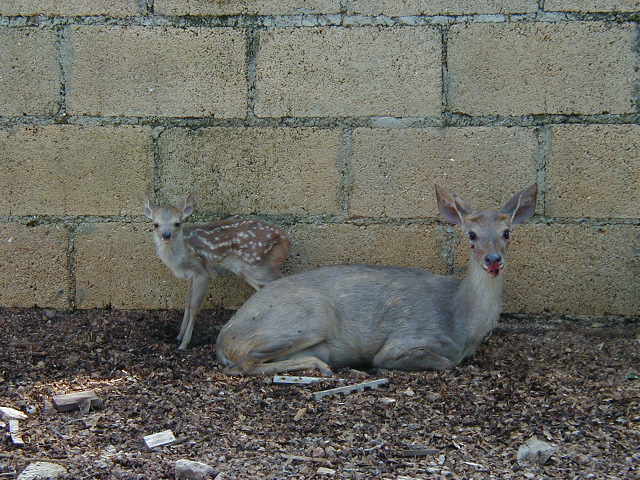
Yucatan Brown Brocket

Yucatan Brown Brocket

Odocoileus pandora

Soparamens, CC BY-SA 4.0, via Wikimedia Commons

Mule Deer

Mule Deer

Odocoileus hemionus

Dcrjsr, CC BY 3.0, via Wikimedia Commons

Side by side

Yucatan Brown BrocketMule Deer
Scientific nameOdocoileus pandora (Merriam, 1901)Odocoileus hemionus (Rafinesque, 1817)
English nameYucatan Brown BrocketMule Deer
GroupMammalsMammals
ClassMammalia MammalMammalia Mammal
OrderArtiodactyla ArtiodactylsArtiodactyla Artiodactyls
FamilyCervidae DeerCervidae Deer
GenusOdocoileus Mule DeerOdocoileus Mule Deer
Named in19011817
Red List categoryNot recordedLeast Concern
Countries on record2 countries3 countries
GBIF occurrence records509 records157,259 records

Rows where the two agree are shown in grey.

Where each is found

Both recorded in 1 country

Only Yucatan Brown Brocket (1)

Only Mule Deer (2)

From Catalogue of Life checklists and GBIF occurrence records. A country missing from a list means no record is held, which is not proof of absence.

Checked facts

Yucatan Brown BrocketMule Deer
AppearanceNo checked fact yet
  • The species has particularly large ears, which are proportionally larger than those of white-tailed deer. nps.gov
  • Its tail has a black tip, distinguishing it from the unmarked tail of the white-tailed deer. English Wikipedia
  • Male individuals have antlers that divide into forks as they grow. English Wikipedia
  • Adult individuals generally have reddish coats in summer and gray coats in winter. pubs.nmsu.edu
  • The summer coat is finer and silkier than the thicker, coarser winter coat. pubs.nmsu.edu
  • Its white rump patch surrounds the base of the tail. pubs.nmsu.edu
  • Its coat coloration varies from dark brown-gray and ash-gray to brown and reddish shades. animaldiversity.org
Size
  • The Yucatan brown brocket is a small deer species. English Wikipedia
  • The Yucatan brown brocket is described as a small deer native to Central America. inaturalist.org
No checked fact yet
Habitat
  • The species occupies environments ranging from dense coniferous forests to open plains, deserts and alpine habitats. fs.usda.gov
  • Its habitats include Great Plains prairies, Rocky Mountain shrublands and forests, sagebrush communities, pinyon-juniper woodlands and southwestern desert scrub. fs.usda.gov
  • The species occupies elevations ranging from coastal environments to subalpine and alpine regions. fs.usda.gov
  • In New Mexico, Rocky Mountain mule deer inhabit environments from above the timberline to low-elevation short grasslands and urban areas. pubs.nmsu.edu
  • In New Mexico, desert mule deer favor shrublands, woodlands, desert mountain hills and arid-flatland arroyos. pubs.nmsu.edu
DietNo checked fact yet
  • The species primarily browses on plants but also consumes forbs, grasses, nuts, berries and other fruits. English Wikipedia
  • Its diet includes flowering herbaceous plants, woody plant leaves and twigs, and berries and fruits. nps.gov
  • In western Nebraska and the western Dakotas, the species heavily browses on skunkbush sumac and Rocky Mountain juniper. nps.gov
  • The species may consume pricklypear cactus pads. nps.gov
  • Mule deer in the Sierra Nevada use the lichen Bryoria fremontii as a winter food source. English Wikipedia
  • The species is a ruminant that digests plant material through fermentation before further digestion. English Wikipedia
BehaviourNo checked fact yet
  • Individuals may move seasonally from lower-elevation winter habitats to higher-elevation summer habitats. English Wikipedia
  • Some migrating individuals travel considerable distances between seasonal ranges, with a documented migration of 150 miles in Wyoming. English Wikipedia
  • The species often escapes by stotting, a movement in which all four feet land together. English Wikipedia
  • Individuals generally maintain established summer and winter home ranges across consecutive years. animaldiversity.org
  • The species forms social groups that include female family clans and groups of unrelated males. animaldiversity.org
  • Male individuals disperse either independently or in groups consisting of unrelated males. animaldiversity.org
ReproductionNo checked fact yet
  • The species has a polygynous mating system. animaldiversity.org
  • The main breeding peak occurs between late November and mid-December. animaldiversity.org
  • The average gestation period is approximately 204 days. animaldiversity.org
  • Most births occur in June, with the peak birth period estimated between June 16 and July 6. animaldiversity.org
  • A typical litter consists of two offspring, although females breeding for the first or second time commonly produce single offspring. animaldiversity.org
  • Newborn individuals typically weigh between 2 and 5 kg. animaldiversity.org
  • Young individuals generally begin weaning at approximately five weeks and complete it by around sixteen weeks of age. animaldiversity.org
  • In New Mexico, females usually give birth to one offspring during their first pregnancy. pubs.nmsu.edu
Distribution
  • The species is native to western North America. English Wikipedia
  • Its natural range extends from the western Great Plains through the Rocky Mountains and southwestern United States to northern Mexico and the Pacific coast. English Wikipedia
ConservationNo checked fact yet
  • Mule deer populations in New Mexico have generally declined since reaching their peak around the 1960s. pubs.nmsu.edu
  • In New Mexico, annual survival among unhunted adult individuals typically exceeds 80%, but may fall below 60% during severe droughts. pubs.nmsu.edu
Similar species
  • The Yucatan brown brocket has previously been classified as a disjunct subspecies of the gray brocket (Mazama gouazoubira). English Wikipedia
  • The Yucatan brown brocket has previously been classified as a subspecies of the red brocket (Mazama americana). English Wikipedia
  • The Yucatan brown brocket differs from the red and gray brockets in skull and antler shape and measurements. English Wikipedia
  • The Central American red brocket (Mazama temama) occurs sympatrically with the Yucatan brown brocket in some areas. English Wikipedia
  • Mule deer can hybridize with white-tailed deer where their geographical ranges overlap, although such hybrids are uncommon in the wild. fs.usda.gov
OtherNo checked fact yet
  • The taxonomic recognition of the Cedros Island and Tiburon Island mule deer as distinct subspecies is uncertain. fs.usda.gov

In brief

Yucatan Brown Brocket

The Yucatan Brown Brocket is a small deer native to Central America. It occurs on the Yucatán Peninsula in Mexico, Belize and Guatemala, and inhabits humid tropical forests as well as arid and relatively open habitats. Full profile

Mule Deer

Odocoileus hemionus is native to western North America, with a natural range extending from the western Great Plains through the Rocky Mountains and southwestern United States to northern Mexico and the Pacific coast. It is distinguished by particularly large ears, a black-tipped tail and a white rump patch surrounding the base of the tail. Full profile

Compare something else

Page built on 27 November 2026 from the data on the two species pages, where every source is listed.

Cite this page

ScientificNames.org. (2026). Yucatan Brown Brocket vs Mule Deer. Retrieved November 27, 2026, from https://scientificnames.org/compare/yucatan-brown-brocket-vs-mule-deer