Comparison
White-tailed Deer vs Yucatan Brown Brocket
White-tailed Deer (Odocoileus virginianus) and Yucatan Brown Brocket (Odocoileus pandora) both belong to the genus Odocoileus (mule deer) and part ways below it. Both are recorded in 2 countries.

White-tailed Deer
Odocoileus virginianus
USDA photo by Scott Bauer, Public domain, via Wikimedia Commons


Side by side
| White-tailed Deer | Yucatan Brown Brocket | |
|---|---|---|
| Scientific name | Odocoileus virginianus (Zimmermann, 1780) | Odocoileus pandora (Merriam, 1901) |
| English name | White-tailed Deer | Yucatan Brown Brocket |
| Group | Mammals | Mammals |
| Class | Mammalia Mammal | Mammalia Mammal |
| Order | Artiodactyla Artiodactyls | Artiodactyla Artiodactyls |
| Family | Cervidae Deer | Cervidae Deer |
| Genus | Odocoileus Mule Deer | Odocoileus Mule Deer |
| Named in | 1780 | 1901 |
| Red List category | Least Concern | Not recorded |
| Countries on record | 25 countries | 2 countries |
| GBIF occurrence records | 359,994 records | 509 records |
Rows where the two agree are shown in grey.
Where each is found
Both recorded in 2 countries
Only White-tailed Deer (23)
- Belize
- Bolivia
- Brazil
- Canada
- Colombia
- Costa Rica
- Cuba
- Curacao
- Ecuador
- El Salvador
- Finland
- French Guiana
- Guyana
- Honduras
- Nicaragua
- Panama
- Peru
- Puerto Rico
- Saint Pierre and Miquelon
- Suriname
- U.S. Virgin Islands
- United States
- Venezuela
From Catalogue of Life checklists and GBIF occurrence records. A country missing from a list means no record is held, which is not proof of absence.
Checked facts
| White-tailed Deer | Yucatan Brown Brocket | |
|---|---|---|
| Appearance |
| No checked fact yet |
| Size |
|
|
| Habitat | No checked fact yet |
|
| Diet |
| No checked fact yet |
| Behaviour |
| No checked fact yet |
| Reproduction |
| No checked fact yet |
| Distribution | No checked fact yet |
|
| Similar species |
|
|
In brief
White-tailed Deer
Odocoileus virginianus is distinguished by the characteristically white underside of its tail, which it raises when alarmed to signal that it has detected a predator. Full profile
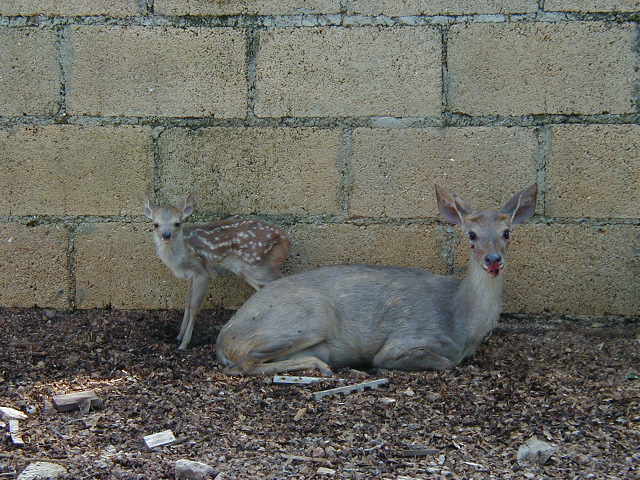
Yucatan Brown Brocket
The Yucatan Brown Brocket is a small deer native to Central America. It occurs on the Yucatán Peninsula in Mexico, Belize and Guatemala, and inhabits humid tropical forests as well as arid and relatively open habitats. Full profile
Compare something else
Page built on 28 November 2026 from the data on the two species pages, where every source is listed.
Cite this page
ScientificNames.org. (2026). White-tailed Deer vs Yucatan Brown Brocket. Retrieved November 28, 2026, from https://scientificnames.org/compare/white-tailed-deer-vs-yucatan-brown-brocket
“White-tailed Deer vs Yucatan Brown Brocket.” ScientificNames.org, 2026, scientificnames.org/compare/white-tailed-deer-vs-yucatan-brown-brocket. Accessed 28 Nov. 2026.
ScientificNames.org. “White-tailed Deer vs Yucatan Brown Brocket.” Accessed November 28, 2026. https://scientificnames.org/compare/white-tailed-deer-vs-yucatan-brown-brocket.
@misc{scientificnames_white_tailed_deer_vs_yucatan_brown_brocket,
  author = {{ScientificNames.org}},
  title = {White-tailed Deer vs Yucatan Brown Brocket},
  year = {2026},
  url = {https://scientificnames.org/compare/white-tailed-deer-vs-yucatan-brown-brocket},
  note = {Accessed 2026-11-28}
}