| Appearance | - The Yellow-eared Parrot has predominantly green plumage, with paler lime-green underparts. English Wikipedia
- The species has a black heavy beak and a black ring of bare skin around its eyes. English Wikipedia
- The species has a yellow feather patch extending from its forehead to its cheeks and ear-coverts. English Wikipedia
- Its calls resemble the sounds made by geese. English Wikipedia
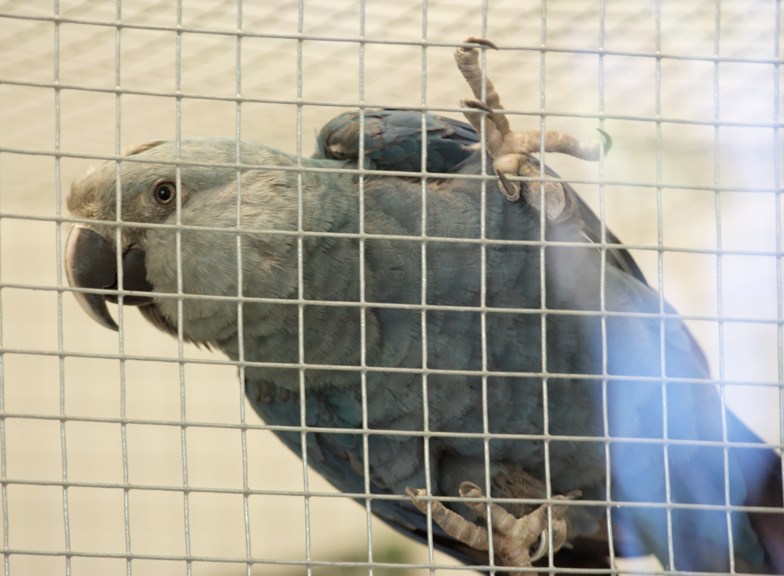
| - Adults have grey-blue heads, pale blue underparts, and vivid blue upperparts, wings, and tails. English Wikipedia
- Adult Spix's macaws have grey bare facial skin, dark grey bills, and yellow irises. English Wikipedia
- Juveniles have pale grey facial skin, brown irises, and a white stripe along the upper center of the bill. English Wikipedia
- Males and females have almost identical external appearances. English Wikipedia
- The species has brownish-black legs and feet. English Wikipedia
|
|---|
| Size | | - Adults measure approximately 56 cm in total length, including a tail measuring 26–38 cm. English Wikipedia
- The wing length ranges from 24.7 to 30.0 cm. English Wikipedia
- Captive males average approximately 318 g, while captive females average approximately 288 g. English Wikipedia
- The species averages 55 cm in length and 360 g in weight according to Animal Diversity Web. animaldiversity.org
- The reported wingspan averages 1.2 m. animaldiversity.org
|
|---|
| Habitat | - The species inhabits cloud forests at elevations of approximately 1,800–3,000 metres above sea level. English Wikipedia
- The species lives and nests among wax palms. English Wikipedia
- The species also occupies elfin forests in Colombia. English Wikipedia
- The species nests inside hollow palm trunks, generally 25–30 metres above the ground. English Wikipedia
| - The species inhabited riparian Caraibeira woodland galleries in the Rio São Francisco drainage basin. English Wikipedia
- Its natural habitat was within the Caatinga dry forest climate of interior northeastern Brazil. English Wikipedia
- The species depended on Caraibeira trees for nesting, feeding, and roosting. English Wikipedia
- Caraibeira woodland galleries extended up to 18 m on either side of seasonal waterways. English Wikipedia
- The Caraibeira trees grew at regular intervals of approximately 10 meters along watercourse banks. animaldiversity.org
- The woodland habitat included thorny shrubs, cacti, and tall craibeira trees along watercourses. animaldiversity.org
- Dead crowns of craibeira trees were used as perches. animaldiversity.org
|
|---|
| Diet | | - The species feeds primarily on Caraiba seeds and nuts and those of Euphorbiaceae shrubs. English Wikipedia
- Wild Spix's macaws commonly consumed seeds and nuts from Pinhão and Favela plants. English Wikipedia
|
|---|
| Behaviour | - The species is social and sometimes gathers in flocks containing approximately 12–24 individuals. English Wikipedia
- Several individuals may cooperate in raising chicks. English Wikipedia
| |
|---|
| Reproduction | | - Wild breeding takes place between November and March. English Wikipedia
- The species nests in hollows of large mature Caraibeira trees and reuses nests annually. English Wikipedia
- Wild females were believed to lay three eggs per clutch. English Wikipedia
- Incubation lasts approximately 25–28 days and is performed exclusively by the female. English Wikipedia
- Chicks fledge at approximately 70 days and become independent between 100 and 130 days. English Wikipedia
- Captive incubation lasts approximately 26 days. animaldiversity.org
- Captive-bred chicks fledge at approximately two months and become independent at five months. animaldiversity.org
|
|---|
| Distribution | - The species occurs in the Western and Central Cordilleras of the Colombian Andes. English Wikipedia
| No checked fact yet |
|---|
| Conservation | - The species is classified as vulnerable on the IUCN Red List. English Wikipedia
- The species has 1,000 mature individuals according to BirdLife DataZone. datazone.birdlife.org
- BirdLife DataZone reports an increasing population trend for the species. datazone.birdlife.org
- Hunting and habitat destruction have contributed to reductions in the species' population. English Wikipedia
- Habitat fragmentation and habitat loss have substantially affected the species. English Wikipedia
- More than 90–93% of Colombia's montane forests have been cleared for agriculture or settlement. English Wikipedia
- Harvesting wax palms for Palm Sunday processions has threatened an important habitat resource for the species. English Wikipedia
- The species depends on the Quindio wax palm for roosting, nesting and feeding. English Wikipedia
- A conservation project led by Fundación ProAves and supported by several organizations began in Colombia in 1998. English Wikipedia
- A reserve was established to support recovery of the species and the wax palm. English Wikipedia
- Conservation measures include artificial nest boxes and habitat restoration. English Wikipedia
- A habitat corridor exceeding 16,000 acres was established in Colombia in 2009 for the species and other threatened parrots. English Wikipedia
- The population had increased to more than 1,500 individuals by 2012. English Wikipedia
- Fundación ProAves reported that the population had exceeded 3,000 individuals by 2021. English Wikipedia
| - The IUCN declared the species extinct in the wild in 2019. English Wikipedia
- A total of 52 individual birds were reintroduced into their natural environment in June 2022. English Wikipedia
- The species is listed on CITES Appendix I. English Wikipedia
- International trade in the species is prohibited except for legitimate conservation, scientific, or educational purposes. English Wikipedia
- A captive breeding program is maintained by several conservation organizations under the Brazilian government's aegis. English Wikipedia
- Deforestation within its restricted range and specialized habitat contributed to the species' rarity in the wild. English Wikipedia
|
|---|
| Uses | - The species has been hunted for food at local and national levels. English Wikipedia
- International trade in the species for pets and display animals has contributed to its decline. English Wikipedia
| No checked fact yet |
|---|
| Similar species | No checked fact yet | - The red-bellied macaw and blue-headed macaw are identified as the species' nearest relatives. English Wikipedia
|
|---|
| Other | - The species is described as a large, thick-billed, macaw-like parrot. ebird.org
| |
|---|