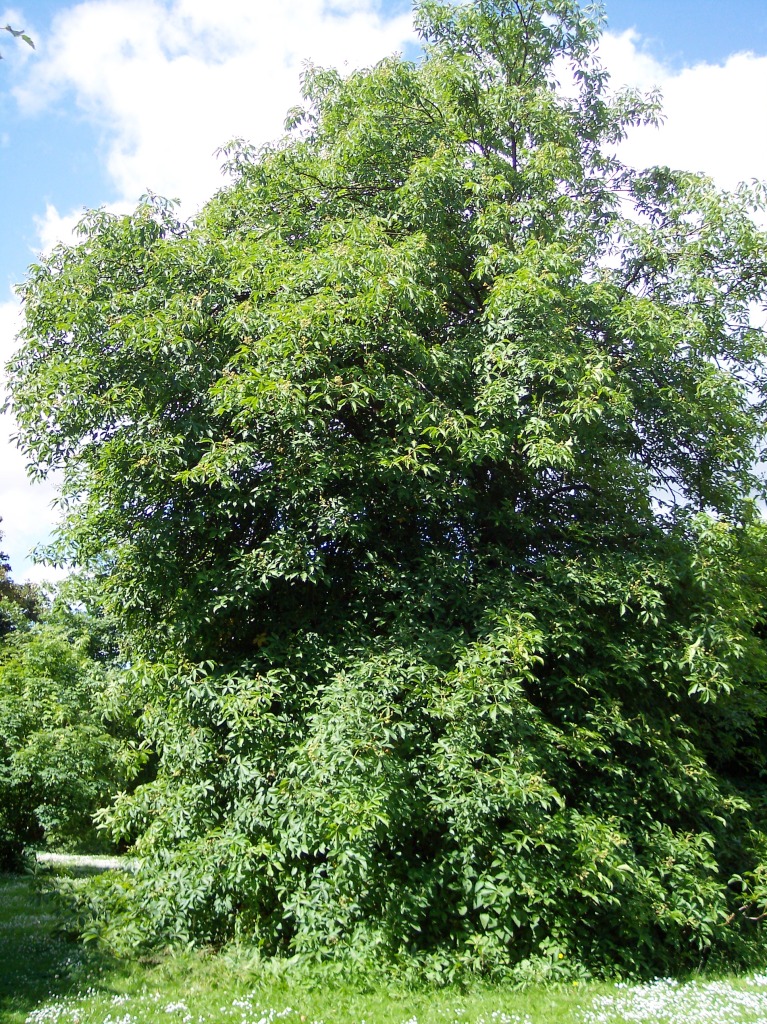
| Appearance | | - Aesculus parviflora is a deciduous, suckering shrub. English Wikipedia
- The leaves grow in opposite pairs and have five to seven palmately arranged leaflets. English Wikipedia
- Each leaflet has an entire margin and measures 12–22 cm long and 5–10 cm wide. English Wikipedia
- The flowers grow in conspicuous, erect, bottlebrush-shaped panicles. English Wikipedia
- The flowers have tubular calyces, small white petals and protruding stamens measuring 3–4 cm long. English Wikipedia
- The flowers develop into pear-shaped capsules containing polished brown seeds. English Wikipedia
- The shrub has numerous upright, slender branches. uaex.uada.edu
- Its compound leaves have five to seven elongated leaflets attached to a petiole approximately four inches long. uaex.uada.edu
- The leaves are green during summer and turn yellow in autumn. uaex.uada.edu
- The shrub has a broad, spreading growth form. uaex.uada.edu
- The fruits are smooth, tan-colored, pear-shaped capsules approximately two inches long. uaex.uada.edu
- The capsules contain large, mahogany-colored seeds. uaex.uada.edu
|
|---|
| Size | - Each leaflet measures 8–16 cm in length and width. English Wikipedia
- Fifty trees measured in Jefferson County, Indiana, averaged 20.7 m in height and 84 cm in diameter at breast height. research.fs.usda.gov
- On dry habitats in eastern Oklahoma, the species grows as a shrub measuring 1.2–1.5 m tall. research.fs.usda.gov
| - The shrub typically reaches a height of 2–4 m. English Wikipedia
- The shrub typically grows about 8 feet tall and twice as wide. uaex.uada.edu
- The shrub can grow larger than its typical dimensions when given sufficient time. uaex.uada.edu
|
|---|
| Habitat | - The species occurs along streambanks, in upland mesic forests, and beside old fields. English Wikipedia
- The species is typically associated with calcareous areas. English Wikipedia
- The species is most frequently found along river bottoms and in streambank soils. research.fs.usda.gov
- The species most commonly grows on Alfisol soils. research.fs.usda.gov
- The species also occurs in hardwood stands on moist sites in Kentucky's limestone-sink-and-cave section of the Bluegrass region. research.fs.usda.gov
- The species can occur on drier and clayey sites, although it usually grows slowly there and rarely becomes dominant. research.fs.usda.gov
- The species develops best as an isolated individual in openings along streambanks and other moist sites. research.fs.usda.gov
| - Its natural habitats include mesic forests, bluffs and ravines. English Wikipedia
- The species prefers moist, well-drained soils in partial to full shade. English Wikipedia
- The species grows best in full sun or light shade. uaex.uada.edu
- The species grows best in acidic, well-drained and friable soil with abundant organic matter. uaex.uada.edu
|
|---|
| Diet | - The seeds contain tannic acid and are poisonous to humans and cattle. English Wikipedia
- The young foliage, shoots, and bark are also poisonous to some degree. English Wikipedia
- The bark and seeds contain a narcotic glucoside considered poisonous to livestock. research.fs.usda.gov
| No checked fact yet |
|---|
| Reproduction | | - The seeds are released in early October. uaex.uada.edu
- New plants can be propagated by planting freshly collected seeds in nursery pots and keeping the growing medium moist until spring. uaex.uada.edu
- Seeds germinate in spring under the described propagation conditions. uaex.uada.edu
- Plants grown from seed begin flowering after approximately three years. uaex.uada.edu
|
|---|
| Distribution | - The species is native to North America. English Wikipedia
- Its natural range is concentrated in the Midwestern and lower Great Plains regions of the United States. English Wikipedia
- Its natural range extends southeast into the Black Belt of Alabama and Mississippi. English Wikipedia
- The species occurs locally in extreme southwestern Ontario, including Walpole Island in Lake St. Clair. English Wikipedia
- Its range extends from western Pennsylvania, Ohio, and southern Michigan westward to Illinois and central Iowa. research.fs.usda.gov
- Its southern distribution reaches eastern Kansas, southwestern Oklahoma, and central Texas. research.fs.usda.gov
- Its eastern distribution reaches western Arkansas, Tennessee, central Alabama, and one location in eastern Mississippi. research.fs.usda.gov
| - The species is native to the southeastern United States, occurring primarily in Alabama, locally in western Georgia and in a disjunct population in South Carolina along the Savannah River. English Wikipedia
|
|---|
| Conservation | No checked fact yet | - The species is reported to be moderately poisonous to humans when eaten. English Wikipedia
|
|---|
| Uses | - Native Americans reportedly consumed the fruit after boiling it to remove tannin. English Wikipedia
- The Lenape carried the nuts in their pockets as a traditional remedy for rheumatism. English Wikipedia
- An infusion of ground nuts was traditionally mixed with sweet oil or mutton tallow for treating earaches. English Wikipedia
- Native Americans ground the nuts and used them to poison fish in streams. English Wikipedia
- The nuts were blanched to extract tannic acid for leather production. English Wikipedia
- Dried nuts were used to make necklaces. English Wikipedia
- The species has limited commercial value as sawtimber because its wood is soft and light. research.fs.usda.gov
- The species is cultivated as an ornamental tree. research.fs.usda.gov
- Extracts from the species have demonstrated anti-cancer properties. English Wikipedia
| - Aesculus parviflora is cultivated as an ornamental garden plant. English Wikipedia
- Its August flowering attracts butterflies. English Wikipedia
- The shrub can be planted at woodland edges as an informal border. uaex.uada.edu
- The shrub can be planted at the back of a flower border or as a specimen in a lawn. uaex.uada.edu
|
|---|
| Similar species | No checked fact yet | - Aesculus parviflora is described as one of approximately 18 buckeye species found in North America and Eurasia. uaex.uada.edu
|
|---|
| Other | No checked fact yet | - Eating the plant can cause depression, muscle weakness, paralysis, vomiting and diarrhea. English Wikipedia
- The seeds are identified as the plant part most likely to cause poisoning because of their attractive appearance. English Wikipedia
- The species has also been reported as toxic to pets. English Wikipedia
- The species is suitable for USDA hardiness zones 4–8 in the United States. English Wikipedia
- The shrub is described as relatively uncommon in American gardens. uaex.uada.edu
- The species is also known by the common name dwarf horse chestnut. inaturalist.org
|
|---|