| Appearance | - The Apache trout has a fusiform body that is widest in the middle and tapers toward both ends. fws.gov
- The Apache trout has a large dorsal fin. fws.gov
- The Apache trout is predominantly golden yellow or yellow-olive, with purple and pink tints. fws.gov
- The Apache trout has pronounced, often uniformly spaced body spots above and below the lateral line. fws.gov
- Two black spots on either side of the pupil create the appearance of a black band through the Apache trout's eye. fws.gov
- A red or pink lateral band is usually absent in the Apache trout. fws.gov
- Adult Apache trout may retain parr marks or dark vertical markings. fws.gov
- The dorsal, pelvic, and anal fins of the Apache trout have conspicuous cream or yellowish tips. fws.gov
- The Apache trout usually has a yellow cutthroat mark. fws.gov
- The Apache trout occasionally has basibranchial teeth at the base of its tongue. fws.gov
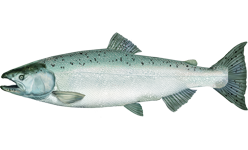
| - Chinook salmon have black spots on their tails and the upper halves of their bodies. English Wikipedia
- A black gum line distinguishes Chinook salmon in both freshwater and saltwater. English Wikipedia
- Spawning Chinook salmon develop darker body coloration, sometimes with substantial changes in hue. English Wikipedia
- Male Chinook salmon develop canine-like teeth and hooked jaws during spawning preparation. English Wikipedia
- Spawning Chinook salmon in freshwater can range in color from red to copper to deep gray. adfg.alaska.gov
- Older adult males aged four to seven years can develop a ridgeback appearance and a hooked upper jaw. adfg.alaska.gov
|
|---|
| Size | - Apache trout have reported lengths ranging from 15 to 61 centimetres. English Wikipedia
- Apache trout rarely exceed 25 centimetres in length. English Wikipedia
- Apache trout can reach 40 centimetres in their native headwater streams. English Wikipedia
- The maximum reported weight of an Apache trout is 5 pounds and 4 ounces. fws.gov
- Apache trout fry are shorter than 100 millimetres. fws.gov
- Apache trout juveniles measure 100 to 129 millimetres in length. fws.gov
- Adult Apache trout measure at least 130 millimetres in length. fws.gov
| No checked fact yet |
|---|
| Habitat | - Apache trout inhabit cold, clean streams in mixed conifer forests and mountain meadows. fws.gov
- Apache trout generally require water temperatures below 77°F. fws.gov
- Apache trout spawning habitat consists of gravel substrates free of fine sediment. fws.gov
- Apache trout use stream margins, slow-moving water, pools, and sheltered areas beneath undercut banks and boulders as rearing habitat. fws.gov
- Adult Apache trout and larger juveniles generally occupy pools and eddies in deeper or faster-flowing water. fws.gov
- Apache trout fry and smaller juveniles occupy relatively shallow, slow-flowing water. fws.gov
| - Chinook salmon use freshwater streams and estuaries as spawning habitats and nursery grounds. adfg.alaska.gov
- Chinook salmon spawn in relatively deep, fast-moving freshwater with gravel beds. adfg.alaska.gov
- Chinook salmon require clean, cool, oxygenated freshwater without sediment for successful egg development. English Wikipedia
- Juvenile Chinook salmon use productive estuarine environments for growth before entering the ocean. English Wikipedia
|
|---|
| Diet | - Apache trout feed on terrestrial and aquatic insects, including caddisflies and true flies. English Wikipedia
- Apache trout living in lakes also consume small fishes and zooplankton. English Wikipedia
- Apache trout feed opportunistically on a variety of aquatic and terrestrial organisms. fws.gov
| - Young Chinook salmon feed on amphipods, other crustaceans, and insects. English Wikipedia
- Older Chinook salmon primarily consume other fish. English Wikipedia
- Juvenile Chinook salmon initially consume plankton and subsequently feed on insects in freshwater. adfg.alaska.gov
- Ocean-dwelling Chinook salmon consume herring, pilchard, sandlance, squid, and crustaceans. adfg.alaska.gov
|
|---|
| Behaviour | No checked fact yet | |
|---|
| Reproduction | - Apache trout generally reach reproductive maturity at approximately three years of age. fws.gov
- Apache trout spawning occurs from March through mid-June, with timing varying according to stream elevation. fws.gov
- Female Apache trout excavate gravel nests called redds for spawning. fws.gov
- After fertilization, Apache trout eggs are covered with gravel. fws.gov
- Apache trout eggs have an incubation period of approximately 30 days. fws.gov
- Young Apache trout emerge from their gravel nests approximately 60 days after spawning. fws.gov
- Each female Apache trout can lay between 200 and 600 eggs. fws.gov
| |
|---|
| Distribution | - The Apache trout is native to the upper Salt River watershed, including the Black and White rivers, and the upper Little Colorado River watershed. English Wikipedia
- Apache trout occur in Arizona and New Mexico according to the species profile. ecos.fws.gov
| - The native North American range of Chinook salmon extends from California to Alaska. English Wikipedia
- The natural Asian range of Chinook salmon extends from northern Japan to the Palyavaam River in Arctic Siberia. English Wikipedia
|
|---|
| Conservation | - The White Mountain Apache Tribe began major conservation measures for Apache trout in 1955 by closing fishing in reservation waters containing remaining native populations. fws.gov
- The Apache trout was originally listed as endangered under the Federal Endangered Species Preservation Act of 1966. fws.gov
- The Apache trout was downlisted from endangered to threatened status in 1975. fws.gov
- Hybridization with introduced rainbow and cutthroat trout is a documented threat to Apache trout. fws.gov
- The Apache trout is threatened by predation and competition from introduced fishes. fws.gov
- Thirty genetically pure Apache trout populations are currently reported across four river basins. fws.gov
| - Some Chinook salmon populations are endangered, while other populations remain healthy. English Wikipedia
- Chinook salmon populations face threats from overfishing, dams, habitat loss, habitat degradation, and climate change. adfg.alaska.gov
|
|---|
| Uses | - Apache trout are raised in hatcheries to support species recovery and maintain populations for sport fishing. English Wikipedia
| - Chinook salmon are commercially harvested for their highly valued food quality. adfg.alaska.gov
- Chinook salmon are targeted by recreational anglers as prized sport fish. English Wikipedia
|
|---|
| Similar species | - The Apache trout is closely related to the Gila trout. English Wikipedia
- Apache trout and Gila trout are believed to have originated from a common ancestor. fws.gov
| |
|---|
| Other | - The Apache trout is the state fish of Arizona. fws.gov
| No checked fact yet |
|---|