Comparison
Dark-throated Oriole vs Eurasian Golden Oriole
Dark-throated Oriole (Oriolus xanthonotus) and Eurasian Golden Oriole (Oriolus oriolus) both belong to the genus Oriolus (oriole) and part ways below it.


Eurasian Golden Oriole
Oriolus oriolus
Michel Idre from Plaisance du Touch, France, CC BY 2.0, via Wikimedia Commons

Side by side
| Dark-throated Oriole | Eurasian Golden Oriole | |
|---|---|---|
| Scientific name | Oriolus xanthonotus Horsfield, 1821 | Oriolus oriolus (Linnaeus, 1758) |
| English name | Dark-throated Oriole | Eurasian Golden Oriole |
| Group | Birds | Birds |
| Class | Aves Bird | Aves Bird |
| Order | Passeriformes Passerine | Passeriformes Passerine |
| Family | Oriolidae Old World Oriole | Oriolidae Old World Oriole |
| Genus | Oriolus Oriole | Oriolus Oriole |
| Named in | 1821 | 1758 |
| Red List category | Least Concern | Least Concern |
| Countries on record | 7 countries | 65 countries |
| GBIF occurrence records | 9,466 records | 731,369 records |
Rows where the two agree are shown in grey.
Where each is found
Only Dark-throated Oriole (7)
Only Eurasian Golden Oriole (65)
- Aland Islands
- Albania
- Andorra
- Armenia
- Austria
- Azerbaijan
- Belarus
- Belgium
- Bosnia and Herzegovina
- Bulgaria
- Croatia
- Cyprus
- Czechia
- Denmark
- Egypt
- Estonia
- Finland
- France
- Georgia
- Germany
- Gibraltar
- Greece
- Hungary
- Iceland
- Iran
- Ireland
- Isle of Man
- Israel
- Italy
- Kazakhstan
- Kenya
- Kosovo
- Kuwait
- Latvia
- Liechtenstein
- Lithuania
- Luxembourg
- Malta
- Moldova
- Montenegro
- Morocco
- Namibia
- North Macedonia
- Norway
- Poland
- Portugal
- Romania
- Russia
- San Marino
- Saudi Arabia
- Serbia
- Slovakia
- Slovenia
- South Africa
- Spain
- Sudan
- Sweden
- Switzerland
- Tanzania
- The Netherlands
- Turkey
- Ukraine
- United Arab Emirates
- United Kingdom
- Zimbabwe
From Catalogue of Life checklists and GBIF occurrence records. A country missing from a list means no record is held, which is not proof of absence.
Checked facts
| Dark-throated Oriole | Eurasian Golden Oriole | |
|---|---|---|
| Appearance |
| |
| Size | No checked fact yet |
|
| Habitat |
|
|
| Diet | No checked fact yet |
|
| Behaviour | No checked fact yet |
|
| Reproduction | No checked fact yet |
|
| Distribution |
|
|
| Conservation |
| No checked fact yet |
| Similar species |
| No checked fact yet |
In brief
Dark-throated Oriole
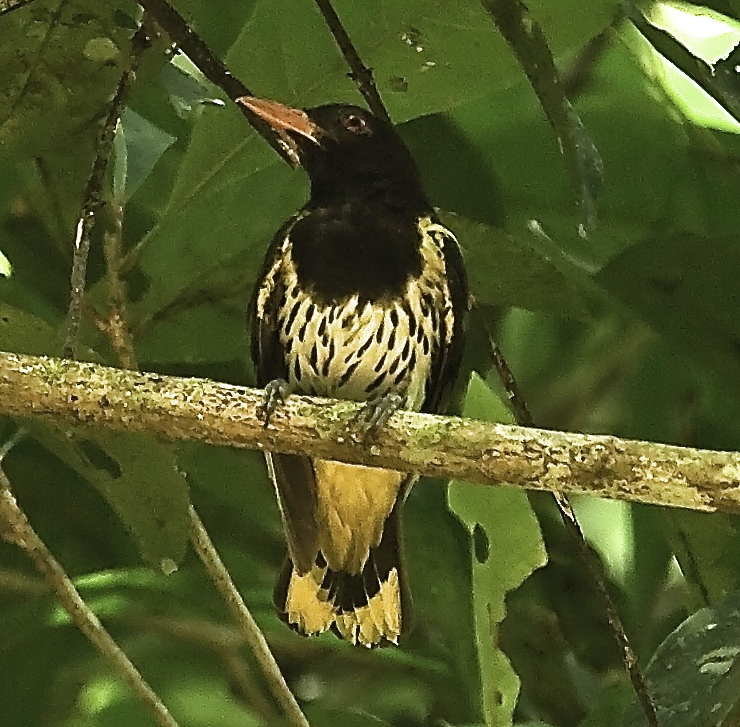
Oriolus xanthonotus inhabits subtropical or tropical moist lowland forests in Southeast Asia, including the Malay Peninsula, Sumatra, Bangka, Java and southwestern Borneo. It has a streaked breast, a relatively long lipstick-pink bill and yellow plumage in adult males, with a glossy black hood and dark wings. Full profile
Eurasian Golden Oriole
The breeding range extends from western Europe and Scandinavia eastward to China, and it winters in central and southern Africa. Adult males have predominantly black and yellow plumage, while females have comparatively dull green plumage. Full profile
Compare something else
Page built on 29 November 2026 from the data on the two species pages, where every source is listed.
Cite this page
ScientificNames.org. (2026). Dark-throated Oriole vs Eurasian Golden Oriole. Retrieved November 29, 2026, from https://scientificnames.org/compare/dark-throated-oriole-vs-eurasian-golden-oriole
“Dark-throated Oriole vs Eurasian Golden Oriole.” ScientificNames.org, 2026, scientificnames.org/compare/dark-throated-oriole-vs-eurasian-golden-oriole. Accessed 29 Nov. 2026.
ScientificNames.org. “Dark-throated Oriole vs Eurasian Golden Oriole.” Accessed November 29, 2026. https://scientificnames.org/compare/dark-throated-oriole-vs-eurasian-golden-oriole.
@misc{scientificnames_dark_throated_oriole_vs_eurasian_golden_oriole,
  author = {{ScientificNames.org}},
  title = {Dark-throated Oriole vs Eurasian Golden Oriole},
  year = {2026},
  url = {https://scientificnames.org/compare/dark-throated-oriole-vs-eurasian-golden-oriole},
  note = {Accessed 2026-11-29}
}